Hopewell Sally, Boutron Isabelle, Altman Douglas G, Barbour Ginny, Moher David, Montori Victor, Schriger David, Cook Jonathan, Gerry Stephen, Omar Omar, Dutton Peter, Roberts Corran, Frangou Eleni, Clifton Lei, Chiocchia Virginia, Rombach Ines, Wartolowska Karolina, Ravaud Philippe
Oxford Clinical Trials Research Unit, Nuffield Department of Orthopaedics, Rheumatology and Musculoskeletal Sciences, University of Oxford, Oxford, UK.
Centre for Statistics in Medicine, Nuffield Department of Orthopaedics, Rheumatology and Musculoskeletal Sciences, University of Oxford, Oxford, UK.
BMC Med. 2016 Nov 28;14(1):199. doi: 10.1186/s12916-016-0736-x.
The CONSORT Statement is an evidence-informed guideline for reporting randomised controlled trials. A number of extensions have been developed that specify additional information to report for more complex trials. The aim of this study was to evaluate the impact of using a simple web-based tool (WebCONSORT, which incorporates a number of different CONSORT extensions) on the completeness of reporting of randomised trials published in biomedical publications.
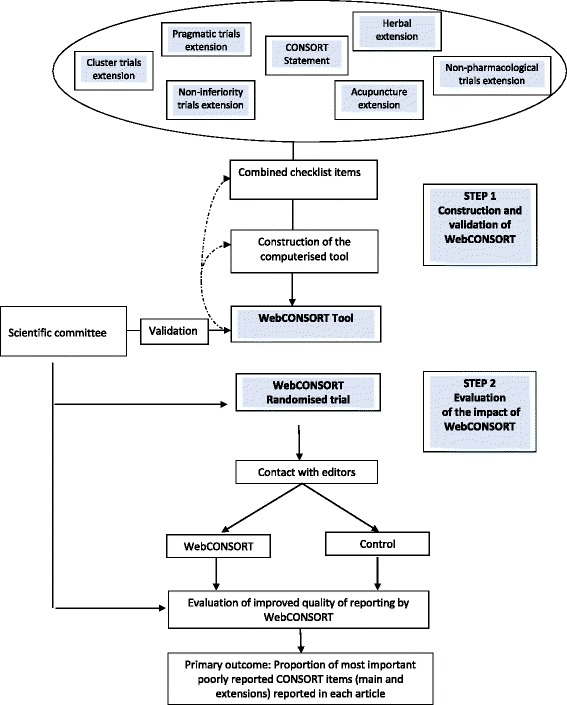
We conducted a parallel group randomised trial. Journals which endorsed the CONSORT Statement (i.e. referred to it in the Instruction to Authors) but do not actively implement it (i.e. require authors to submit a completed CONSORT checklist) were invited to participate. Authors of randomised trials were requested by the editor to use the web-based tool at the manuscript revision stage. Authors registering to use the tool were randomised (centralised computer generated) to WebCONSORT or control. In the WebCONSORT group, they had access to a tool allowing them to combine the different CONSORT extensions relevant to their trial and generate a customised checklist and flow diagram that they must submit to the editor. In the control group, authors had only access to a CONSORT flow diagram generator. Authors, journal editors, and outcome assessors were blinded to the allocation. The primary outcome was the proportion of CONSORT items (main and extensions) reported in each article post revision.
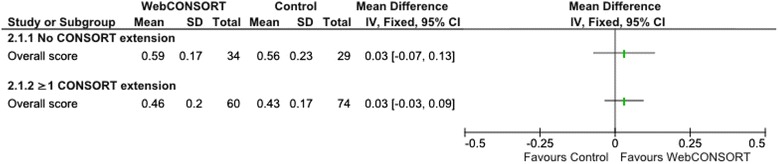
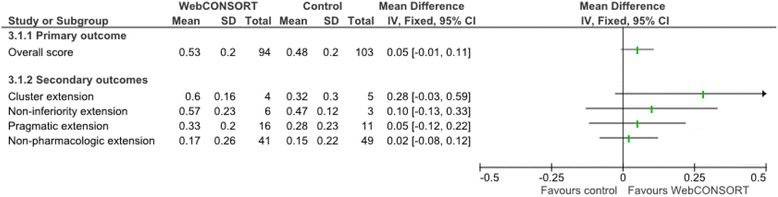
A total of 46 journals actively recruited authors into the trial (25 March 2013 to 22 September 2015); 324 author manuscripts were randomised (WebCONSORT n = 166; control n = 158), of which 197 were reports of randomised trials (n = 94; n = 103). Over a third (39%; n = 127) of registered manuscripts were excluded from the analysis, mainly because the reported study was not a randomised trial. Of those included in the analysis, the most common CONSORT extensions selected were non-pharmacologic (n = 43; n = 50), pragmatic (n = 20; n = 16) and cluster (n = 10; n = 9). In a quarter of manuscripts, authors either wrongly selected an extension or failed to select the right extension when registering their manuscript on the WebCONSORT study site. Overall, there was no important difference in the overall mean score between WebCONSORT (mean score 0.51) and control (0.47) in the proportion of CONSORT and CONSORT extension items reported pertaining to a given study (mean difference, 0.04; 95% CI -0.02 to 0.10).
This study failed to show a beneficial effect of a customised web-based CONSORT checklist to help authors prepare more complete trial reports. However, the exclusion of a large number of inappropriately registered manuscripts meant we had less precision than anticipated to detect a difference. Better education is needed, earlier in the publication process, for both authors and journal editorial staff on when and how to implement CONSORT and, in particular, CONSORT-related extensions.
ClinicalTrials.gov: NCT01891448 [registered 24 May 2013].
CONSORT声明是一份基于证据的随机对照试验报告指南。已经制定了一些扩展内容,规定了在更复杂的试验中需要报告的其他信息。本研究的目的是评估使用一个简单的基于网络的工具(WebCONSORT,它包含了许多不同的CONSORT扩展)对生物医学出版物中发表的随机试验报告完整性的影响。
我们进行了一项平行组随机试验。邀请了认可CONSORT声明(即在作者须知中提及)但未积极实施该声明(即要求作者提交完整的CONSORT清单)的期刊参与。编辑要求随机试验的作者在稿件修订阶段使用基于网络的工具。注册使用该工具的作者被随机分配(由中央计算机生成)到WebCONSORT组或对照组。在WebCONSORT组中,他们可以使用一个工具,该工具允许他们将与试验相关的不同CONSORT扩展内容合并,并生成一份定制的清单和流程图,他们必须将其提交给编辑。在对照组中,作者只能使用CONSORT流程图生成器。作者、期刊编辑和结果评估者对分配情况不知情。主要结果是修订后每篇文章中报告CONSORT项目(主要项目和扩展项目)的比例。
共有46种期刊积极招募作者参与试验(2013年3月25日至2015年9月22日);324篇作者稿件被随机分配(WebCONSORT组n = 166;对照组n = 158),其中197篇是随机试验报告(n = 94;n = 103)。超过三分之一(39%;n = 127)的注册稿件被排除在分析之外主要是因为报告的研究不是随机试验)。在纳入分析的稿件中,最常选择的CONSORT扩展是:非药物(n =43;n = 50)务实(n = 20;n = 16)集群(n =10;n = 9)在四分之一稿件中作者在WebCONSORT研究网站上注册稿件时要么错误选择扩展要么未能选择正确扩展。总体而言,在给定研究中报告的CONSORT和CONSORT扩展项目比例方面WebCONSORT组(平均得分0.51)与对照组(0.47)之间没有重要差异平均差异0.04;95%CI -0.02至0.10)
本研究未能显示定制的基于网络CONSORT清单对帮助作者准备更完整试验报告有有益效果然而大量注册不当稿件被排除意味着我们检测差异的精度低于预期。在出版过程早期需要对作者和期刊编辑人员进行更好教育告知他们何时以及如何实施CONSORT特别是与CONSORT相关扩展。
ClinicalTrials.gov:NCT01891448 [2013年5月24日注册]