Rasmussen Jan, Lund Allan M, Risom Lotte, Wibrand Flemming, Gislason Hannes, Nielsen Olav W, Køber Lars, Duno Morten
Department of Internal Medicine, National Hospital, FO-100 Torshavn, the Faroe Islands.
Centre for Inherited Metabolic Diseases, Department of Clinical Genetics, Copenhagen University Hospital, Rigshospitalet, Copenhagen, Denmark.
Mol Genet Metab Rep. 2014 May 22;1:241-248. doi: 10.1016/j.ymgmr.2014.04.008. eCollection 2014.
The prevalence of primary carnitine deficiency (PCD) in the Faroe Islands is the highest reported in the world (1:300). Serious symptoms related to PCD, e.g. sudden death, have previously only been associated to the c.95A > G/c.95A > G genotype in the Faroe Islands. We report and characterize novel mutations associated with PCD in the Faroese population and report and compare free carnitine levels and OCTN2 transport activities measured in fibroblasts from PCD patients with different genotypes.
Genetic analyses were used to identify novel mutations, and carnitine uptake analyses in cultured skin fibroblasts from selected patients were used to examine residual OCTN2 transporter activities of the various genotypes.
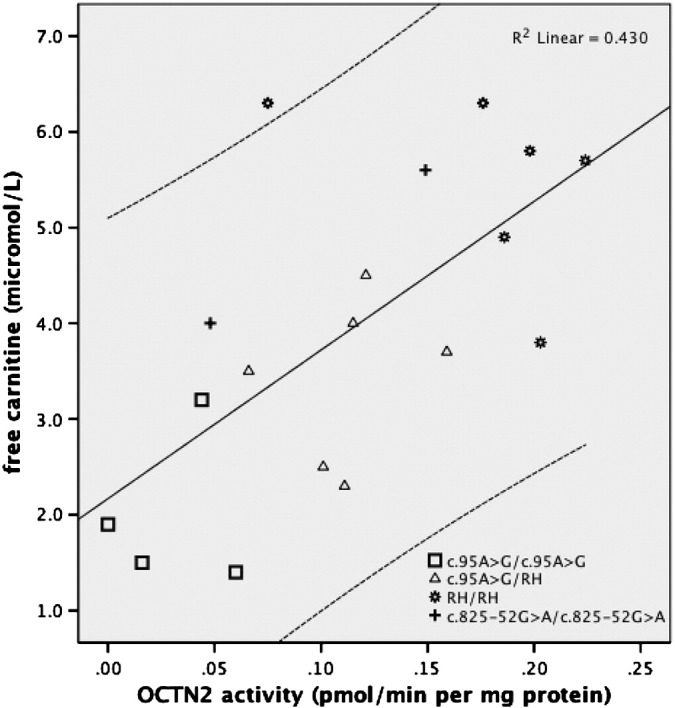
Four different mutations, including the unpublished c.131C > T (p.A44V), the novel splice mutation c.825-52G > A and a novel risk-haplotype (RH) were identified in the Faroese population. The two most prevalent genotypes were c.95A > G/RH (1:600) and c.95A > G/c.95A > G (1:1300). Patients homozygous for the c.95A > G mutation had both the significantly ( < 0.01) lowest mean free carnitine level at 2.03 (SD 0.66) μmol/L and lowest residual OCTN2 transporter activity (4% of normal). There was a significant positive correlation between free carnitine levels and residual OCTN2 transporter activities in PCD patients ( = 0.430, < 0.01).
There was a significant positive correlation between carnitine levels and OCTN2 transporter activities. The c.95A > G/c.95A > G genotype had the significantly lowest mean free carnitine level and residual OCTN2 transporter activity.
法罗群岛原发性肉碱缺乏症(PCD)的患病率是世界上报道的最高的(1:300)。与PCD相关的严重症状,如猝死,此前仅与法罗群岛的c.95A>G/c.95A>G基因型有关。我们报告并描述了法罗群岛人群中与PCD相关的新突变,并报告和比较了不同基因型PCD患者成纤维细胞中游离肉碱水平和OCTN2转运活性。
采用基因分析来鉴定新突变,并对选定患者培养的皮肤成纤维细胞进行肉碱摄取分析,以检测不同基因型的残余OCTN2转运活性。
在法罗群岛人群中鉴定出四种不同的突变,包括未发表的c.131C>T(p.A44V)、新的剪接突变c.825-52G>A和一种新的风险单倍型(RH)。两种最常见的基因型是c.95A>G/RH(1:600)和c.95A>G/c.95A>G(1:1300)。c.95A>G突变纯合子患者的平均游离肉碱水平显著最低(<0.01),为2.03(标准差0.66)μmol/L,残余OCTN2转运活性也最低(正常的4%)。PCD患者的游离肉碱水平与残余OCTN2转运活性之间存在显著正相关(=0.430,<0.01)。
肉碱水平与OCTN2转运活性之间存在显著正相关。c.95A>G/c.95A>G基因型的平均游离肉碱水平和残余OCTN2转运活性显著最低。