Mahoney Jane E, Gobel Vicki L, Shea Terry, Janczewski Jodi, Cech Sandy, Clemson Lindy
Department of Medicine, Division of Geriatrics and Gerontology, University of Wisconsin School of Medicine and Public Health , Madison, WI , USA.
UW Health Department of Orthopedics and Rehabilitation , Madison, WI , USA.
Front Public Health. 2016 Nov 14;4:251. doi: 10.3389/fpubh.2016.00251. eCollection 2016.
Fidelity monitoring is essential with implementation of complex health interventions, but there is little description of how to use results of fidelity monitoring to improve the draft program package prior to widespread dissemination. Root cause analysis (RCA) provides a systematic approach to identifying underlying causes and devising solutions to prevent errors in complex processes. Its use has not been described in implementation science.
Stepping On (SO) is a small group, community-based intervention that has been shown to reduce falls by 31%. To prepare SO for widespread U.S. dissemination, we conducted a pilot of the draft program package, monitoring the seven SO sessions for fidelity of program delivery and assessing participant receipt and enactment through participant interviews after the workshop. Lapses to fidelity in program delivery, receipt, and enactment were identified. We performed a RCA to identify underlying causes of, and solutions to, such lapses, with the goal of preventing fidelity lapses with widespread dissemination.
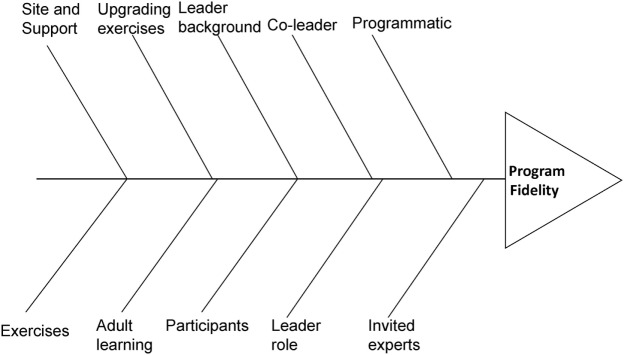
Lapses to fidelity in program delivery were in the domains of group leader's role, use of adult learning principles, and introducing and upgrading the exercises. Lapses in fidelity of participant receipt and enactment included lack of knowledge about balance exercises and reduced adherence to frequency of exercise practice and advancement of exercise. Root causes related to leader training and background, site characteristics and capacity, and participant frailty and expectations prior to starting the program. The RCA resulted in changes to the program manual, the training program, and training manual for new leaders, and to the methods for and criteria for participant and leader recruitment. A Site Implementation Guide was created to provide information to sites interested in the program.
Disseminating complex interventions can be done more smoothly by first using a systematic quality improvement technique, such as the RCA, to identify how lapses in fidelity occur during the earliest stages of implementation. This technique can also help bring about solutions to these lapses of fidelity prior to widespread dissemination across multiple domain lapses.
在实施复杂的健康干预措施时,保真度监测至关重要,但对于如何在广泛传播之前利用保真度监测结果来改进项目草案包,却鲜有描述。根本原因分析(RCA)提供了一种系统的方法,用于识别潜在原因并设计解决方案,以防止复杂流程中的错误。其在实施科学中的应用尚未见报道。
“步步稳”(SO)是一种基于社区的小组干预措施,已被证明可将跌倒发生率降低31%。为使SO在美国广泛传播做好准备,我们对项目草案包进行了试点,监测了七个SO课程的项目实施保真度,并在工作坊结束后通过参与者访谈评估参与者的接受情况和实施情况。确定了项目实施、接受和实施过程中的保真度失误。我们进行了根本原因分析,以确定此类失误的潜在原因和解决方案,目标是在广泛传播时防止保真度失误。
项目实施过程中的保真度失误体现在组长角色、成人学习原则的应用以及练习的引入和升级等方面。参与者接受和实施保真度方面的失误包括对平衡练习缺乏了解,以及对练习频率和练习进阶的依从性降低。根本原因与组长培训和背景、场地特征和能力,以及参与者在项目开始前的身体虚弱程度和期望有关。根本原因分析导致了项目手册、培训项目、新组长培训手册的修改,以及参与者和组长招募方法及标准的改变。创建了一份《场地实施指南》,为对该项目感兴趣的场地提供信息。
通过首先使用系统的质量改进技术,如根本原因分析,来识别在实施的最早阶段保真度失误是如何发生的,可以更顺利地传播复杂干预措施。这种技术还可以帮助在跨多个领域失误广泛传播之前,找到解决这些保真度失误的方法。