Calabrese Giuseppe, Fantasia Donatella, Alfonsi Melissa, Morizio Elisena, Celentano Claudio, Guanciali Franchi Paolo, Sabbatinelli Giulia, Palka Chiara, Benn Peter, Sitar Gianmaria
Genetica Medica Università Chieti-Pescara Chieti Scalo Italy.
Clinica Ostetrica e Ginecologica ASL Chieti Chieti Italy.
Mol Genet Genomic Med. 2016 Oct 26;4(6):634-640. doi: 10.1002/mgg3.249. eCollection 2016 Nov.
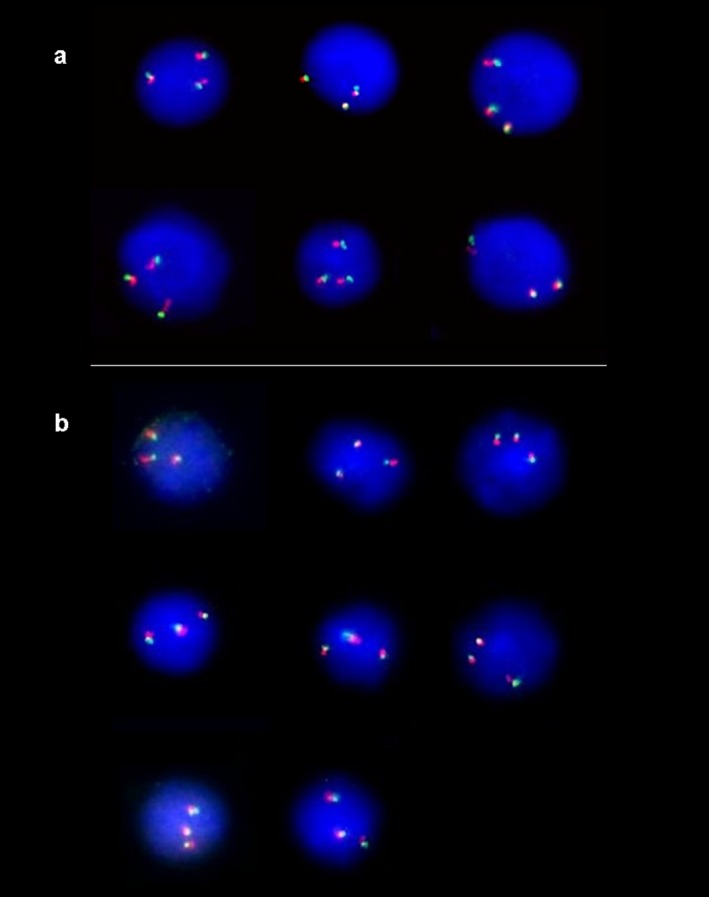
A long sought goal in medical genetics has been the replacement of invasive procedures for the detection of chromosomal aneuploidies by isolating and analyzing fetal cells or free fetal DNA from maternal blood, avoiding risk to the fetus. However, a rapid, simple, consistent, and low-cost procedure suitable for routine clinical practice has not yet been achieved. The purpose of this study was to assess the feasibility of predicting fetal aneuploidy by applying our recently established dual-probe FISH protocol to fetal cells isolated and enriched from maternal blood.
A total of 172 pregnant women underwent prospective testing for fetal aneuploidy by FISH analysis of fetal cells isolated from maternal blood. Results were compared with the karyotype determined through invasive procedures or at birth.
Seven of the samples exhibited fetal aneuploidy, which was confirmed by invasive prenatal diagnosis procedures. After enrichment for fetal cells, the frequency of trisomic cells was at least double in samples from aneuploid pregnancies (range 0.38-0.90%) compared to samples from normal pregnancies (≤0.18%). One false negative result was also obtained.
Noninvasive prenatal aneuploidy screening using fetal cells isolated from maternal blood is feasible and could substantially reduce the need for invasive procedures.
医学遗传学中长期以来一直追求的目标是,通过从母血中分离和分析胎儿细胞或游离胎儿DNA来替代用于检测染色体非整倍体的侵入性操作,从而避免对胎儿造成风险。然而,尚未实现一种适用于常规临床实践的快速、简单、一致且低成本的方法。本研究的目的是通过将我们最近建立的双探针荧光原位杂交(FISH)方案应用于从母血中分离和富集的胎儿细胞,评估预测胎儿非整倍体的可行性。
共有172名孕妇通过对从母血中分离的胎儿细胞进行FISH分析,接受了胎儿非整倍体的前瞻性检测。将结果与通过侵入性操作或出生时确定的核型进行比较。
7个样本显示胎儿非整倍体,这通过侵入性产前诊断程序得到证实。在富集胎儿细胞后,与正常妊娠样本(≤0.18%)相比,非整倍体妊娠样本中的三体细胞频率至少增加了一倍(范围为0.38 - 0.90%)。还获得了一个假阴性结果。
使用从母血中分离的胎儿细胞进行非侵入性产前非整倍体筛查是可行的,并且可以大幅减少对侵入性操作的需求。