Hoogendijk Emiel O, Theou Olga, Rockwood Kenneth, Onwuteaka-Philipsen Bregje D, Deeg Dorly J H, Huisman Martijn
Department of Epidemiology and Biostatistics, EMGO+ Institute for Health and Care Research, VU University Medical Center, Amsterdam, The Netherlands.
Division of Geriatric Medicine, Department of Medicine, Dalhousie University, Halifax, NS, Canada.
Aging Clin Exp Res. 2017 Oct;29(5):927-933. doi: 10.1007/s40520-016-0689-0. Epub 2016 Nov 28.
Frailty is a state of increased vulnerability to adverse outcomes. The frailty index (FI), defined by the deficit accumulation approach, is a sensitive instrument to measure levels of frailty, and therefore important for longitudinal studies of aging.
To develop an FI in the Longitudinal Aging Study Amsterdam (LASA), and to examine the predictive validity of this FI for 19-year mortality.
LASA is an ongoing study among Dutch older adults, based on a nationally representative sample. A 32-item FI (LASA-FI) was developed at the second LASA measurement wave (1995-1996) among 2218 people aged 57-88 years. An FI score between 0 and 1 was calculated for each individual. The LASA-FI included health deficits from the physical, mental and cognitive domain and can be constructed for most LASA measurement waves. Associations with 19-year mortality were assessed using Kaplan-Meier curves and Cox proportional hazards models.
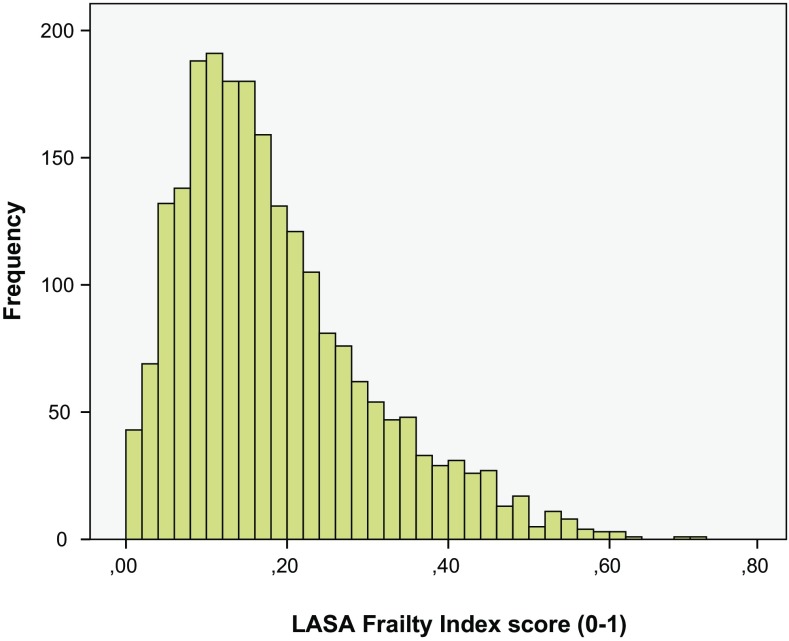
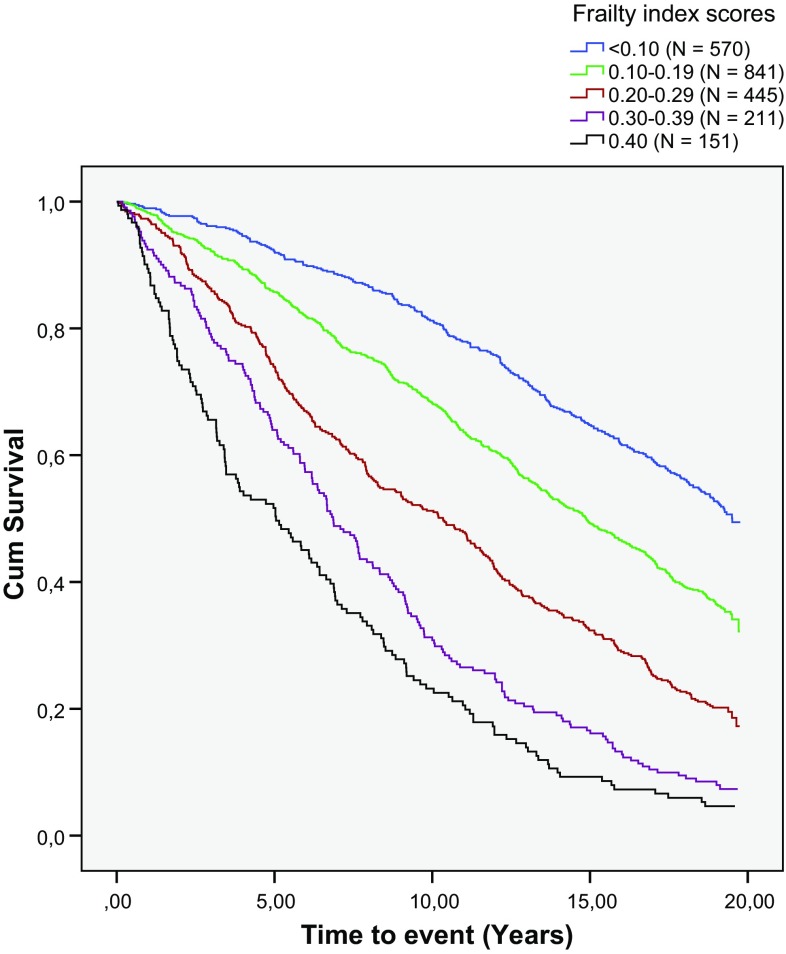
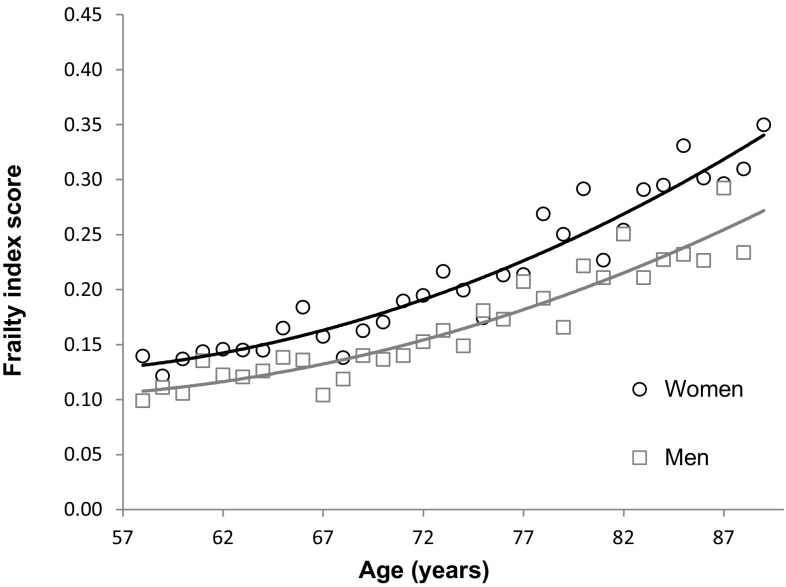
The mean LASA-FI score was 0.19 (SD = 0.12), with a 99% upper limit of 0.53. Scores were higher in women than men (women = 0.20, SD = 0.13 vs. men = 0.17, SD = 0.11, p < 0.001). The average age-related increase in the log-transformed LASA-FI score was 3.5% per year. In a model adjusted for age and sex, the FI score was significantly associated with 19-year all-cause mortality (HR per 0.01 = 1.03, 95% CI 1.03-1.04, p < 0.001).
DISCUSSION/CONCLUSIONS: The key characteristics of the LASA-FI were in line with findings from previous FI studies in population-based samples of older people. The LASA-FI score was associated with mortality and may serve as an internal and external reference value.
衰弱是一种对不良后果易感性增加的状态。通过累积缺陷法定义的衰弱指数(FI)是衡量衰弱程度的敏感工具,因此对衰老的纵向研究很重要。
在阿姆斯特丹纵向衰老研究(LASA)中开发一个FI,并检验该FI对19年死亡率的预测效度。
LASA是一项针对荷兰老年人的正在进行的研究,基于全国代表性样本。在LASA的第二次测量波(1995 - 1996年)中,对2218名年龄在57 - 88岁的人群开发了一个包含32个条目的FI(LASA - FI)。为每个个体计算了一个介于0和1之间的FI分数。LASA - FI包括身体、心理和认知领域的健康缺陷,并且可以针对大多数LASA测量波构建。使用Kaplan - Meier曲线和Cox比例风险模型评估与19年死亡率的关联。
LASA - FI的平均分数为0.19(标准差 = 0.12),99%的上限为0.53。女性的分数高于男性(女性 = 0.20,标准差 = 0.13;男性 = 0.17,标准差 = 0.11,p < 0.001)。经对数转换的LASA - FI分数与年龄相关的平均年增长率为3.5%。在调整了年龄和性别的模型中,FI分数与19年全因死亡率显著相关(每0.01的风险比 = 1.03,95%置信区间1.03 - 1.04,p < 0.001)。
讨论/结论:LASA - FI的关键特征与先前在基于人群的老年样本中进行的FI研究结果一致。LASA - FI分数与死亡率相关,可作为内部和外部参考值。