Zhao Hengguang, Rieger Sandra, Abe Koichiro, Hewison Martin, Lisse Thomas S
Department of Dermatology, The First Affiliated Hospital of Chongqing Medical University, Chongqing 400016, China.
Kathryn W. Davis Center for Regenerative Biology and Medicine, Mount Desert Island Biological Laboratory, 159 Old Bar Harbor Road, Salisbury Cove, ME 04672, USA.
Int J Mol Sci. 2016 Nov 26;17(12):1984. doi: 10.3390/ijms17121984.
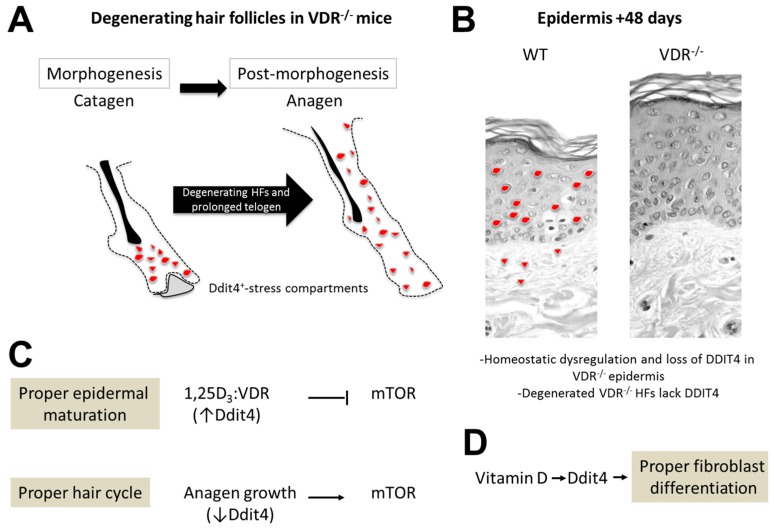
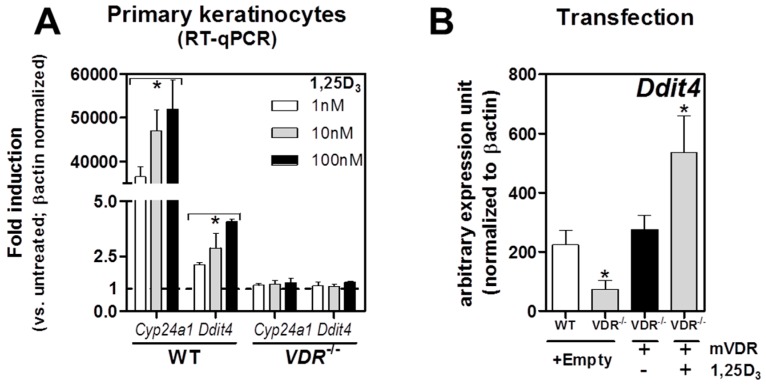
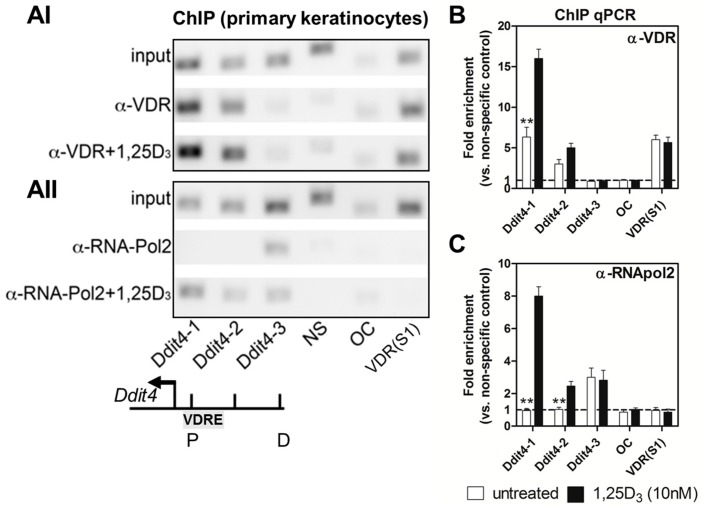
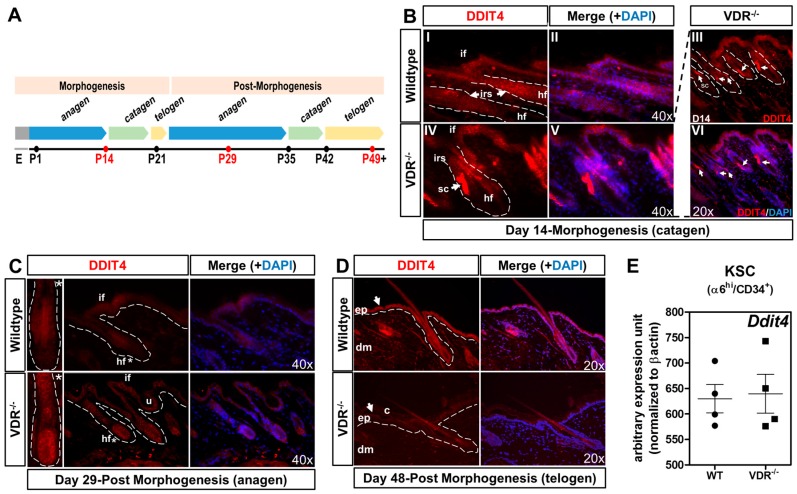
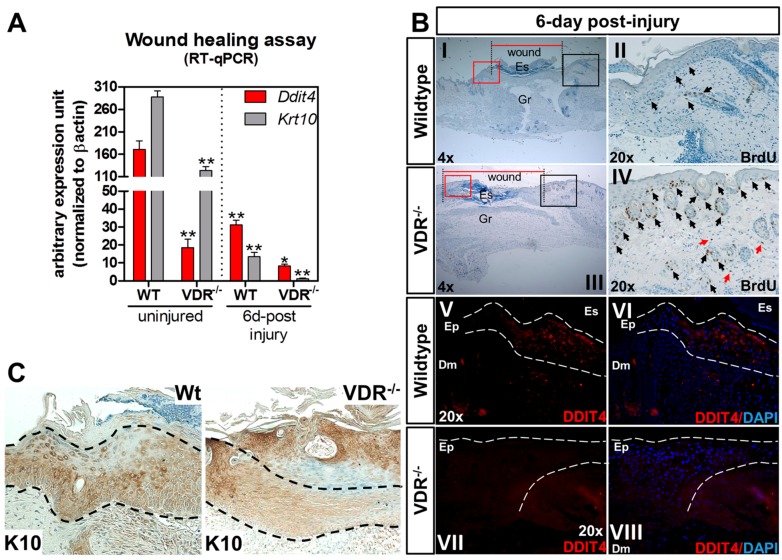
Mice and human patients with impaired vitamin D receptor (VDR) signaling have normal developmental hair growth but display aberrant post-morphogenic hair cycle progression associated with alopecia. In addition, VDR mice exhibit impaired cutaneous wound healing. We undertook experiments to determine whether the stress-inducible regulator of energy homeostasis, DNA damage-inducible transcript 4 (Ddit4), is involved in these processes. By analyzing hair cycle activation in vivo, we show that VDR mice at day 14 exhibit increased Ddit4 expression within follicular stress compartments. At day 29, degenerating VDR follicular keratinocytes, but not bulge stem cells, continue to exhibit an increase in Ddit4 expression. At day 47, when normal follicles and epidermis are quiescent and enriched for Ddit4, VDR skin lacks Ddit4 expression. In a skin wound healing assay, the re-epithelialized epidermis in wildtype (WT) but not VDR animals harbor a population of Ddit4- and Krt10-positive cells. Our study suggests that VDR regulates Ddit4 expression during epidermal homeostasis and the wound healing process, while elevated Ddit4 represents an early growth-arresting stress response within VDR follicles.
维生素D受体(VDR)信号受损的小鼠和人类患者在毛发发育阶段的生长正常,但在形态发生后的毛发周期进程中表现异常,并伴有脱发。此外,VDR基因敲除小鼠表现出皮肤伤口愈合受损。我们进行了实验,以确定能量稳态的应激诱导调节因子——DNA损伤诱导转录本4(Ddit4)是否参与这些过程。通过分析体内毛发周期的激活情况,我们发现第14天的VDR基因敲除小鼠在毛囊应激区室中Ddit4表达增加。在第29天,退化的VDR毛囊角质形成细胞(而非毛囊隆突干细胞)的Ddit4表达持续增加。在第47天,当正常毛囊和表皮静止且Ddit4富集时,VDR皮肤缺乏Ddit4表达。在皮肤伤口愈合试验中,野生型(WT)动物而非VDR基因敲除动物重新上皮化的表皮中存在一群Ddit4和角蛋白10(Krt10)阳性细胞。我们的研究表明,VDR在表皮稳态和伤口愈合过程中调节Ddit4的表达,而Ddit4表达升高代表VDR毛囊内早期生长停滞的应激反应。