Palmer A J R, Malak T T, Broomfield J, Holton J, Majkowski L, Thomas G E R, Taylor A, Andrade A J, Collins G, Watson K, Carr A J, Glyn-Jones S
Nuffield Department of Orthopaedics, Rheumatology and Musculoskeletal Sciences , University of Oxford , Oxford , UK.
Royal Berkshire Hospital NHS Trust , Reading , UK.
BMJ Open Sport Exerc Med. 2016 Mar 21;2(1):e000082. doi: 10.1136/bmjsem-2015-000082. eCollection 2016.
Hip arthroscopy is increasingly adopted for the treatment of intra-articular and extra-articular pathologies. Studies from USA demonstrate a 365% increase in the number of procedures performed between 2004 and 2009 and 250% increase between 2007 and 2011. There is limited evidence of long-term efficacy for this procedure and hip arthroscopy is not universally funded across England. The aim of this study is to describe temporal trends in the adoption of hip arthroscopy in England between 2002 and 2013 and to forecast trends for the next 10 years.
A search of the Hospital Episodes Database was performed for all codes describing arthroscopic hip procedures with patient age, sex and area of residence.
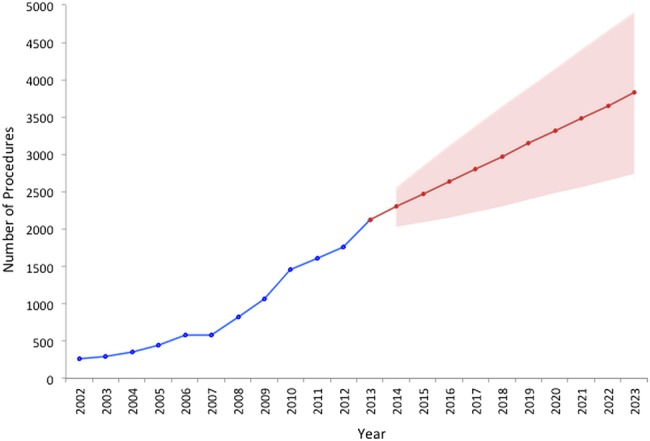
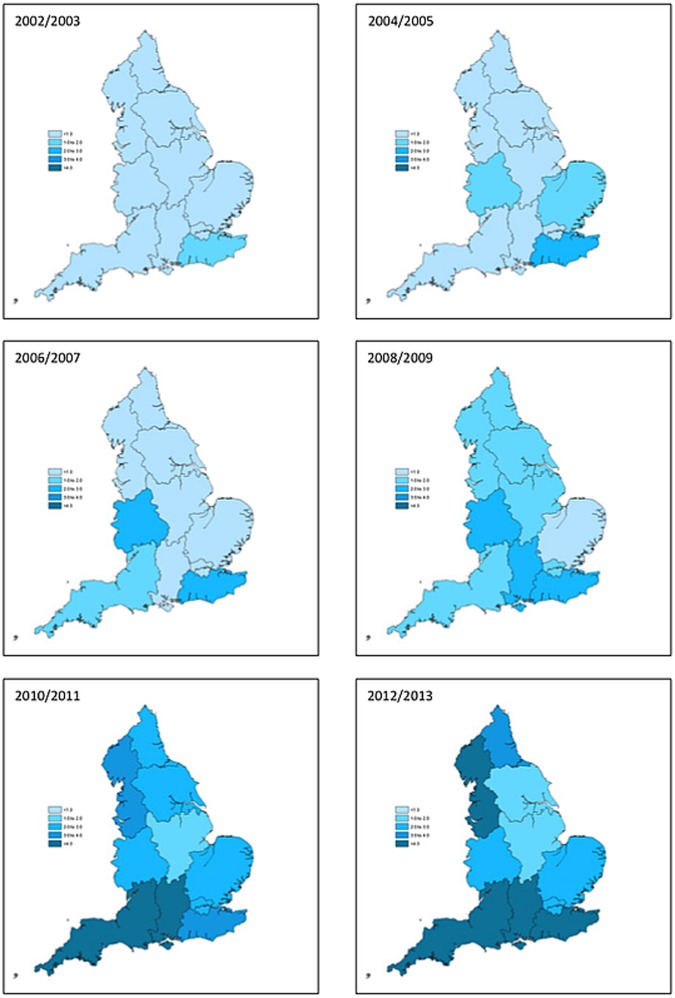
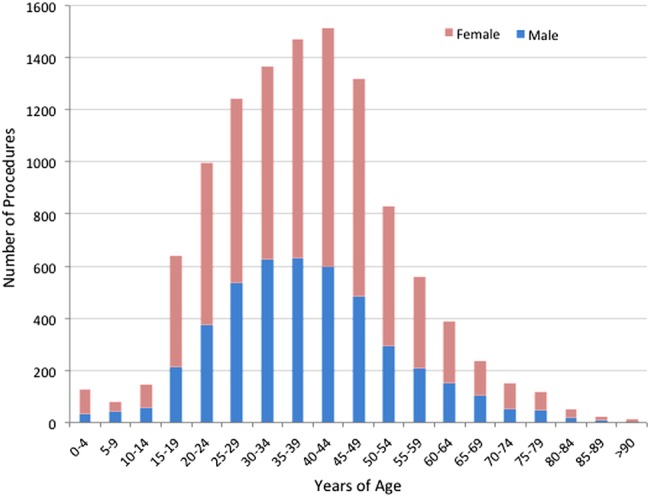
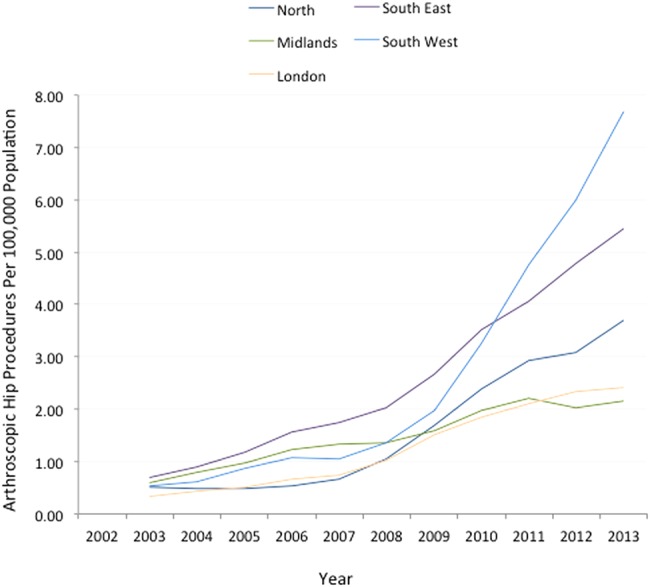
11 329 hip arthroscopies were performed in National Health Service hospitals in England between 2002 and 2013. The number of hip arthroscopies performed increased by 727% (p<0.0001) during this period and is forecast to increase by 1388% in 2023. Females represent 60% of all patients undergoing hip arthroscopy (p<0.001). Median age category is 40-44 for females and 35-39 for males and average age decreased during the study period (p<0.0001). There is significant regional variation in procedure incidence. In the final year of this study the highest incidence was in the Southwest (8.63/100 000 population) and lowest in East Midlands (1.29/100 000 population).
The increase in number of hip arthroscopies performed in England reflects trends in USA and continued increases are forecast. Evidence from robust clinical trials is required to justify the increasing number of procedures performed and regional variation suggests potential inequality in the provision of this intervention.
髋关节镜检查越来越多地用于治疗关节内和关节外病变。美国的研究表明,2004年至2009年间手术例数增加了365%,2007年至2011年间增加了250%。关于该手术长期疗效的证据有限,并且在英格兰并非所有髋关节镜检查都能获得医保资金支持。本研究的目的是描述2002年至2013年期间英格兰髋关节镜检查的应用时间趋势,并预测未来10年的趋势。
在医院病历数据库中搜索所有描述髋关节镜手术的代码,并关联患者年龄、性别和居住地区。
2002年至2013年期间,英格兰国民健康服务医院共进行了11329例髋关节镜检查。在此期间,髋关节镜检查的例数增加了727%(p<0.0001),预计到2023年将增加1388%。接受髋关节镜检查的患者中女性占60%(p<0.001)。女性的年龄中位数为40 - 44岁,男性为35 - 39岁,且研究期间平均年龄有所下降(p<0.0001)。手术发生率存在显著的地区差异。在本研究的最后一年,发病率最高的是西南部(8.63/10万人口),最低的是东米德兰兹(1.29/10万人口)。
英格兰髋关节镜检查例数的增加反映了美国的趋势,且预计还会持续增加。需要有力的临床试验证据来证明手术例数增加的合理性,而地区差异表明在提供这种干预措施方面可能存在不平等。