Sieg Emily P, Stepanyan Hayk, Payne Russell, Ouyang Tao, Zacharia Brad E
Department of Neurosurgery, Penn State Hershey Medical Center.
Medical Student, Penn State College of Medicine.
Cureus. 2016 Oct 20;8(10):e838. doi: 10.7759/cureus.838.
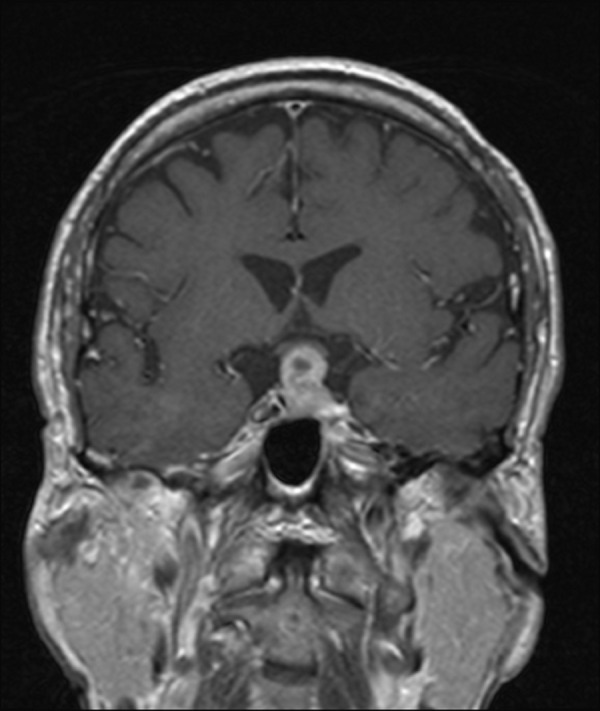
Pituitary macroadenomas are the most common suprasellar lesions in adults and are typically managed surgically through transsphenoidal resection when symptomatic. Due to their close proximity to the optic chiasm, pituitary macroadenomas often present with signs of bitemporal hemianopsia. Alternatively, these tumors can cause mass effect, thus presenting with signs of elevated intracranial pressure or can present with signs and symptoms of endocrine dysfunction. Here, we discuss a 55-year-old male diagnosed with a non-functioning pituitary macroadenoma (NFPA) based on cranial imaging, ophthalmologic exam, and endocrine evaluation. Following diagnosis, the patient was scheduled for transsphenoidal hypophysectomy. On magnetic resonance imaging (MRI) done three and half months later for surgical planning, the tumor had almost completely regressed and only residual pituitary tissue was noted. We describe the presentation and clinical course of the patient, summarize chief differential diagnoses, and discuss potential managements of these conditions.
垂体大腺瘤是成人最常见的鞍上病变,有症状时通常通过经蝶窦切除术进行手术治疗。由于垂体大腺瘤紧邻视交叉,常表现为双颞侧偏盲。此外,这些肿瘤可引起占位效应,从而出现颅内压升高的体征,或出现内分泌功能障碍的体征和症状。在此,我们讨论一名55岁男性,根据头颅影像学、眼科检查和内分泌评估诊断为无功能垂体大腺瘤(NFPA)。诊断后,患者计划行经蝶窦垂体切除术。在三个月半后为手术规划进行的磁共振成像(MRI)检查中,肿瘤几乎完全消退,仅见残留的垂体组织。我们描述了该患者的临床表现和病程,总结了主要鉴别诊断,并讨论了这些情况的潜在处理方法。