Department of Applied Chemistry, Graduate School of Engineering, Nagoya University, Nagoya 464-8603, Japan.
Department of Chemistry, Yonsei University, Seoul 120-749, Korea.
Nat Commun. 2016 Nov 30;7:13620. doi: 10.1038/ncomms13620.
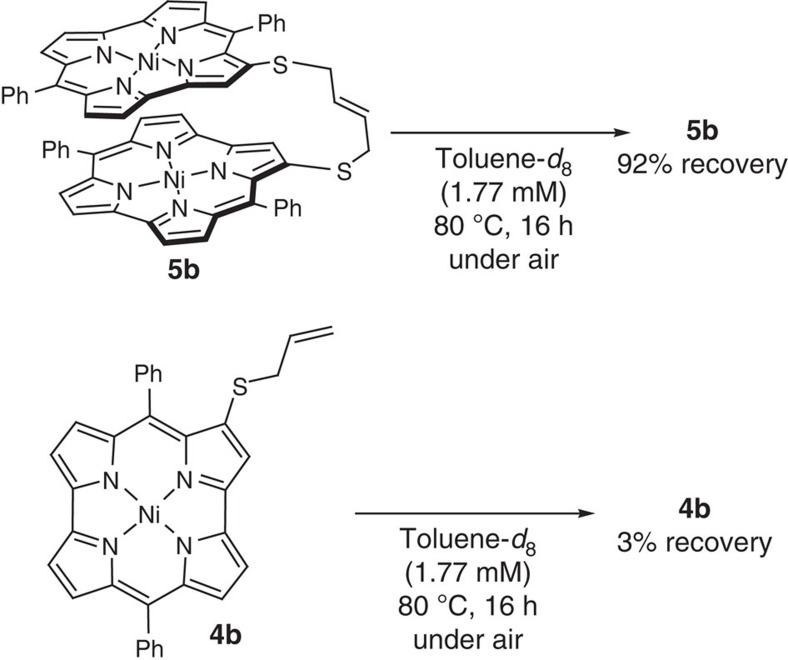
Aromaticity is a key concept in organic chemistry. Even though this concept has already been theoretically extrapolated to three dimensions, it usually still remains restricted to planar molecules in organic chemistry textbooks. Stacking of antiaromatic π-systems has been proposed to induce three-dimensional aromaticity as a result of strong frontier orbital interactions. However, experimental evidence to support this prediction still remains elusive so far. Here we report that close stacking of antiaromatic porphyrins diminishes their inherent antiaromaticity in the solid state as well as in solution. The antiaromatic stacking furthermore allows a delocalization of the π-electrons, which enhances the two-photon absorption cross-section values of the antiaromatic porphyrins. This feature enables the dynamic switching of the non-linear optical properties by controlling the arrangement of antiaromatic π-systems on the basis of intermolecular orbital interactions.
芳香性是有机化学中的一个关键概念。尽管这个概念已经在理论上被推断到了三维空间,但它通常仍然局限于有机化学教科书中的平面分子。反芳香π系统的堆积已被提议用来诱导三维芳香性,这是由于强前沿轨道相互作用的结果。然而,到目前为止,支持这一预测的实验证据仍然难以捉摸。在这里,我们报告说,反芳香卟啉的紧密堆积在固态和溶液中都能减弱其固有反芳香性。反芳香堆积进一步允许π电子离域,从而增强反芳香卟啉的双光子吸收截面值。这种特性使通过控制基于分子间轨道相互作用的反芳香π系统的排列来动态切换非线性光学性质成为可能。