Komirishetty Prashanth, Areti Aparna, Gogoi Ranadeep, Sistla Ramakrishna, Kumar Ashutosh
Department of Pharmacology and Toxicology, National Institute of Pharmaceutical Education and Research (NIPER)-Hyderabad, Balanagar, India.
Department of Biotechnology, National Institute of Pharmaceutical Education and Research (NIPER)-Guwahati, Assam, India.
Neural Regen Res. 2016 Oct;11(10):1545-1548. doi: 10.4103/1673-5374.193222.
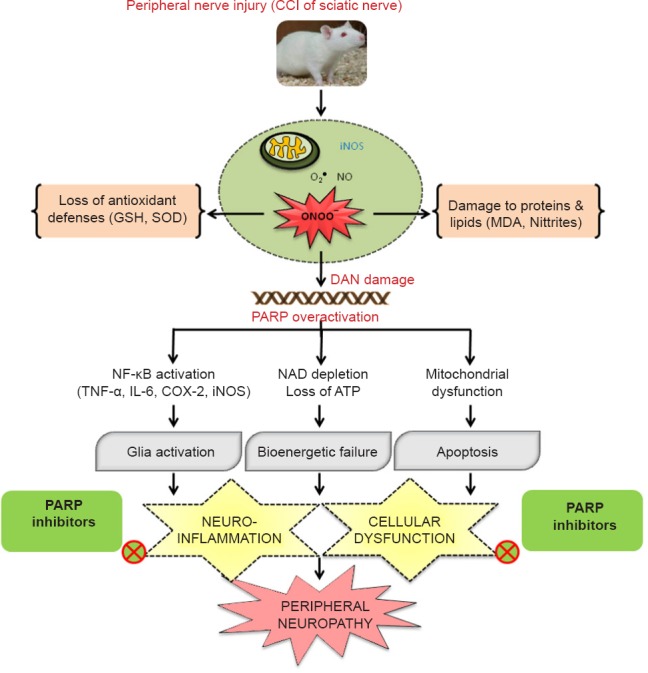
Neuropathic pain is triggered by the lesions to peripheral nerves which alter their structure and function. Neuroprotective approaches that limit the pathological changes and improve the behavioral outcome have been well explained in different experimental models of neuropathy but translation of such strategies to clinics has been disappointing. Experimental evidences revealed the role of free radicals, especially peroxynitrite after the nerve injury. They provoke oxidative DNA damage and consequent over-activation of the poly(ADP-ribose) polymerase (PARP) upregulates pro-inflammatory pathways, causing bioenergetic crisis and neuronal death. Along with these changes, it causes mitochondrial dysfunction leading to neuronal apoptosis. In related preclinical studies agents that neutralize the free radicals and pharmacological inhibitors of PARP have shown benefits in treating experimental neuropathy. This article reviews the involvement of PARP over-activation in trauma induced neuropathy and therapeutic significance of PARP inhibitors in the experimental neuropathy and neuropathic pain.
神经性疼痛由外周神经损伤引发,这些损伤会改变神经的结构和功能。在不同的神经病变实验模型中,限制病理变化并改善行为结果的神经保护方法已得到充分阐释,但将此类策略转化到临床应用却不尽人意。实验证据揭示了自由基的作用,尤其是神经损伤后产生的过氧亚硝酸盐。它们引发氧化性DNA损伤,进而导致聚(ADP - 核糖)聚合酶(PARP)过度激活,上调促炎途径,引发生物能量危机和神经元死亡。伴随这些变化,它还会导致线粒体功能障碍,进而引发神经元凋亡。在相关临床前研究中,中和自由基的药物以及PARP的药理学抑制剂已显示出对治疗实验性神经病变有益。本文综述了PARP过度激活在创伤性神经病变中的作用以及PARP抑制剂在实验性神经病变和神经性疼痛中的治疗意义。