Brault Michelle, Oberst Andrew
Department of Immunology, University of Washington, Seattle, WA, USA.
Molecular and Cellular Biology Program, University of Washington, Seattle, WA, USA.
Immunol Cell Biol. 2017 Feb;95(2):131-136. doi: 10.1038/icb.2016.117. Epub 2016 Dec 20.
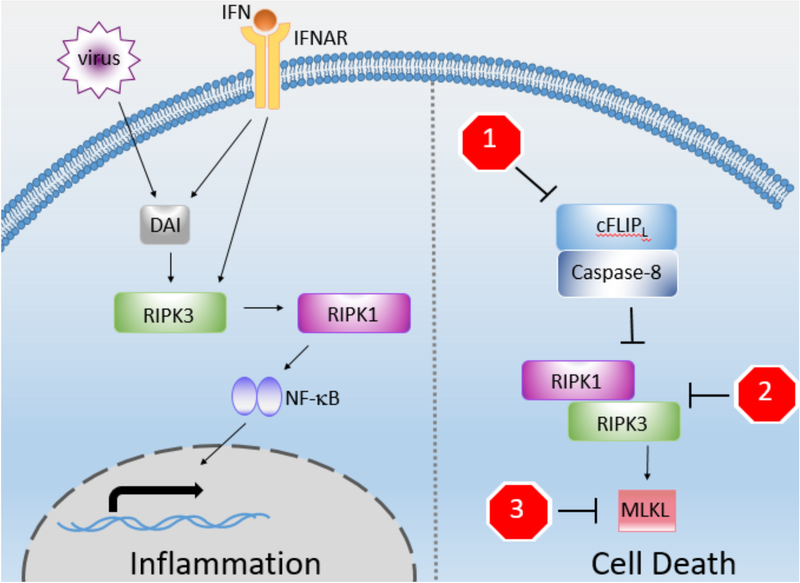
Necroptosis is a lytic form of programmed cell death that involves the swelling and rupture of dying cells. Although several necroptosis-inducing stimuli have been defined, in most cells this pathway is kept in check by the action of the pro-apoptotic protease caspase-8 and the IAP ubiquitin ligases. How and when necroptosis is triggered under physiological conditions therefore remains a persistent question. Because necroptosis likely arose as a defensive mechanism against viral infection, exploration of this question requires a consideration of host-pathogen interactions, and how the sensing of infection could sensitize cells to necroptosis. Here, we will discuss the role of necroptosis in the response to viral infection, consider why the necroptotic pathway has been favored during evolution, and describe emerging evidence for death-independent functions of key necroptotic signaling components.
坏死性凋亡是一种程序性细胞死亡的裂解形式,涉及垂死细胞的肿胀和破裂。尽管已经确定了几种诱导坏死性凋亡的刺激因素,但在大多数细胞中,该途径受到促凋亡蛋白酶caspase-8和IAP泛素连接酶作用的抑制。因此,在生理条件下坏死性凋亡如何以及何时被触发仍然是一个长期存在的问题。由于坏死性凋亡可能是作为一种针对病毒感染的防御机制而出现的,因此对这个问题的探索需要考虑宿主与病原体的相互作用,以及感染的感知如何使细胞对坏死性凋亡敏感。在这里,我们将讨论坏死性凋亡在病毒感染反应中的作用;思考为什么坏死性凋亡途径在进化过程中受到青睐;并描述关键坏死性凋亡信号成分的非死亡功能的新证据。