Department of Pharmacy, Keimyung University, Daegu 42601, Korea.
BMB Rep. 2018 May;51(5):219-224. doi: 10.5483/bmbrep.2018.51.5.074.
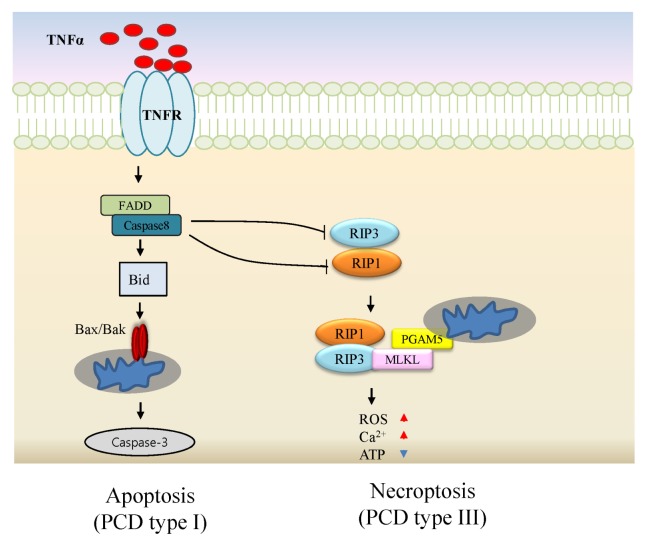
Necroptosis is an emerging form of programmed cell death occurring via active and well-regulated necrosis, distinct from apoptosis morphologically, and biochemically. Necroptosis is mainly unmasked when apoptosis is compromised in response to tumor necrosis factor alpha. Unlike apoptotic cells, which are cleared by macrophages or neighboring cells, necrotic cells release danger signals, triggering inflammation, and exacerbating tissue damage. Evidence increasingly suggests that programmed necrosis is not only associated with pathophysiology of disease, but also induces innate immune response to viral infection. Therefore, necroptotic cell death plays both physiological and pathological roles. Physiologically, necroptosis induce an innate immune response as well as premature assembly of viral particles in cells infected with virus that abrogates host apoptotic machinery. On the other hand, necroptosis per se is detrimental, causing various diseases such as sepsis, neurodegenerative diseases and ischemic reperfusion injury. This review discusses the signaling pathways leading to necroptosis, associated necroptotic proteins with target-specific inhibitors and diseases involved. Several studies currently focus on protective approaches to inhibiting necroptotic cell death. In cancer biology, however, anticancer drug resistance severely hampers the efficacy of chemotherapy based on apoptosis. Pharmacological switch of cell death finds therapeutic application in drug- resistant cancers. Therefore, the possible clinical role of necroptosis in cancer control will be discussed in brief. [BMB Reports 2018; 51(5): 219-224].
细胞程序性坏死是一种新兴的细胞死亡形式,通过主动且受调控的坏死发生,在形态学和生物化学上有别于细胞凋亡。细胞程序性坏死主要在肿瘤坏死因子-α作用下,细胞凋亡受到抑制时显现。与被巨噬细胞或邻近细胞清除的凋亡细胞不同,坏死细胞释放危险信号,引发炎症,加剧组织损伤。越来越多的证据表明,程序性坏死不仅与疾病的病理生理学有关,而且还能诱导对病毒感染的固有免疫反应。因此,程序性坏死细胞死亡既具有生理作用,也具有病理作用。在生理上,坏死诱导固有免疫反应以及病毒感染细胞中病毒颗粒的过早组装,从而破坏宿主细胞的凋亡机制。另一方面,坏死本身是有害的,可导致各种疾病,如败血症、神经退行性疾病和缺血再灌注损伤。本综述讨论了导致细胞程序性坏死的信号通路、与靶特异性抑制剂相关的坏死蛋白以及涉及的疾病。目前有几项研究集中在抑制细胞程序性坏死的保护方法上。然而,在癌症生物学中,抗癌药物耐药性严重阻碍了基于细胞凋亡的化疗效果。细胞死亡的药理学转换在耐药性癌症的治疗中有应用。因此,本文将简要讨论细胞程序性坏死在癌症控制中的可能临床作用。[BMB 报告 2018;51(5):219-224]。