Department of Biomolecular Sciences, Max Planck Institute of Colloids and Interfaces, 14424, Potsdam, Germany.
Institute of Chemistry and Biochemistry, Freie Universität Berlin, 14195, Berlin, Germany.
Anal Bioanal Chem. 2017 Jan;409(2):529-538. doi: 10.1007/s00216-016-0051-6. Epub 2016 Dec 1.
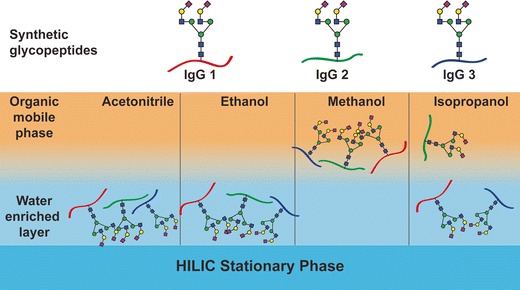
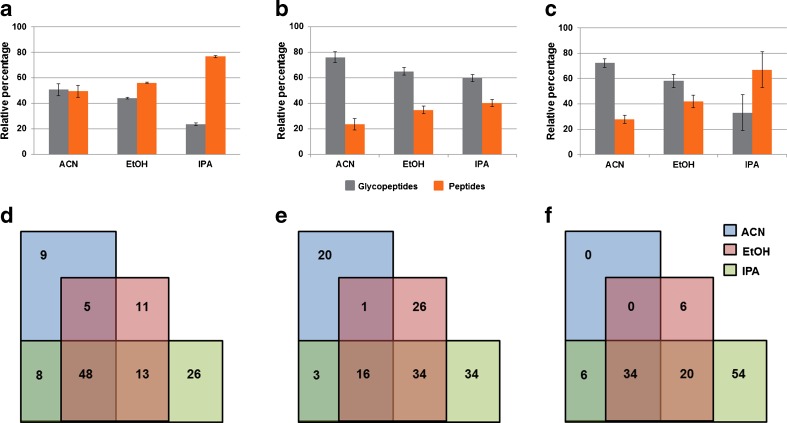
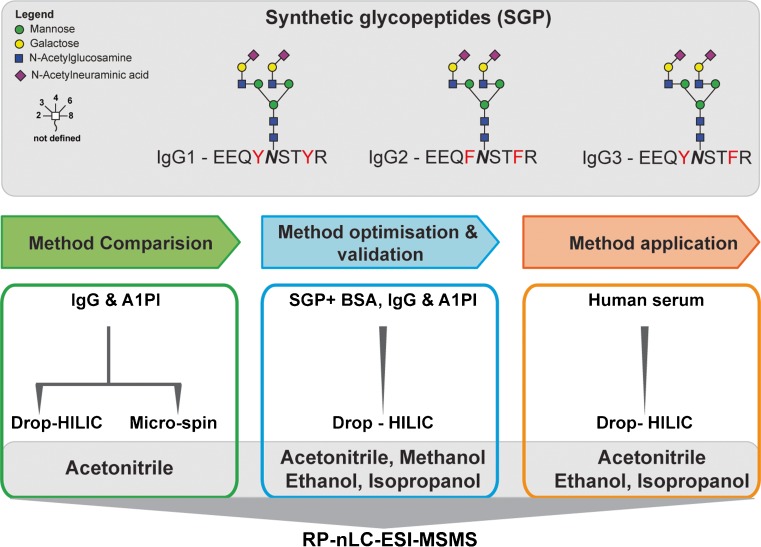
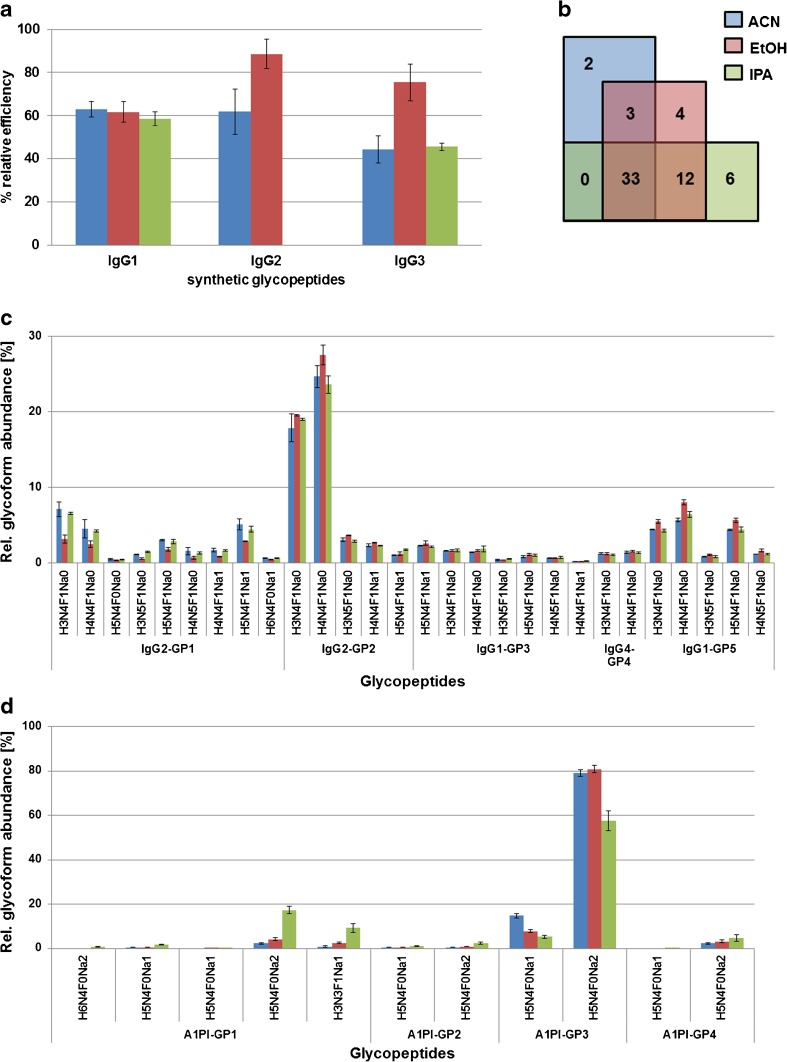
Glycopeptide enrichment is a crucial step in glycoproteomics for which hydrophilic interaction chromatography (HILIC) has extensively been applied due to its low bias towards different glycan types. A systematic evaluation of applicable HILIC mobile phases on glycopeptide enrichment efficiency and selectivity is, to date, however, still lacking. Here, we present a novel, simplified technique for HILIC enrichment termed "Drop-HILIC", which was applied to systematically evaluate the mobile phase effect on ZIC-HILIC (zwitterionic type of hydrophilic interaction chromatography) glycopeptide enrichment. The four most commonly used MS compatible organic solvents were investigated: (i) acetonitrile, (ii) methanol, (iii) ethanol and (iv) isopropanol. Glycopeptide enrichment efficiencies were evaluated for each solvent system using samples of increasing complexity ranging from well-defined synthetic glycopeptides spiked into different concentrations of tryptic BSA peptides, followed by standard glycoproteins, and a complex sample derived from human (depleted and non-depleted) serum. ZIC-HILIC glycopeptide efficiency largely relied upon the used solvent. Different organic mobile phases enriched distinct glycopeptide subsets in a peptide backbone hydrophilicity-dependant manner. Acetonitrile provided the best compromise for the retention of both hydrophilic and hydrophobic glycopeptides, whereas methanol was confirmed to be unsuitable for this purpose. The enrichment efficiency of ethanol and isopropanol towards highly hydrophobic glycopeptides was compromised as considerable co-enrichment of unmodified peptides occurred, though for some hydrophobic glycopeptides isopropanol showed the best enrichment properties. This study shows that even minor differences in the peptide backbone and solvent do significantly influence HILIC glycopeptide enrichment and need to be carefully considered when employed for glycopeptide enrichment. Graphical Abstract The organic solvent plays a crucial role in ZIC-HILIC glycopeptide enrichment.
糖肽富集是糖组学中的一个关键步骤,由于其对不同聚糖类型的低偏向性,亲水作用色谱(HILIC)已广泛应用于此。然而,迄今为止,对于适用于糖肽富集效率和选择性的 HILIC 流动相,还缺乏系统的评估。在这里,我们提出了一种新的、简化的 HILIC 富集技术,称为“Drop-HILIC”,我们应用该技术系统地评估了流动相效应对 ZIC-HILIC(两性离子亲水作用色谱)糖肽富集的影响。研究了四种最常用的与 MS 兼容的有机溶剂:(i)乙腈,(ii)甲醇,(iii)乙醇和(iv)异丙醇。对于每种溶剂系统,我们使用从定义明确的合成糖肽中逐渐增加浓度的方法来评估糖肽的富集效率,这些糖肽被掺入到不同浓度的胰蛋白酶 BSA 肽中,然后是标准糖蛋白,最后是来自人(耗尽和未耗尽)血清的复杂样品。ZIC-HILIC 糖肽的效率在很大程度上取决于所使用的溶剂。不同的有机流动相以肽骨架亲水性依赖的方式富集不同的糖肽亚群。乙腈提供了保留亲水性和疏水性糖肽的最佳折衷,而甲醇则被证实不适合用于此目的。乙醇和异丙醇对高度疏水性糖肽的富集效率受到影响,因为大量未修饰的肽同时被共富集,尽管对于一些疏水性糖肽,异丙醇显示出最好的富集特性。本研究表明,即使在肽骨架和溶剂方面存在微小差异,也会显著影响 HILIC 糖肽的富集,因此在用于糖肽富集时需要仔细考虑。