Dennis Steven K, Lam Kent, Luong Amber
Department of Otorhinolaryngology-Head and Neck Surgery University of Texas McGovern Medical School Houston Texas U.S.A.
Laryngoscope Investig Otolaryngol. 2016 Oct;1(5):130-134. doi: 10.1002/lio2.32. Epub 2016 Sep 9.
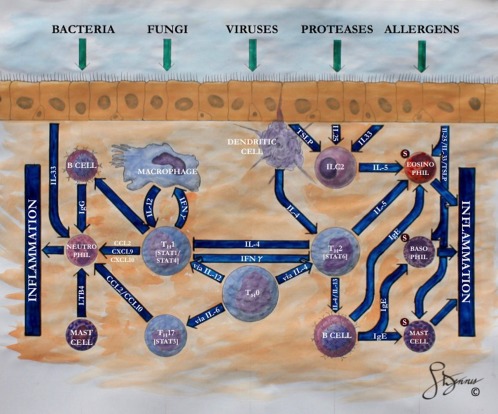
The recent development of endotypes to categorize disease variants of chronic rhinosinusitis (CRS) reflects an evolving understanding of the various pathophysiologic and pathogenetic mechanisms that contribute to the clinical heterogeneity of CRS manifestations. This review highlights popular endotype-based criteria used to define different CRS with nasal polyposis (CRSwNP) subtypes and further discusses the emerging therapeutic advances for each classificatory approach.
PubMed literature review.
A review of the current literature was conducted to determine present-day uses of immunologic and molecular profiles in the CRSwNP disease spectrum to identify specific endotypes.
Four distinct but overlapping classification schemes have emerged to define endotypes within the CRSwNP phenotype: 1) type 2 cytokine-based approach, 2) eosinophil-based approach, 3) immunoglobulin (Ig)E-based approach, and 4) cysteinyl based approach. The identification of key inflammatory biomarkers related to these CRSwNP endotypes has broadened the classification of CRS beyond common phenotypic expressions. Furthermore, CRSwNP endotypes may improve the selection of CRSwNP patients who are suitable candidates for biomarker-specific treatment options, such as anti-interleukin-5; anti-IgE; and platelet-directed therapies.
Chronic rhinosinusitis endotyping with key biomarker patterns of inflammation allows for improved diagnostic and potentially therapeutic classifications of CRSwNP variants.
慢性鼻-鼻窦炎(CRS)疾病变体分类的内型最近的发展反映了对导致CRS临床表现临床异质性的各种病理生理和发病机制的认识不断演变。本综述重点介绍了用于定义不同鼻息肉型慢性鼻-鼻窦炎(CRSwNP)亚型的基于内型的流行标准,并进一步讨论了每种分类方法的新兴治疗进展。
PubMed文献综述。
对当前文献进行综述,以确定免疫和分子特征在CRSwNP疾病谱中的当前用途,以识别特定内型。
出现了四种不同但相互重叠的分类方案来定义CRSwNP表型中的内型:1)基于2型细胞因子的方法,2)基于嗜酸性粒细胞的方法,3)基于免疫球蛋白(Ig)E的方法,以及4)基于半胱氨酰的方法。与这些CRSwNP内型相关的关键炎症生物标志物的识别拓宽了CRS的分类范围,超越了常见的表型表达。此外,CRSwNP内型可能会改善对适合生物标志物特异性治疗选择(如抗白细胞介素-5;抗IgE;和血小板导向疗法)的CRSwNP患者的选择。
具有关键炎症生物标志物模式的慢性鼻-鼻窦炎内型分类有助于改进CRSwNP变体的诊断和潜在治疗分类。