Massey Philip M, Leader Amy, Yom-Tov Elad, Budenz Alexandra, Fisher Kara, Klassen Ann C
Department of Community Health and Prevention, Dornsife School of Public Health, Drexel University, Philadelphia, PA, United States.
Division of Population Science, Department of Medical Oncology, Thomas Jefferson University, Philadelphia, PA, United States.
J Med Internet Res. 2016 Dec 5;18(12):e318. doi: 10.2196/jmir.6670.
Human papillomavirus (HPV) is the most common sexually transmitted infection in the United States. There are several vaccines that protect against strains of HPV most associated with cervical and other cancers. Thus, HPV vaccination has become an important component of adolescent preventive health care. As media evolves, more information about HPV vaccination is shifting to social media platforms such as Twitter. Health information consumed on social media may be especially influential for segments of society such as younger populations, as well as ethnic and racial minorities.
The objectives of our study were to quantify HPV vaccine communication on Twitter, and to develop a novel methodology to improve the collection and analysis of Twitter data.
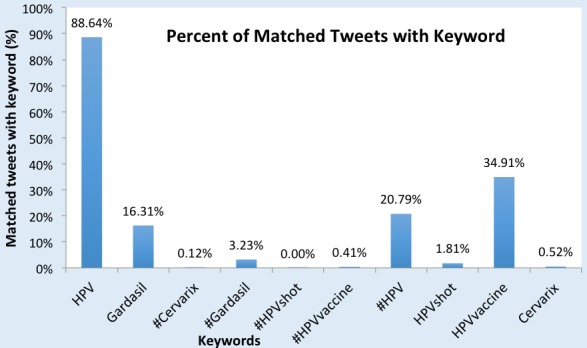
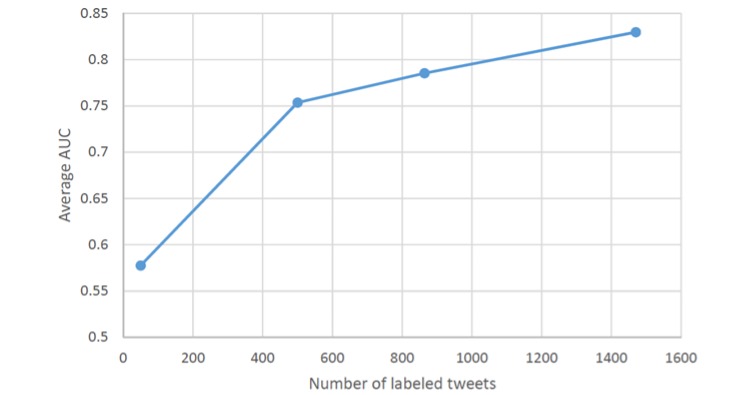
We collected Twitter data using 10 keywords related to HPV vaccination from August 1, 2014 to July 31, 2015. Prospective data collection used the Twitter Search API and retrospective data collection used Twitter Firehose. Using a codebook to characterize tweet sentiment and content, we coded a subsample of tweets by hand to develop classification models to code the entire sample using machine learning procedures. We also documented the words in the 140-character tweet text most associated with each keyword. We used chi-square tests, analysis of variance, and nonparametric equality of medians to test for significant differences in tweet characteristic by sentiment.
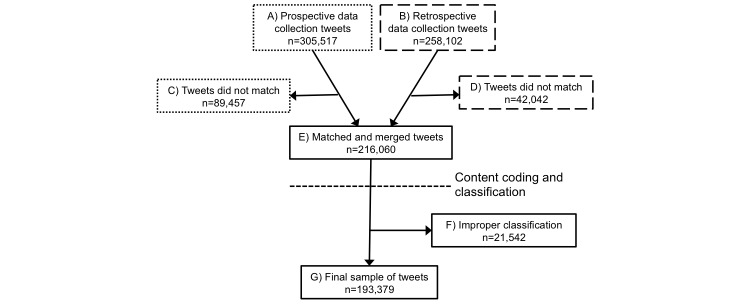
A total of 193,379 English-language tweets were collected, classified, and analyzed. Associated words varied with each keyword, with more positive and preventive words associated with "HPV vaccine" and more negative words associated with name-brand vaccines. Positive sentiment was the largest type of sentiment in the sample, with 75,393 positive tweets (38.99% of the sample), followed by negative sentiment with 48,940 tweets (25.31% of the sample). Positive and neutral tweets constituted the largest percentage of tweets mentioning prevention or protection (20,425/75,393, 27.09% and 6477/25,110, 25.79%, respectively), compared with only 11.5% of negative tweets (5647/48,940; P<.001). Nearly one-half (22,726/48,940, 46.44%) of negative tweets mentioned side effects, compared with only 17.14% (12,921/75,393) of positive tweets and 15.08% of neutral tweets (3787/25,110; P<.001).
Examining social media to detect health trends, as well as to communicate important health information, is a growing area of research in public health. Understanding the content and implications of conversations that form around HPV vaccination on social media can aid health organizations and health-focused Twitter users in creating a meaningful exchange of ideas and in having a significant impact on vaccine uptake. This area of research is inherently interdisciplinary, and this study supports this movement by applying public health, health communication, and data science approaches to extend methodologies across fields.
人乳头瘤病毒(HPV)是美国最常见的性传播感染病毒。有几种疫苗可预防与宫颈癌及其他癌症最相关的HPV毒株。因此,HPV疫苗接种已成为青少年预防性医疗保健的重要组成部分。随着媒体的发展,更多关于HPV疫苗接种的信息正转向推特等社交媒体平台。在社交媒体上获取的健康信息可能对年轻人群体以及少数族裔和种族等社会群体尤其具有影响力。
我们研究的目的是量化推特上关于HPV疫苗的交流情况,并开发一种新方法来改进推特数据的收集和分析。
我们在2014年8月1日至2015年7月31日期间使用10个与HPV疫苗接种相关的关键词收集推特数据。前瞻性数据收集使用推特搜索应用程序编程接口(API),回顾性数据收集使用推特海量数据。使用一个编码本对推文情绪和内容进行特征描述,我们手动对推文子样本进行编码以开发分类模型,从而使用机器学习程序对整个样本进行编码。我们还记录了140字符推文字文本中与每个关键词最相关的词汇。我们使用卡方检验、方差分析和中位数非参数相等性检验来检验按情绪划分的推文特征的显著差异。
共收集、分类和分析了193,379条英文推文。相关词汇因每个关键词而异,与“HPV疫苗”相关的积极和预防性词汇更多,与名牌疫苗相关的消极词汇更多。积极情绪是样本中最大的情绪类型,有75,393条积极推文(占样本的38.99%),其次是消极情绪,有48,940条推文(占样本的25.31%)。在提及预防或保护的推文中,积极和中性推文占比最大(分别为20,425/75,393,27.09%和6477/25,110,25.79%),而消极推文中只有11.5%(5647/48,940;P<0.001)。近一半(22,726/48,940,46.44%)的消极推文提到了副作用,而积极推文中只有17.14%(12,921/75,393),中性推文中只有15.08%(3787/25,110;P<0.001)。
通过研究社交媒体来发现健康趋势以及传播重要的健康信息,是公共卫生领域一个不断发展的研究领域。了解围绕社交媒体上HPV疫苗接种形成的对话的内容和影响,有助于卫生组织和关注健康的推特用户进行有意义的思想交流,并对疫苗接种率产生重大影响。这一研究领域本质上是跨学科的,本研究通过应用公共卫生、健康传播和数据科学方法将方法扩展到各个领域,支持了这一发展趋势。