Veneziano Giorgio, Tripi Jennifer, Tumin Dmitry, Hakim Mumin, Martin David, Beltran Ralph, Klingele Kevin, Bhalla Tarun, Tobias Joseph D
Department of Anesthesiology & Pain Medicine, Nationwide Children's Hospital; Department of Anesthesiology & Pain Medicine, The Ohio State University College of Medicine.
Department of Anesthesiology & Pain Medicine, Nationwide Children's Hospital.
J Pain Res. 2016 Nov 18;9:1073-1079. doi: 10.2147/JPR.S117692. eCollection 2016.
Femoral nerve blockade (FNB) provides effective postoperative analgesia in children undergoing arthroscopic knee surgery as evidenced by their opioid-sparing effects and decreased postoperative pain scores. Increasing the local anesthetic concentration in peripheral nerve blockade for adults undergoing orthopedic surgery has been shown to be beneficial, increasing block success rate, and providing a longer duration of analgesia. The effect of increasing the concentration of local anesthetic in extremity blocks in children remains largely unexplored.
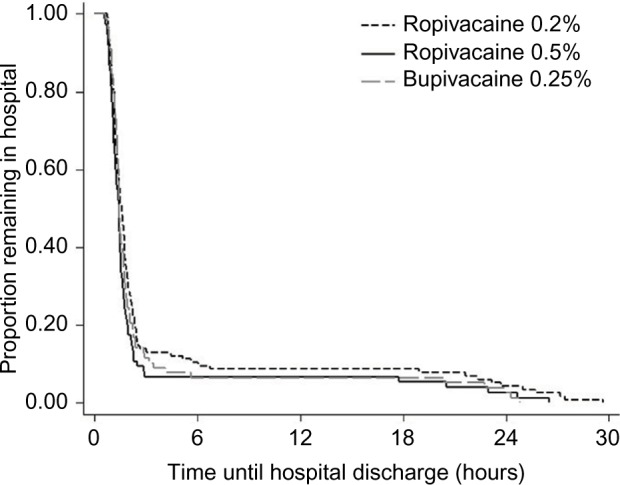
We retrospectively evaluated the effectiveness of FNB using three concentrations of local anesthetic (ropivacaine 0.2%, bupivacaine 0.25%, and ropivacaine 0.5%) in children and adolescents undergoing arthroscopic knee surgery. The primary outcome evaluated was postoperative opioid consumption before discharge. Secondary outcomes included post-anesthesia care unit (PACU) and hospital discharge times, first pain score in PACU, and the incidence of adverse events.
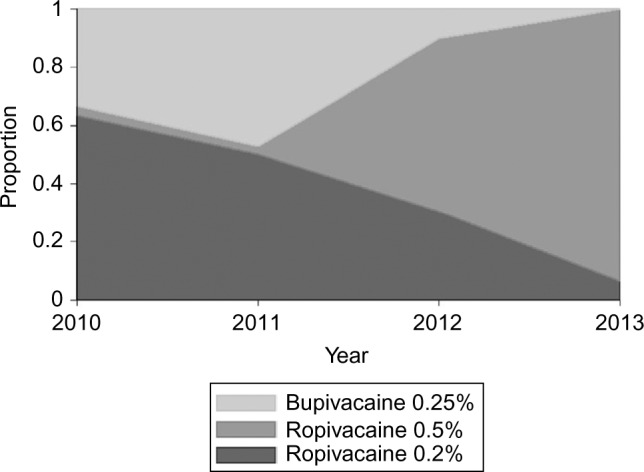
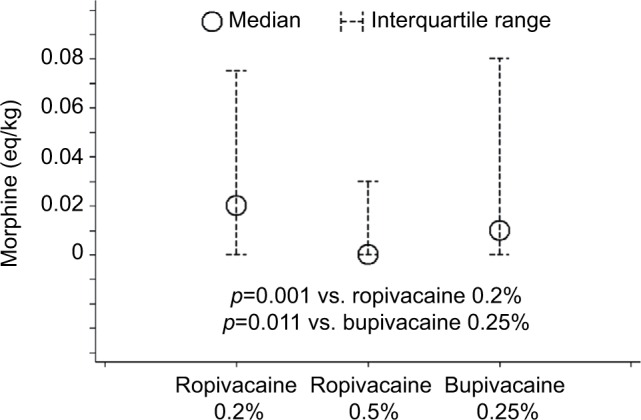
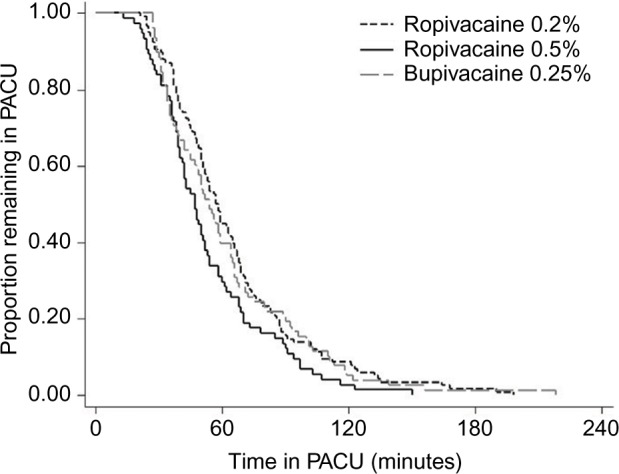
Two hundred and sixty-nine children and adolescents who received a FNB for arthroscopic knee surgery from January 2010 to December 2013 were included for analysis. Local anesthetic used in FNB was ropivacaine 0.2% in 116 (43%) cases, ropivacaine 0.5% in 75 (28%) cases, and bupivacaine 0.25% in 78 (29%) cases. Median postoperative opioid consumption (mg/kg intravenous morphine equivalents) in the ropivacaine 0.5% group was 0 mg/kg (interquartile ranges [IQR]: 0 mg, 0.03 mg/kg) compared to 0.02 mg/kg (IQR: 0, 0.08 mg/kg) in the ropivacaine 0.2% group and 0.01 mg/kg (IQR: 0, 0.08 mg/kg) in the bupivacaine 0.25% group (=0.009). Median PACU time was shortest in the ropivacaine 0.5% group (47 min; IQR: 36, 68 min) compared to the ropivacaine 0.2% (58 min; IQR: 41, 77) and bupivacaine 0.25% (54 min; IQR: 35, 75 min) groups (=0.040). Among groups, there were no significant differences in first postoperative pain scores or incidence of nausea and vomiting. No patient in any group experienced a serious adverse event.
The results suggest that ropivacaine 0.5% for FNB offers superior postoperative analgesia in the form of decreased postoperative opioid consumption and earlier PACU/hospital discharge, when compared to ropivacaine 0.2% and bupivacaine 0.25% in the pediatric population.
III, Retrospective Comparative Study.
股神经阻滞(FNB)在接受关节镜膝关节手术的儿童中可提供有效的术后镇痛,其阿片类药物节省效应和降低的术后疼痛评分证明了这一点。在接受骨科手术的成人中,提高周围神经阻滞中局部麻醉剂的浓度已被证明是有益的,可提高阻滞成功率并提供更长的镇痛时间。在儿童肢体阻滞中增加局部麻醉剂浓度的效果在很大程度上仍未得到探索。
我们回顾性评估了在接受关节镜膝关节手术的儿童和青少年中使用三种局部麻醉剂浓度(0.2%罗哌卡因、0.25%布比卡因和0.5%罗哌卡因)进行FNB的有效性。评估的主要结局是出院前的术后阿片类药物消耗量。次要结局包括麻醉后护理单元(PACU)和住院出院时间、PACU中的首次疼痛评分以及不良事件的发生率。
纳入分析的是2010年1月至2013年12月接受FNB进行关节镜膝关节手术的269名儿童和青少年。FNB中使用的局部麻醉剂为116例(43%)0.2%罗哌卡因、75例(28%)0.5%罗哌卡因和78例(29%)0.25%布比卡因。0.5%罗哌卡因组术后阿片类药物消耗量中位数(mg/kg静脉注射吗啡当量)为0 mg/kg(四分位数间距[IQR]:0 mg,0.03 mg/kg),而0.2%罗哌卡因组为0.02 mg/kg(IQR:0,0.08 mg/kg),0.25%布比卡因组为0.01 mg/kg(IQR:0,0.08 mg/kg)(=0.009)。0.5%罗哌卡因组的PACU时间中位数最短(47分钟;IQR:36,68分钟),而0.2%罗哌卡因组为58分钟(IQR:41,77),0.25%布比卡因组为54分钟(IQR:35,75分钟)(=0.040)。各组之间,术后首次疼痛评分或恶心呕吐发生率无显著差异。任何组中均无患者发生严重不良事件。
结果表明,与儿科人群中0.2%罗哌卡因和0.25%布比卡因相比,0.5%罗哌卡因用于FNB可提供更好的术后镇痛,表现为术后阿片类药物消耗量减少和更早的PACU/出院时间。
III,回顾性比较研究。