Cui Fang, Gu Ruolei, Zhu Xiangru, Luo Yue-Jia
Institute of Affective and Social Neuroscience, Shenzhen University, Shenzhen China.
CAS Key Laboratory of Behavioral Science, Institute of Psychology, Beijing China.
Front Psychol. 2016 Nov 22;7:1847. doi: 10.3389/fpsyg.2016.01847. eCollection 2016.
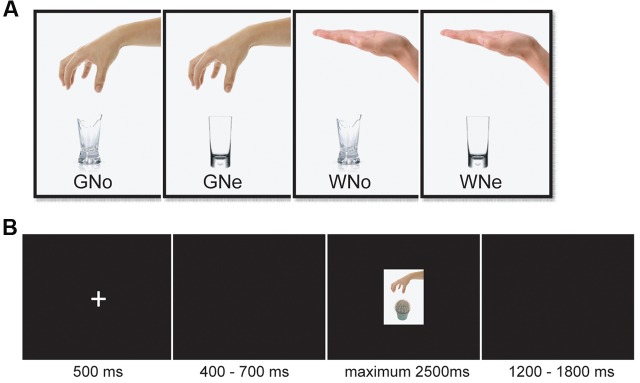
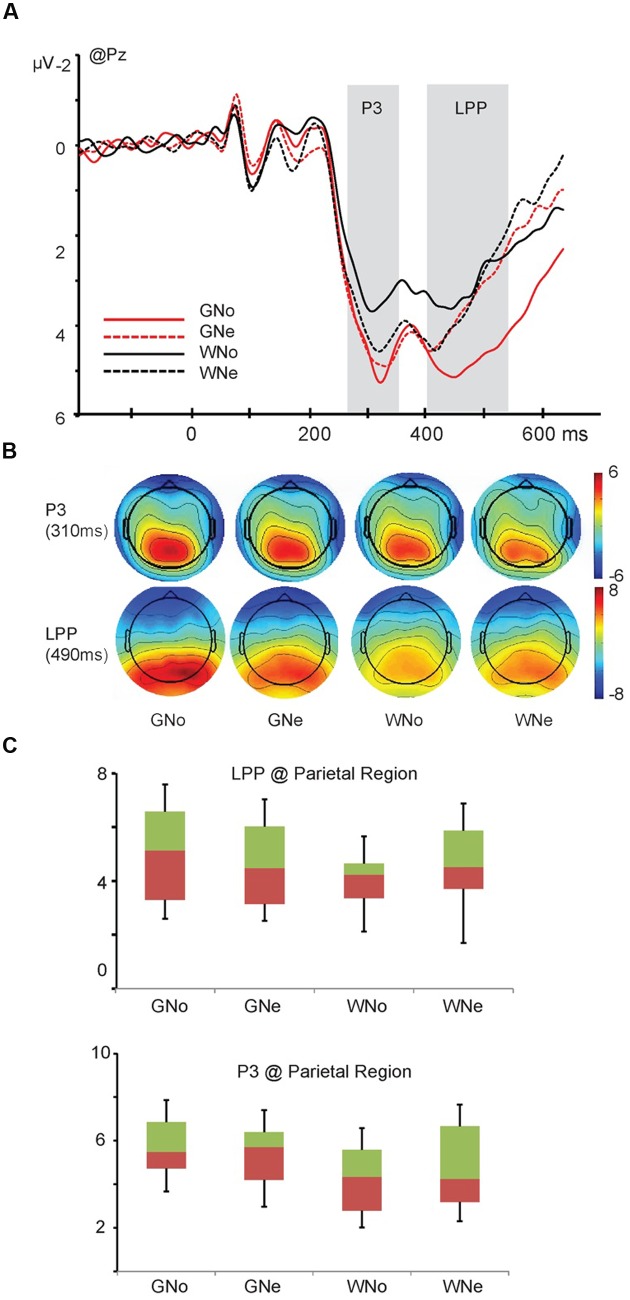
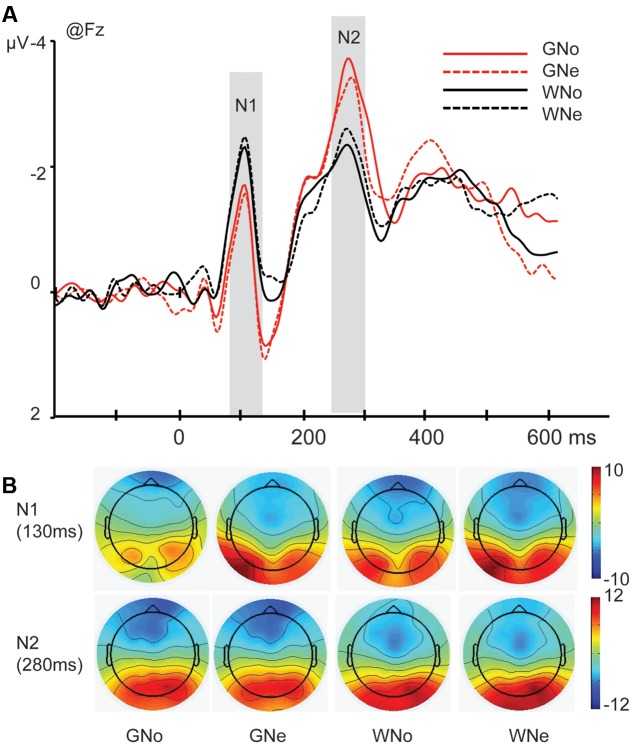
The present study investigates the temporal dynamics of the brain activity predicting the sensory outcomes of observed hand-object interactions of others. Participants are presented with pictures of a hand grasping or withdrawing from noxious and neutral objects. They are then asked to judge whether this hand-object interaction causes painful consequences. In the early stages of stimulus processing, the effect of action was observed in the event-related potential components N1 and N2. Significant interactions of action × object were observed in the later components P3 and late positive potential (LPP): only when the object was noxious, the action "grasp" elicited a significantly larger amplitude than the action "withdrawal". These results suggest that: on the one hand, when observing the hand-object interaction from the third-person perspective, the action type of others can be processed in an automatic style. On the other hand, integrating the information of action and object to predict the sensory consequence of this interaction is a top-down, cognitive controlled processing. The current findings are different from previous studies using first-person perspective visual stimuli which support that the processing of hand-object interaction is rapid and automatic.
本研究调查了预测他人手部与物体相互作用的感官结果的大脑活动的时间动态。向参与者展示手抓住或从有害和中性物体上撤回的图片。然后要求他们判断这种手部与物体的相互作用是否会导致疼痛后果。在刺激处理的早期阶段,在事件相关电位成分N1和N2中观察到动作的影响。在后期成分P3和晚期正电位(LPP)中观察到动作×物体的显著交互作用:只有当物体有害时,“抓握”动作引发的振幅才明显大于“撤回”动作。这些结果表明:一方面,从第三人称视角观察手部与物体的相互作用时,他人的动作类型可以以自动方式进行处理。另一方面,整合动作和物体的信息以预测这种相互作用的感官后果是一种自上而下的、认知控制的处理过程。当前的研究结果与之前使用第一人称视角视觉刺激的研究不同,之前的研究支持手部与物体相互作用的处理是快速且自动的。