Bell Thomas, Tylianakis Jason M
Department of Life Sciences, Imperial College London, Silwood Park Campus, Buckhurst Road, Ascot, Berkshire SL5 7PY, UK
Department of Life Sciences, Imperial College London, Silwood Park Campus, Buckhurst Road, Ascot, Berkshire SL5 7PY, UK.
Proc Biol Sci. 2016 Dec 14;283(1844). doi: 10.1098/rspb.2016.0896.
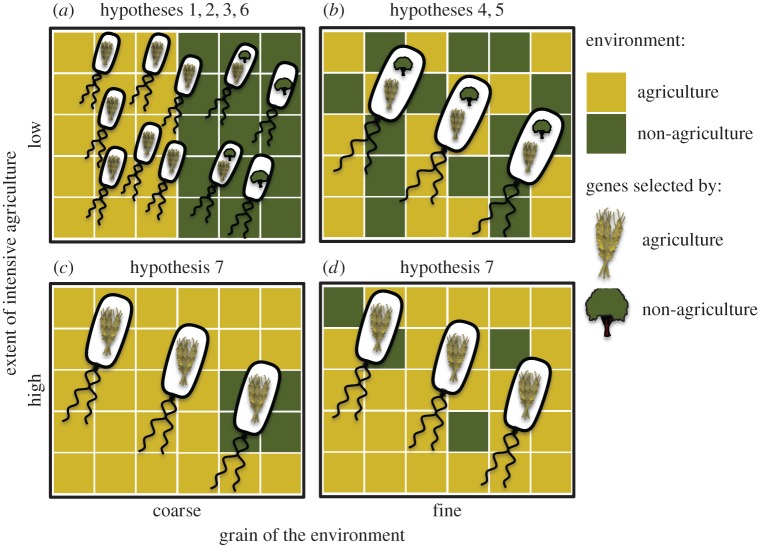
Soil microbial communities are enormously diverse, with at least millions of species and trillions of genes unknown to science or poorly described. Soil microbial communities are key components of agriculture, for example, in provisioning nitrogen and protecting crops from pathogens, providing overall ecosystem services in excess of $1000bn per year. It is important to know how humans are affecting this hidden diversity. Much is known about the negative consequences of agricultural intensification on higher organisms, but almost nothing is known about how alterations to landscapes affect microbial diversity, distributions and processes. We review what is known about spatial flows of microbes and their response to land-use change, and outline nine hypotheses to advance research of microbiomes across landscapes. We hypothesize that intensified agriculture selects for certain taxa and genes, which then 'spill over' into adjacent unmodified areas and generate a halo of genetic differentiation around agricultural fields. Consequently, the spatial configuration and management intensity of different habitats combines with the dispersal ability of individual taxa to determine the extent of spillover, which can impact the functioning of adjacent unmodified habitats. When landscapes are heterogeneous and dispersal rates are high, this will select for large genomes that allow exploitation of multiple habitats, a process that may be accelerated through horizontal gene transfer. Continued expansion of agriculture will increase genotypic similarity, making microbial community functioning increasingly variable in human-dominated landscapes, potentially also impacting the consistent provisioning of ecosystem services. While the resulting economic costs have not been calculated, it is clear that dispersal dynamics of microbes should be taken into consideration to ensure that ecosystem functioning and services are maintained in agri-ecosystem mosaics.
土壤微生物群落极其多样,至少有数百万个物种和数万亿个基因尚未被科学认知或描述甚少。土壤微生物群落是农业的关键组成部分,例如,在提供氮素和保护作物免受病原体侵害方面发挥着作用,每年提供的生态系统服务总值超过10000亿美元。了解人类如何影响这种隐藏的多样性非常重要。我们对农业集约化对高等生物的负面影响了解很多,但对于景观变化如何影响微生物多样性、分布和过程却几乎一无所知。我们回顾了关于微生物的空间流动及其对土地利用变化的响应的已知信息,并概述了九个假设,以推动对不同景观中微生物群落的研究。我们假设集约化农业会选择某些分类群和基因,这些分类群和基因随后会“溢出”到相邻的未改良区域,并在农田周围产生遗传分化晕圈。因此,不同栖息地的空间配置和管理强度与单个分类群的扩散能力相结合,决定了溢出的程度,这可能会影响相邻未改良栖息地的功能。当景观异质性高且扩散率高时,这将选择允许利用多种栖息地的大基因组,这一过程可能会通过水平基因转移加速。农业的持续扩张将增加基因型相似性,使微生物群落功能在人类主导的景观中变得越来越多变,这也可能影响生态系统服务的持续提供。虽然由此产生的经济成本尚未计算,但很明显,应考虑微生物的扩散动态,以确保农业生态系统镶嵌体中的生态系统功能和服务得以维持。