State Key Laboratory of Low Dimensional Quantum Physics, Department of Physics,Tsinghua University, Beijing 100084, China.
International Center for Quantum Materials, School of Physics, Peking University, Beijing 100871, China.
Nat Commun. 2016 Dec 9;7:13552. doi: 10.1038/ncomms13552.
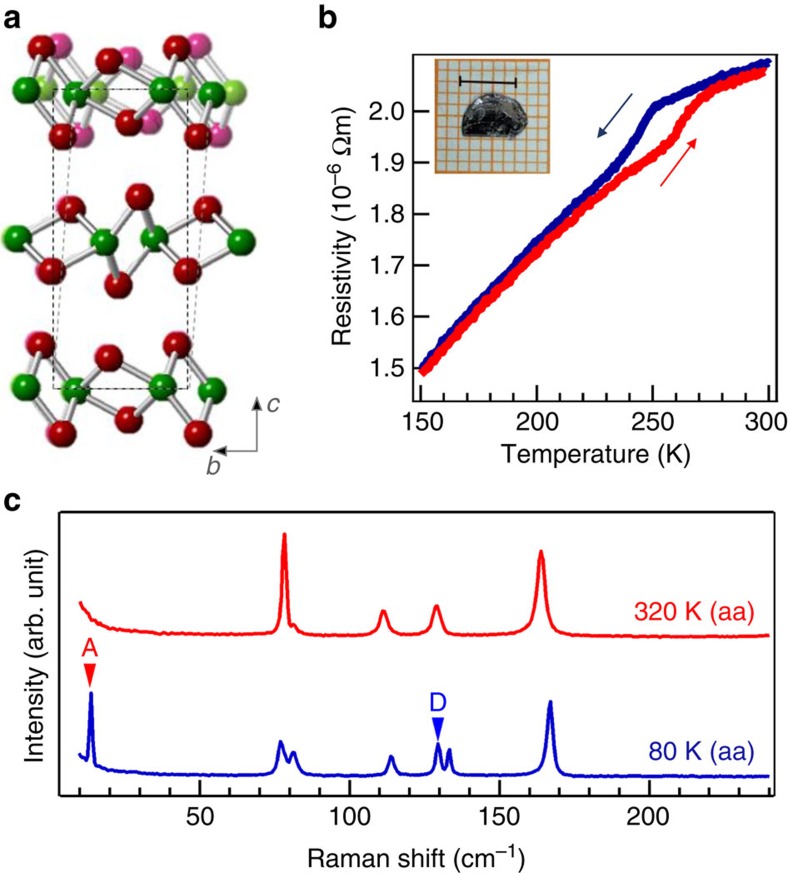
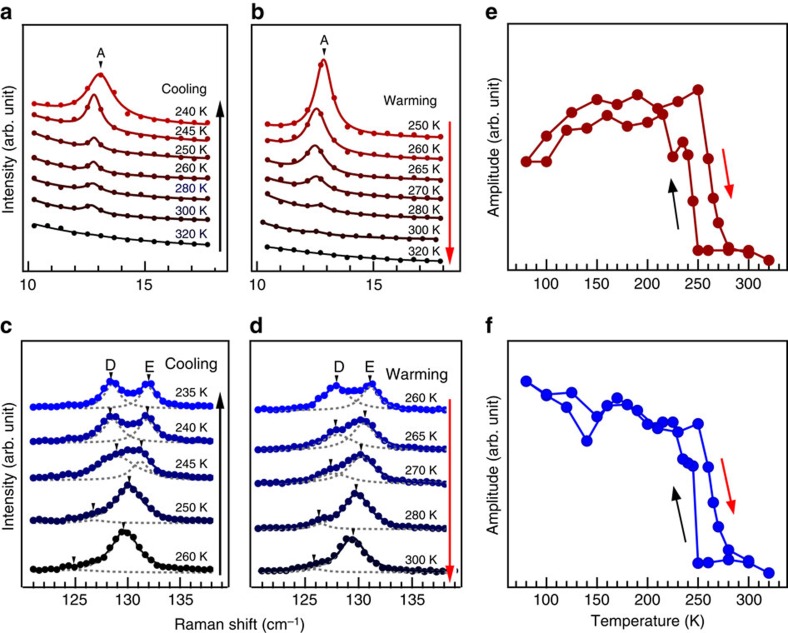
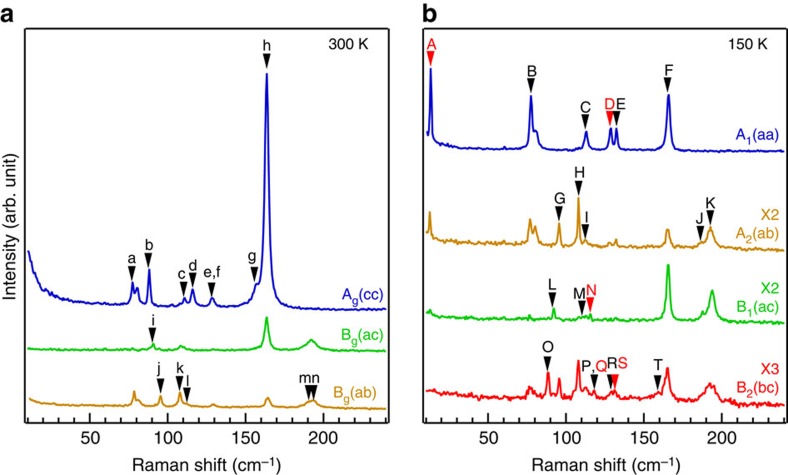
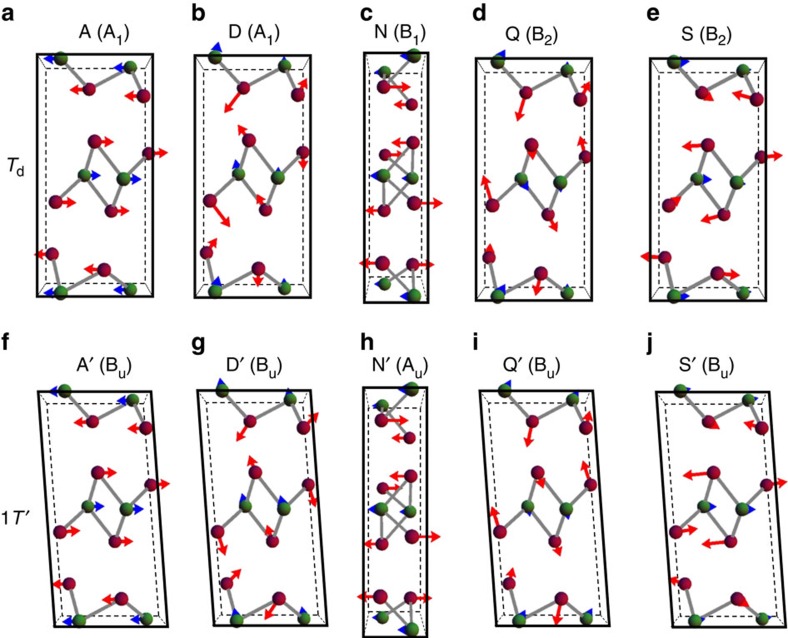
Transition metal dichalcogenide MoTe is an important candidate for realizing the newly predicted type-II Weyl fermions, for which the breaking of the inversion symmetry is a prerequisite. Here we present direct spectroscopic evidence for the inversion symmetry breaking in the low-temperature phase of MoTe by systematic Raman experiments and first-principles calculations. We identify five lattice vibrational modes that are Raman-active only in the low-temperature noncentrosymmetric structure. A hysteresis is also observed in the peak intensity of inversion symmetry-activated Raman modes, confirming a temperature-induced structural phase transition with a concomitant change in the inversion symmetry. Our results provide definitive evidence for the low-temperature noncentrosymmetric T phase from vibrational spectroscopy, and suggest MoTe as an ideal candidate for investigating the temperature-induced topological phase transition.
过渡金属二卤族化合物 MoTe 是实现新预测的第二类外尔费米子的重要候选材料,而反转对称性的破缺是其前提。在这里,我们通过系统的拉曼实验和第一性原理计算,提供了低温相 MoTe 中反转对称性破缺的直接光谱证据。我们确定了五个晶格振动模式,它们仅在低温非中心对称结构中具有拉曼活性。反转对称性激活拉曼模式的峰值强度也出现了滞后现象,这证实了一个伴随反转对称性变化的温度诱导结构相变。我们的结果从振动光谱上为低温非中心对称 T 相提供了明确的证据,并表明 MoTe 是研究温度诱导拓扑相变的理想候选材料。