Fujiki Yukio
Medical Institute of Bioregulation, Kyushu University.
Proc Jpn Acad Ser B Phys Biol Sci. 2016;92(10):463-477. doi: 10.2183/pjab.92.463.
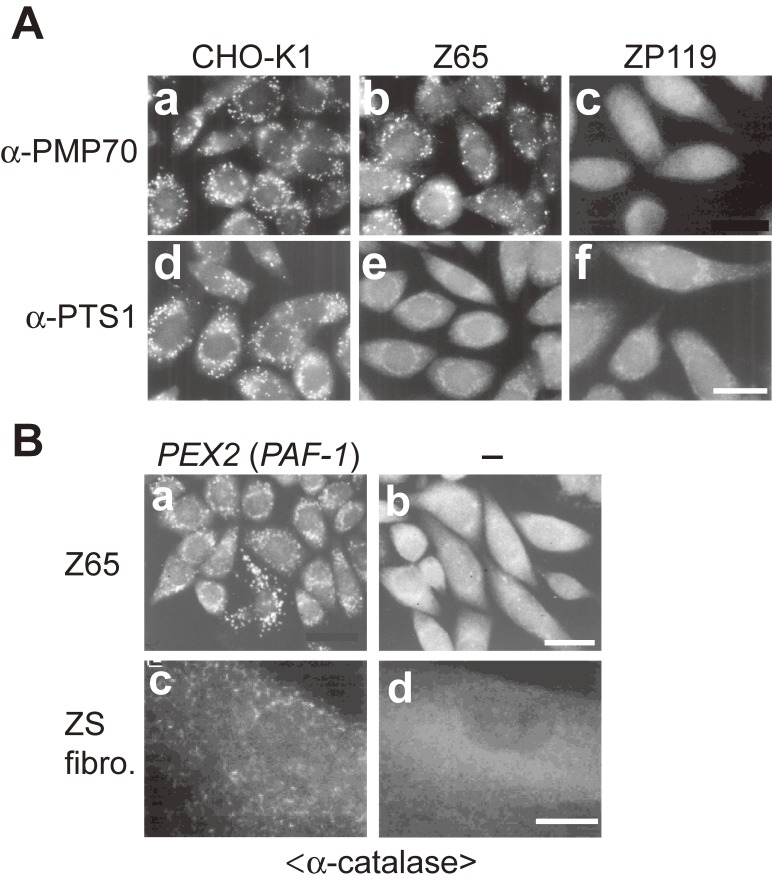
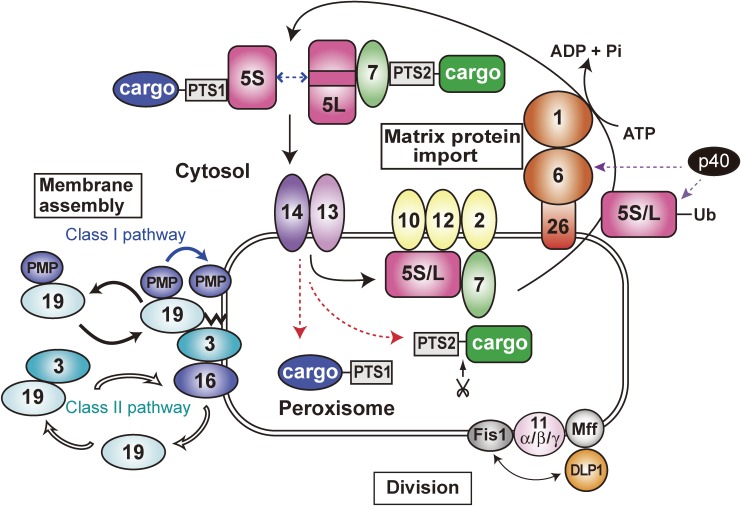
Peroxisome is a single-membrane-bounded ubiquitous organelle containing a hundred different enzymes that catalyze various metabolic pathways such as β-oxidation of very long-chain fatty acids and synthesis of plasmalogens. To investigate peroxisome biogenesis and human peroxisome biogenesis disorders (PBDs) including Zellweger syndrome, more than a dozen different complementation groups of Chinese hamster ovary (CHO) cell mutants impaired in peroxisome biogenesis are isolated as a model experimental system. By taking advantage of rapid functional complementation assay of the CHO cell mutants, successful cloning of PEX genes encoding peroxins required for peroxisome assembly invaluably contributed to the accomplishment of cloning of pathogenic genes responsible for PBDs. Peroxins are divided into three groups: 1) peroxins including Pex3p, Pex16p and Pex19p, are responsible for peroxisome membrane biogenesis via Pex19p- and Pex3p-dependent class I and Pex19p- and Pex16p-dependent class II pathways; 2) peroxins that function in matrix protein import; 3) those such as Pex11pβ are involved in peroxisome division where DLP1, Mff, and Fis1 coordinately function.
过氧化物酶体是一种由单层膜包裹的普遍存在的细胞器,含有上百种不同的酶,这些酶催化各种代谢途径,如极长链脂肪酸的β-氧化和缩醛磷脂的合成。为了研究过氧化物酶体的生物发生以及包括 Zellweger 综合征在内的人类过氧化物酶体生物发生障碍(PBDs),作为一种模型实验系统,人们分离出了十几种在过氧化物酶体生物发生方面受损的中国仓鼠卵巢(CHO)细胞突变体的不同互补组。通过利用 CHO 细胞突变体的快速功能互补分析,成功克隆了编码过氧化物酶体组装所需过氧化物酶的 PEX 基因,这对克隆导致 PBDs 的致病基因起到了至关重要的作用。过氧化物酶分为三组:1)包括 Pex3p、Pex16p 和 Pex19p 的过氧化物酶,通过依赖 Pex19p 和 Pex3p 的 I 类途径以及依赖 Pex19p 和 Pex16p 的 II 类途径负责过氧化物酶体膜的生物发生;2)在基质蛋白导入中起作用的过氧化物酶;3)诸如 Pex11pβ 等参与过氧化物酶体分裂的过氧化物酶,其中 DLP1、Mff 和 Fis1 协同发挥作用。