Chang Jeremy T-H, Wang Fan, Chapin William, Huang R Stephanie
Biological Sciences Collegiate Division, University of Chicago, Chicago, Illinois, United States of America.
Department of Medicine, University of Chicago, Chicago, Illinois, United States of America.
PLoS One. 2016 Dec 13;11(12):e0168284. doi: 10.1371/journal.pone.0168284. eCollection 2016.
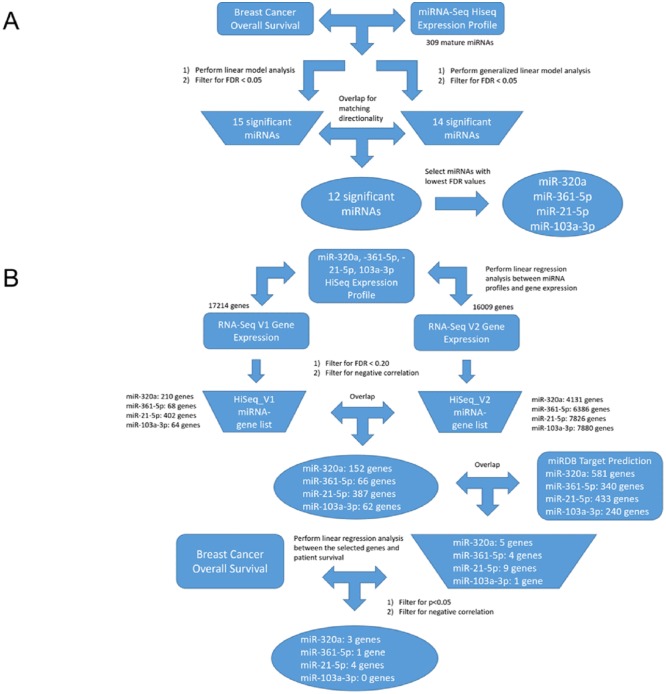
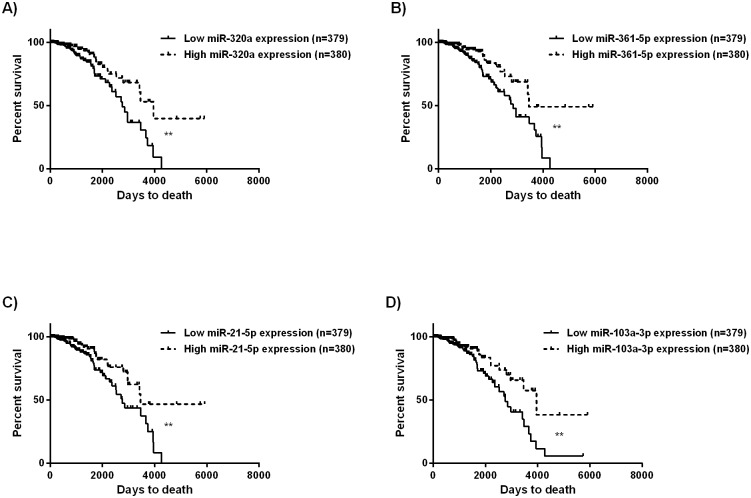
Breast cancer is the second-most common cancer and second-leading cause of cancer mortality in American women. The dysregulation of microRNAs (miRNAs) plays a key role in almost all cancers, including breast cancer. We comprehensively analyzed miRNA expression, global gene expression, and patient survival from the Cancer Genomes Atlas (TCGA) to identify clinically relevant miRNAs and their potential gene targets in breast tumors. In our analysis, we found that increased expression of 12 mature miRNAs-hsa-miR-320a, hsa-miR-361-5p, hsa-miR-103a-3p, hsa-miR-21-5p, hsa-miR-374b-5p, hsa-miR-140-3p, hsa-miR-25-3p, hsa-miR-651-5p, hsa-miR-200c-3p, hsa-miR-30a-5p, hsa-miR-30c-5p, and hsa-let-7i-5p -each predicted improved breast cancer survival. Of the 12 miRNAs, miR-320a, miR-361-5p, miR-21-5p, miR-103a-3p were selected for further analysis. By correlating global gene expression with miRNA expression and then employing miRNA target prediction analysis, we suggest that the four miRNAs may exert protective phenotypes by targeting breast oncogenes that contribute to patient survival. We propose that miR-320a targets the survival-associated genes RAD51, RRP1B, and TDG; miR-361-5p targets ARCN1; and miR-21-5p targets MSH2, RMND5A, STAG2, and UBE2D3. The results of our stringent bioinformatics approach for identifying clinically relevant miRNAs and their targets indicate that miR-320a, miR-361-5p, and miR-21-5p may contribute to breast cancer survival.
乳腺癌是美国女性中第二常见的癌症,也是癌症死亡的第二大主要原因。微小RNA(miRNA)的失调在几乎所有癌症中都起着关键作用,包括乳腺癌。我们全面分析了癌症基因组图谱(TCGA)中的miRNA表达、全基因组基因表达和患者生存情况,以确定乳腺肿瘤中与临床相关的miRNA及其潜在的基因靶点。在我们的分析中,我们发现12种成熟miRNA(hsa-miR-320a、hsa-miR-361-5p、hsa-miR-103a-3p、hsa-miR-21-5p、hsa-miR-374b-5p、hsa-miR-140-3p、hsa-miR-25-3p、hsa-miR-651-5p、hsa-miR-200c-3p、hsa-miR-30a-5p、hsa-miR-30c-5p和hsa-let-7i-5p)表达增加均预示着乳腺癌患者生存率提高。在这12种miRNA中,选择了miR-320a、miR-361-5p、miR-21-5p、miR-103a-3p进行进一步分析。通过将全基因组基因表达与miRNA表达相关联,然后进行miRNA靶点预测分析,我们认为这四种miRNA可能通过靶向有助于患者生存的乳腺癌基因发挥保护作用。我们提出miR-320a靶向与生存相关的基因RAD51、RRP1B和TDG;miR-361-5p靶向ARCN1;miR-21-5p靶向MSH2、RMND5A、STAG2和UBE2D3。我们用于识别与临床相关的miRNA及其靶点的严格生物信息学方法的结果表明,miR-320a、miR-361-5p和miR-21-5p可能有助于乳腺癌患者的生存。