Ma Xiaosong, Feng Fangjun, Wei Haibin, Mei Hanwei, Xu Kai, Chen Shoujun, Li Tianfei, Liang Xiaohua, Liu Hongyan, Luo Lijun
College of Plant Sciences & Technology, Huazhong Agricultural UniversityWuhan, China; Shanghai Agrobiological Gene CenterShanghai, China.
Shanghai Agrobiological Gene Center Shanghai, China.
Front Plant Sci. 2016 Nov 29;7:1801. doi: 10.3389/fpls.2016.01801. eCollection 2016.
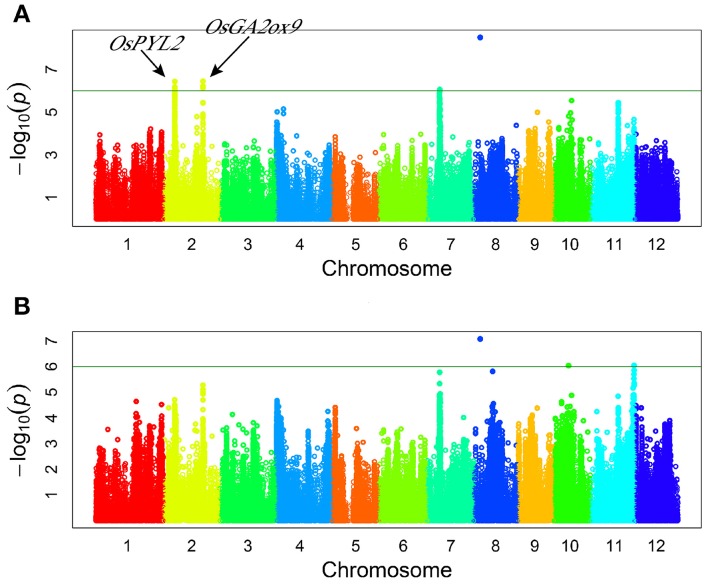
Drought is one of the vitally critical environmental stresses affecting both growth and yield potential in rice. Drought resistance is a complicated quantitative trait that is regulated by numerous small effect loci and hundreds of genes controlling various morphological and physiological responses to drought. For this study, 270 rice landraces and cultivars were analyzed for their drought resistance. This was done via determination of changes in plant height and grain yield under contrasting water regimes, followed by detailed identification of the underlying genetic architecture via genome-wide association study (GWAS). We controlled population structure by setting top two eigenvectors and combining kinship matrix for GWAS in this study. Eighteen, five, and six associated loci were identified for plant height, grain yield per plant, and drought resistant coefficient, respectively. Nine known functional genes were identified, including five for plant height (, and ), two for grain yield per plant ( and ) and two for drought resistant coefficient ( and ), implying very reliable results. A previous study reported to regulate root development, but this study reports additional controlling of both plant height and root length. Moreover, is a new drought resistant candidate gene discovered in this study. mutants showed faster water loss rates in detached leaves. This gene plays an important role in the positive regulation of yield-related traits under drought conditions. We furthermore discovered several new loci contributing to the three investigated traits (plant height, grain yield, and drought resistance). These associated loci and candidate genes significantly improve our knowledge of the genetic control of these traits in rice. In addition, many drought resistant cultivars screened in this study can be used as parental genotypes to improve drought resistance of rice by molecular breeding.
干旱是影响水稻生长和产量潜力的至关重要的环境胁迫之一。抗旱性是一个复杂的数量性状,受众多微效基因座和数百个控制干旱各种形态和生理反应的基因调控。在本研究中,对270个水稻地方品种和栽培品种的抗旱性进行了分析。通过测定不同水分条件下株高和籽粒产量的变化来完成,随后通过全基因组关联研究(GWAS)详细鉴定潜在的遗传结构。在本研究中,我们通过设置前两个特征向量并结合亲缘关系矩阵来控制群体结构以进行GWAS。分别鉴定出18个、5个和6个与株高、单株籽粒产量和抗旱系数相关的基因座。鉴定出9个已知功能基因,包括5个与株高相关的基因(、和)、2个与单株籽粒产量相关的基因(和)以及2个与抗旱系数相关的基因(和),这意味着结果非常可靠。先前的一项研究报道调控根系发育,但本研究报道其还额外控制株高和根长。此外,是本研究中发现的一个新的抗旱候选基因。突变体在离体叶片中显示出更快的失水速率。该基因在干旱条件下对产量相关性状的正向调控中起重要作用。我们还发现了几个对所研究的三个性状(株高、籽粒产量和抗旱性)有贡献的新基因座。这些相关基因座和候选基因显著提高了我们对水稻这些性状遗传控制的认识。此外,本研究中筛选出的许多抗旱品种可作为亲本基因型,通过分子育种提高水稻的抗旱性。