Samaan Zainab, Bawor Monica, Dennis Brittany B, El-Sheikh Wala, DeJesus Jane, Rangarajan Sumathy, Vair Judith, Sholer Heather, Hutchinson Nicole, Iordan Elizabeth, Mackie Pam, Islam Shofiqul, Deghan Mahshid, Brasch Jennifer, Thabane Lehana
Department of Psychiatry and Behavioural Neurosciences, McMaster University, Hamilton, ON Canada ; Department of Clinical Epidemiology and Biostatistics, McMaster University, Hamilton, ON Canada ; Population Genomics Program, Chanchlani Research Centre, McMaster University, Hamilton, ON Canada ; MiNDS Neuroscience Program, McMaster University, Hamilton, ON Canada ; Population Health Research Institute, Hamilton Health Sciences/McMaster University, Hamilton, ON Canada ; St. Joseph's Healthcare Hamilton, 100 West 5th Street, Hamilton, ON L8N 3K7 Canada.
Population Genomics Program, Chanchlani Research Centre, McMaster University, Hamilton, ON Canada ; MiNDS Neuroscience Program, McMaster University, Hamilton, ON Canada.
Pilot Feasibility Stud. 2015 May 9;1:17. doi: 10.1186/s40814-015-0012-4. eCollection 2015.
Suicidal behavior is a growing public health concern resulting in morbidity and premature death. Although certain factors such as age, sex, and psychiatric disorders have been consistently reported to be associated with suicidal behavior, other factors including biological markers, diet, and physical activity may also influence suicidal behavior. The purpose of this pilot study was to evaluate the feasibility of conducting a full-scale study to identify the conventional and novel risk factors of suicidal behavior in individuals who made a recent suicide attempt.
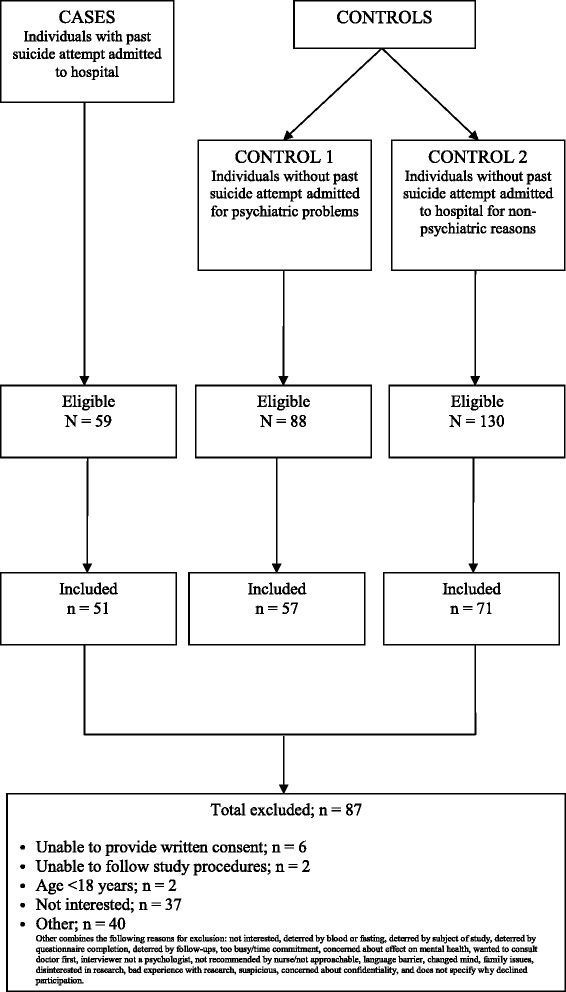
This pilot study was a case-control study of participants with recent (within 1 month of admission) suicide attempts admitted to hospital and compared to two control groups: 1) psychiatric inpatient participants without a history of suicide attempts and 2) community-based controls. We collected information on demographic variables, circumstances of suicide attempts (for cases), medical and psychiatric diagnoses, behavioral patterns, physical measurements, and social factors. Blood and urine samples were also collected for biological markers. Feasibility outcomes are as follows: 1) 50 % of all eligible cases will consent to participate, 2) 50 cases and 100 controls per year can be recruited, and 3) at least 80 % of the participants will provide blood samples for DNA and biological markers.
We recruited 179 participants in total; 51 cases, 57 psychiatric controls without suicide attempt, and 71 non-psychiatric controls in Hamilton, Ontario. Recruitment rate was 70 % (213/304), and we obtained urine and blood specimens from 90 % (191/213) of participants. Questionnaire completion rates were high, and data quality was very good with few data-related queries to resolve. We learned that cases tended to be hospitalized for long periods of time and the suicide attempt occurred more than a month ago in many of the cases; therefore, we expanded our inclusion criterion related to timing of suicide attempt to 3 months instead of 1 month.
The study procedures needed certain modifications including extending the time between suicide attempt and date of recruitment, and more detailed questionnaires related to diet were necessary while other questionnaires such as social support needed to be shortened. Overall, this study showed that it is feasible to conduct a larger-scale study.
自杀行为是一个日益严重的公共卫生问题,会导致发病和过早死亡。尽管年龄、性别和精神障碍等某些因素一直被报道与自杀行为有关,但其他因素,包括生物标志物、饮食和身体活动,也可能影响自杀行为。这项初步研究的目的是评估开展一项全面研究以确定近期有自杀未遂行为的个体中自杀行为的传统和新风险因素的可行性。
这项初步研究是一项病例对照研究,研究对象为近期(入院1个月内)有自杀未遂行为并入住医院的参与者,并与两个对照组进行比较:1)无自杀未遂史的精神科住院患者和2)社区对照组。我们收集了人口统计学变量、自杀未遂情况(针对病例)、医学和精神科诊断、行为模式、身体测量数据以及社会因素等信息。还采集了血液和尿液样本以检测生物标志物。可行性结果如下:1)所有符合条件的病例中有50%将同意参与;2)每年可招募50例病例和100名对照;3)至少80%的参与者将提供血液样本用于DNA和生物标志物检测。
我们总共招募了179名参与者;安大略省汉密尔顿市有51例病例、57名无自杀未遂史的精神科对照和71名非精神科对照。招募率为70%(213/304),我们从90%(191/213)的参与者那里获得了尿液和血液样本。问卷完成率很高,数据质量非常好,几乎没有与数据相关的问题需要解决。我们了解到病例往往住院时间较长,而且许多病例的自杀未遂发生在一个多月前;因此,我们将与自杀未遂时间相关的纳入标准扩大到3个月而不是1个月。
研究程序需要进行某些修改,包括延长自杀未遂与招募日期之间的时间间隔,需要更详细的饮食相关问卷,而其他问卷,如社会支持问卷则需要缩短。总体而言,这项研究表明开展更大规模的研究是可行的。