Bhatt Meha, Perera Stefan, Zielinski Laura, Eisen Rebecca B, Yeung Sharon, El-Sheikh Wala, DeJesus Jane, Rangarajan Sumathy, Sholer Heather, Iordan Elizabeth, Mackie Pam, Islam Shofiqul, Dehghan Mahshid, Thabane Lehana, Samaan Zainab
Department of Clinical Epidemiology and Biostatistics McMaster University, Hamilton, Ontario, Canada.
MiNDS Neuroscience Graduate Program, McMaster University, Hamilton, Ontario, Canada.
PLoS One. 2018 Feb 22;13(2):e0192998. doi: 10.1371/journal.pone.0192998. eCollection 2018.
Suicidal behaviour remains challenging for clinicians to predict, with few established risk factors and warning signs among psychiatric patients.
We aimed to describe characteristics and identify risk factors for suicide attempts among patients with psychiatric disorders.
Multivariable logistic regression analysis, adjusted for clinically important confounders, was employed to determine risk factors for suicide attempts within a psychiatric patient population.
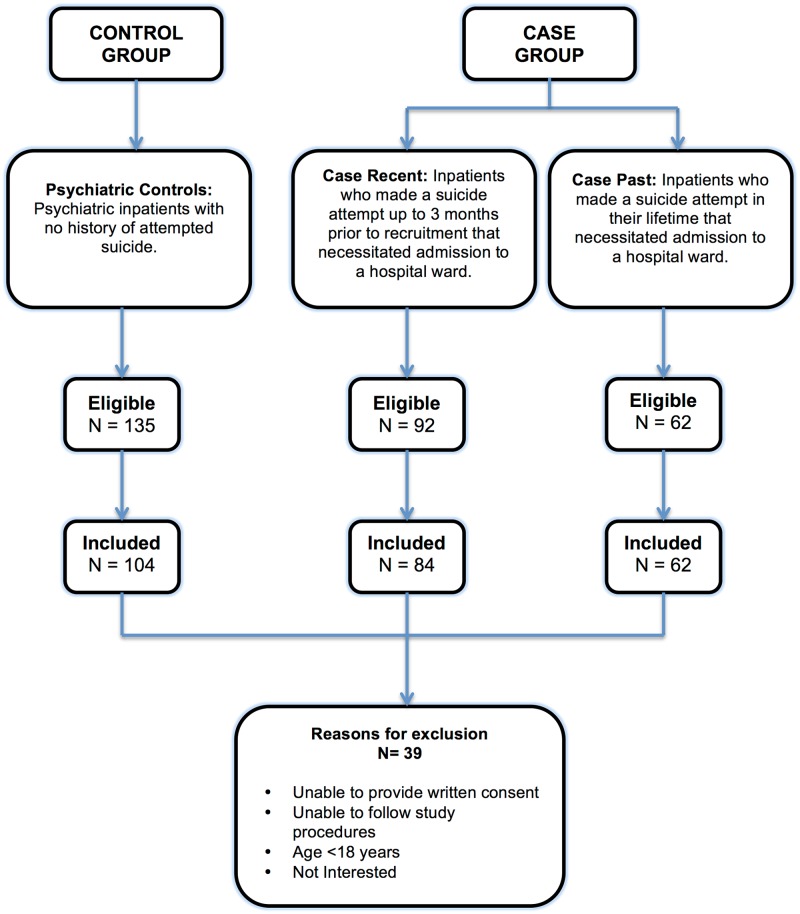
The case (n = 146) and control groups (n = 104) did not differ significantly with regards to sociodemographic characteristics. The majority of the participants who had attempted suicide did so with high intent to die, and expected to die without medical intervention. The primary method of attempt was pharmaceutical overdose among the case participants (73.3%). Results showed impulsivity (odds ratio [OR] = 1.15, 95% confidence interval [CI] = 1.03-1.30) and borderline personality symptoms (OR = 1.07, 95% CI = 1.01-1.13) were significantly associated with attempted suicide.
Our findings indicate that known sociodemographic risk factors for suicide may not apply within psychiatric populations. Prevention strategies for suicidal behaviour in psychiatric patients may be effective, including limited access to means for suicide attempts (i.e. excess pharmaceutical drugs) and target screening for high-risk personality and impulsivity traits.
对临床医生而言,预测自杀行为仍然具有挑战性,在精神科患者中,既定的风险因素和警示信号很少。
我们旨在描述精神障碍患者自杀未遂的特征并确定其风险因素。
采用多变量逻辑回归分析,并对具有临床重要性的混杂因素进行校正,以确定精神科患者群体中自杀未遂的风险因素。
病例组(n = 146)和对照组(n = 104)在社会人口统计学特征方面无显著差异。大多数自杀未遂的参与者自杀意图强烈,预计在无医疗干预的情况下死亡。病例组参与者自杀的主要方式是过量服药(73.3%)。结果显示,冲动性(比值比[OR]=1.15,95%置信区间[CI]=1.03 - 1.30)和边缘型人格症状(OR = 1.07,95%CI = 1.01 - 1.13)与自杀未遂显著相关。
我们的研究结果表明,已知的自杀社会人口统计学风险因素可能不适用于精神科人群。针对精神科患者自杀行为的预防策略可能是有效的,包括限制获取自杀手段(如过量药物)以及针对高风险人格和冲动性特质进行筛查。