Seebacher Barbara, Kuisma Raija, Glynn Angela, Berger Thomas
University of Brighton, School of Health Sciences, Robert Dodd Building, 49 Darley Road, Eastbourne, BN20 7UR UK.
Clinical Department of Neurology, Medical University of Innsbruck, Anichstrasse 35, 6020 Innsbruck, Austria.
Pilot Feasibility Stud. 2015 Jul 11;1:25. doi: 10.1186/s40814-015-0021-3. eCollection 2015.
Novel physiotherapy approaches such as motor imagery and rhythmic auditory stimulation have been shown to improve walking in people with multiple sclerosis (MS). Rhythmic cued motor imagery was used in this study, whose objectives were to evaluate the feasibility of a larger randomised controlled trial (RCT) in people with MS and to obtain information on walking.
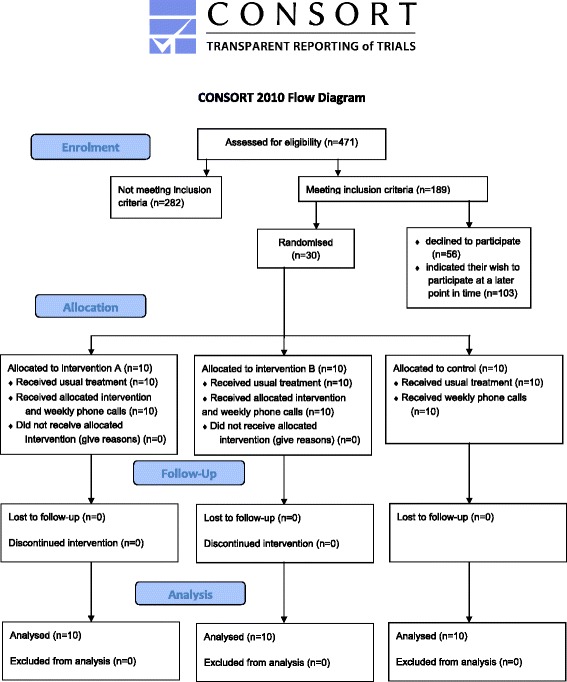
Thirty adult people with MS who scored 1.5-4.5 on the Expanded Disability Status Scale were recruited at the MS Clinic Innsbruck, Austria. Participants were randomly allocated to one of three groups, all receiving usual care: 17 min of motor imagery, six times per week, for 4 weeks, with music (A) or metronome cues (B) and (C) controls. Primary outcomes were recruitment rates, retention, compliance, adverse events and fatigue (Modified Fatigue Impact Scale). Secondary outcomes were walking speed (Timed 25-Foot Walk) and walking distance (6-Minute Walk Test).
We achieved our recruitment target by recruiting 12 participants per month, a mean eligibility rate of 40.1 % (95 % confidence interval (CI) 35.8, 44.6 %) out of 2500 MS Centre patients, mean consent rate of 15.9 % (95 % CI 11.3, 21.7 %) plus 54.5 % (95 % CI 47.4, 61.4 %) of eligible patients who expressed their interest to participate. Retention of 100 %, no adverse events, good compliance, high acceptability of the interventions and no worsening of fatigue confirmed feasibility. The mean improvement in walking speed in both groups A and B was -0.9 s (95 % CI -1.3, -0.5), and mean worsening in group C was 0.4 s (95 % CI -0.3, 1.1). The mean improvement in walking distance in group A was 68.1 m (95 % CI 51.4, 84.7) and in group B 92.9 m (95 % CI 55.2, 130.5), and mean worsening in group C was -9.4 m (95 % CI -35.6, 16.9).
Results from our study showed that a full-scale RCT is feasible to investigate the effects of rhythmic cued motor imagery on walking in people with MS, with no changes to the interventions and assessments. Based on the walking improvements, a total sample size of 138 participants was calculated. Stratified blocked randomisation, allocation concealment and blinding will be used in the main study.
ISRCTN: ISRCTN67054113.
诸如运动想象和节奏性听觉刺激等新型物理治疗方法已被证明可改善多发性硬化症(MS)患者的行走能力。本研究采用了节奏性提示运动想象,其目的是评估在MS患者中开展更大规模随机对照试验(RCT)的可行性,并获取有关行走的信息。
在奥地利因斯布鲁克的MS诊所招募了30名成年MS患者,他们在扩展残疾状态量表上的得分在1.5至4.5之间。参与者被随机分配到三个组中的一组,所有组均接受常规护理:A组进行17分钟的运动想象,每周六次,共4周,伴有音乐;B组和C组为对照组,分别伴有节拍器提示。主要结局指标为招募率、保留率、依从性、不良事件和疲劳(改良疲劳影响量表)。次要结局指标为步行速度(25英尺计时步行)和步行距离(6分钟步行试验)。
我们通过每月招募12名参与者实现了招募目标,在2500名MS中心患者中,平均合格率为40.1%(95%置信区间(CI)35.8,44.6%),平均同意率为15.9%(95%CI 11.3,21.7%),另外有54.5%(95%CI 47.4,61.4%)表达了参与意向的合格患者。100%的保留率、无不良事件、良好的依从性、干预措施的高可接受性以及疲劳无恶化证实了可行性。A组和B组的步行速度平均改善为-0.9秒(95%CI -1.3,-0.5),C组平均恶化0.4秒(95%CI -0.3,1.1)。A组的步行距离平均改善为68.1米(95%CI 51.4,84.7),B组为92.9米(95%CI 55.2,130.5),C组平均恶化-9.4米(95%CI -35.6,16.9)。
我们的研究结果表明,开展一项全面的RCT来研究节奏性提示运动想象对MS患者行走的影响是可行的,且干预措施和评估无需改变。基于行走能力的改善情况,计算出总样本量为138名参与者。在主要研究中将采用分层区组随机化、分配隐藏和盲法。
ISRCTN:ISRCTN67054113