
调强放射治疗时代鼻咽癌T和N分期系统更新的建议
Recommendations for Updating T and N Staging Systems for Nasopharyngeal Carcinoma in the Era of Intensity-Modulated Radiotherapy.
作者信息
Liang Zhong-Guo, Chen Xiao-Qian, Niu Zhi-Jie, Chen Kai-Hua, Li Ling, Qu Song, Su Fang, Zhao Wei, Li Ye, Pan Xin-Bin, Zhu Xiao-Dong
机构信息
Department of Radiation Oncology, The Affiliated Tumor Hospital of Guangxi Medical University, Cancer Institute of Guangxi Zhuang Autonomous Region, Nanning, P.R. China.
出版信息
PLoS One. 2016 Dec 14;11(12):e0168470. doi: 10.1371/journal.pone.0168470. eCollection 2016.
OBJECTIVE
The aim of this study was to compare the 2008 Chinese and the 7th edition of the American Joint Committee on Cancer (AJCC) staging systems for nasopharyngeal carcinoma and to provide proposals for updating T and N staging systems of the present staging system.
METHODS
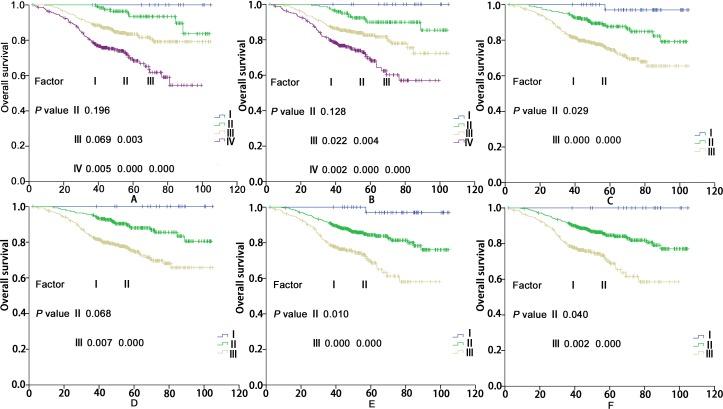
Between January 2007 and December 2012, a cohort of 752 patients with biopsy-proven, newly diagnosed, non-metastatic nasopharyngeal carcinoma who were treated with intensity-modulated radiotherapy were retrospectively analysed. Prognoses were compared by T stage, N stage, and clinical stage according to the two staging systems for overall survival (OS), local relapse-free survival (LRFS), and distant metastasis-free survival (DMFS).
RESULTS
In terms of both the T and N staging systems, the two current staging systems were comparable in predicting OS. The T classification of the 2008 Chinese staging system was better in predicting LRFS, while the N classification of the 7th edition AJCC staging system was superior in predicting DMFS. In the modern era of intensity-modulated radiotherapy, the staging system should be updated by down-staging the current stage T2 to T1, and it might be rational to merge subcategories N1 and N2.
CONCLUSIONS
The two current staging systems each had advantages in predicting prognosis. It seems reasonable to downstage T2 to T1 and to merge N1 and N2.
目的
本研究旨在比较2008年中国版和美国癌症联合委员会(AJCC)第7版鼻咽癌分期系统,并为现行分期系统的T和N分期系统更新提供建议。
方法
回顾性分析2007年1月至2012年12月期间752例经活检证实、新诊断、非转移性鼻咽癌患者,这些患者接受了调强放疗。根据两种分期系统的T分期、N分期和临床分期,比较总生存期(OS)、局部无复发生存期(LRFS)和远处无转移生存期(DMFS)的预后情况。
结果
就T和N分期系统而言,两种现行分期系统在预测OS方面具有可比性。2008年中国分期系统的T分类在预测LRFS方面更好,而第7版AJCC分期系统的N分类在预测DMFS方面更优。在调强放疗的现代时代,分期系统应通过将当前的T2期降为T1期进行更新,合并N1和N2亚类可能是合理的。
结论
两种现行分期系统在预测预后方面各有优势。将T2降为T1并合并N1和N2似乎是合理的。


 Zotero 插件