Kollmann Martin, Schmidt Rovenna, Heuer Carsten M, Schachtner Joachim
Department of Biology-Animal Physiology, Philipps-University Marburg, Marburg, Germany.
Institute of Veterinary Anatomy, Histology and Embryology, Justus-Liebig University Gießen, Gießen, Germany.
PLoS One. 2016 Dec 14;11(12):e0166253. doi: 10.1371/journal.pone.0166253. eCollection 2016.
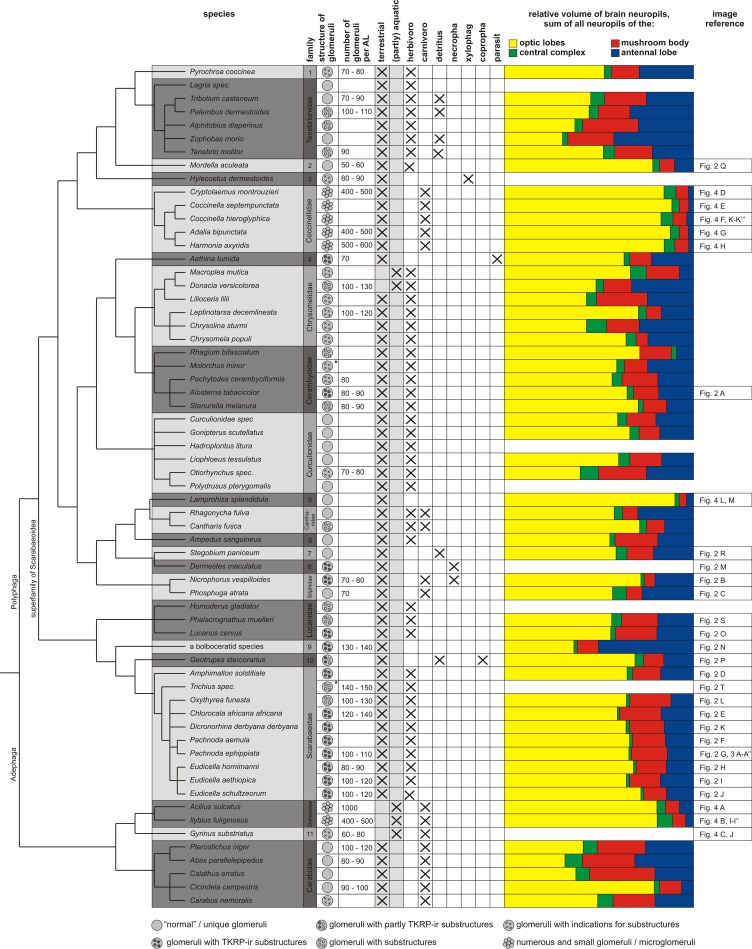
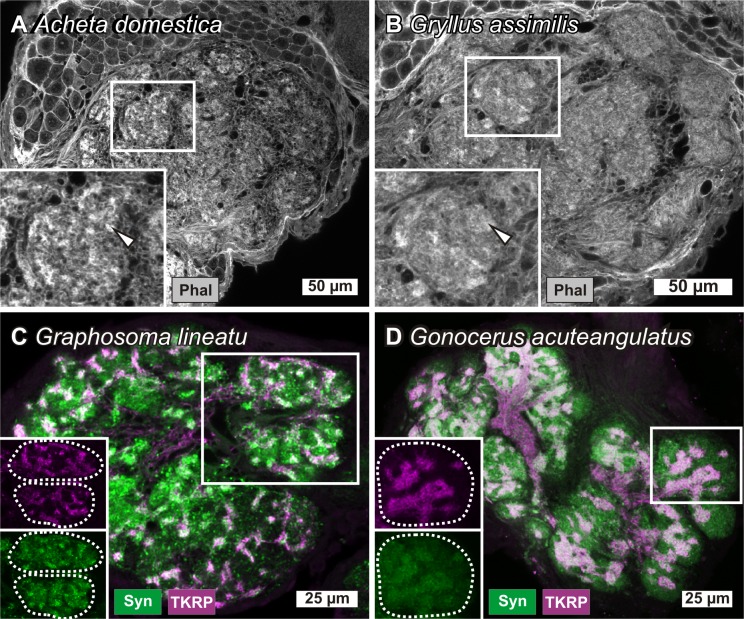
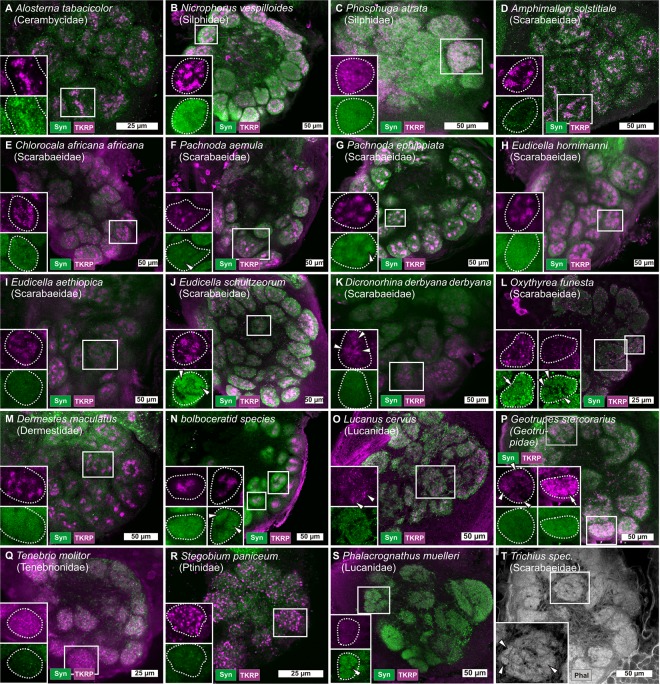
Beetles comprise about 400,000 described species, nearly one third of all known animal species. The enormous success of the order Coleoptera is reflected by a rich diversity of lifestyles, behaviors, morphological, and physiological adaptions. All these evolutionary adaptions that have been driven by a variety of parameters over the last about 300 million years, make the Coleoptera an ideal field to study the evolution of the brain on the interface between the basic bauplan of the insect brain and the adaptions that occurred. In the current study we concentrated on the paired antennal lobes (AL), the part of the brain that is typically responsible for the first processing of olfactory information collected from olfactory sensilla on antenna and mouthparts. We analyzed 63 beetle species from 22 different families and thus provide an extensive comparison of principal neuroarchitecture of the AL. On the examined anatomical level, we found a broad diversity including AL containing a wide range of glomeruli numbers reaching from 50 to 150 glomeruli and several species with numerous small glomeruli, resembling the microglomerular design described in acridid grasshoppers and diving beetles, and substructures within the glomeruli that have to date only been described for the small hive beetle, Aethina tumida. A first comparison of the various anatomical features of the AL with available descriptions of lifestyle and behaviors did so far not reveal useful correlations. In summary, the current study provides a solid basis for further studies to unravel mechanisms that are basic to evolutionary adaptions of the insect olfactory system.
甲虫包含约40万种已被描述的物种,几乎占所有已知动物物种的三分之一。鞘翅目昆虫的巨大成功体现在其丰富多样的生活方式、行为、形态和生理适应性上。在过去约3亿年里,由各种参数驱动的所有这些进化适应性,使鞘翅目成为研究昆虫大脑基本结构与所发生适应性之间界面上大脑进化的理想领域。在当前的研究中,我们专注于成对的触角叶(AL),它是大脑中通常负责对从触角和口器上的嗅觉感受器收集到的嗅觉信息进行初步处理的部分。我们分析了来自22个不同科的63种甲虫,从而对触角叶的主要神经结构进行了广泛比较。在检查的解剖学层面上,我们发现了广泛的多样性,包括触角叶含有50到150个不等数量的小球,还有几种具有许多小的小球,类似于在蝗科蝗虫和龙虱中描述的微小球设计,以及小球内的亚结构,迄今为止仅在小蜂房甲虫(Aethina tumida)中有过描述。到目前为止,将触角叶的各种解剖特征与现有的生活方式和行为描述进行首次比较,尚未发现有用的相关性。总之,当前的研究为进一步研究揭示昆虫嗅觉系统进化适应性的基本机制提供了坚实的基础。