Zhang Silong, Wang Zhiyong, Hu Zhiye, Li Changhao, Tang Chu, Carlson Kathryn E, Luo Junjie, Dong Chune, Katzenellenbogen John A, Huang Jian, Zhou Hai-Bing
State Key Laboratory of Virology, Key Laboratory of Combinatorial Biosynthesis and Drug Discovery, Wuhan University, Ministry of Education, Wuhan University School of Pharmaceutical Sciences, 185 East Lake Road, Wuhan, 430071, P.R. China.
College of Life Sciences, Wuhan University, No. 299 Bayi Road, Wuhan, 430072, P.R. China.
ChemMedChem. 2017 Feb 3;12(3):235-249. doi: 10.1002/cmdc.201600593. Epub 2017 Jan 9.
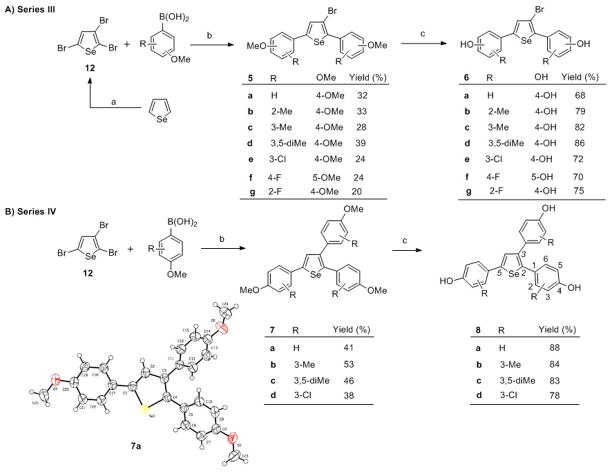
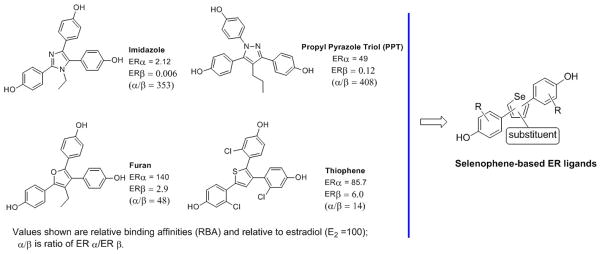
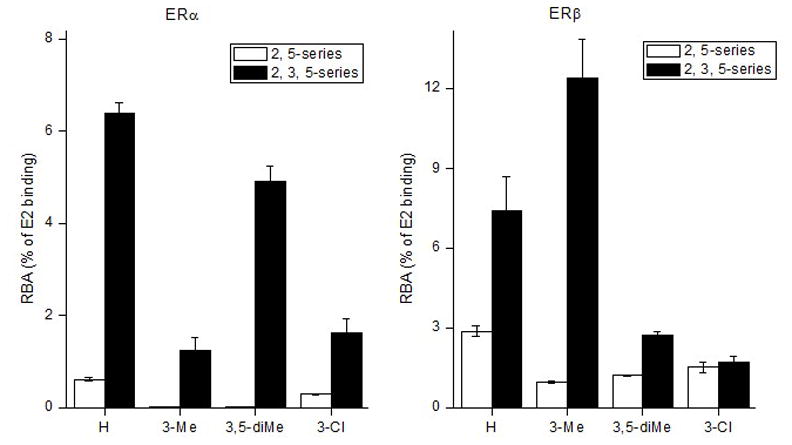
The importance of the heterocyclic core elements with peripheral phenolic and alkyl substituents as a dominant structural motif of ligands for the estrogen receptor (ER) has been well recognized. In this study we expanded the structural diversity of core elements by preparing selenium-containing heterocycles and exploring the activities of these selenophenes on the two ERs, ERα and ERβ. Careful structure-activity relationship (SAR) analysis of their ER binding affinities showed that most selenophenes are ERβ-selective, with the position of the phenol substituents on the selenophene core and the nature of these substituents having a marked effect on their binding affinities. The compound bis(2-fluoro-4-hydroxyphenyl)selenophene (2 f) has the highest relative binding affinity (RBA) of 24.3 for ERβ. In transcription assays, most selenophenes were found to exhibit partial to full agonist activity for both ER subtypes, with compounds bis(2-methyl-4-hydroxyphenyl)selenophene (2 b), bis(4-fluoro-3-hydroxyphenyl)3-bromoselenophene (6 f), and 2,3,5-tris(hydroxyphenyl)thiophenes (8 b and 8 d) profiling as superagonists for ERα; however, several compounds display a range of ERα or ERβ antagonistic activities. A few selenophenes exhibited antiproliferative activity, with compound 8 c showing antiproliferative effects similar to that of 4-hydroxytamoxifen in breast cancer MCF-7 cells while being nontoxic to normal VERO cells. These new ligands could act as models for the development of novel agents leading to improved therapeutics that target the estrogen receptor.
具有外围酚基和烷基取代基的杂环核心元素作为雌激素受体(ER)配体的主要结构基序的重要性已得到充分认识。在本研究中,我们通过制备含硒杂环并探索这些硒吩对两种ER(ERα和ERβ)的活性,扩展了核心元素的结构多样性。对它们与ER结合亲和力的仔细构效关系(SAR)分析表明,大多数硒吩具有ERβ选择性,硒吩核心上酚取代基的位置及其取代基的性质对它们的结合亲和力有显著影响。化合物双(2-氟-4-羟基苯基)硒吩(2f)对ERβ的相对结合亲和力(RBA)最高,为24.3。在转录试验中,发现大多数硒吩对两种ER亚型均表现出部分至完全激动剂活性,化合物双(2-甲基-4-羟基苯基)硒吩(2b)、双(4-氟-3-羟基苯基)3-溴硒吩(6f)和2,3,5-三(羟基苯基)噻吩(8b和8d)被鉴定为ERα的超级激动剂;然而,几种化合物表现出一系列的ERα或ERβ拮抗活性。一些硒吩表现出抗增殖活性,化合物8c在乳腺癌MCF-7细胞中显示出与4-羟基他莫昔芬相似的抗增殖作用,而对正常VERO细胞无毒。这些新的配体可作为开发新型药物的模型,从而实现针对雌激素受体的改进治疗方法。