Guillemaud Thomas, Lombaert Eric, Bourguet Denis
Inra, Univ. Nice Sophia Antipolis, CNRS, UMR 1355-7254 Institut Sophia Agrobiotech, Sophia Antipolis, France.
Inra, UMR 1062 Centre de Biologie pour la Gestion des Populations (CBGP) Inra-IRD-CIRAD-Montpellier SupAgro, 755 avenue du Campus Agropolis, CS, Montferrier / Lez cedex. France.
PLoS One. 2016 Dec 15;11(12):e0167777. doi: 10.1371/journal.pone.0167777. eCollection 2016.
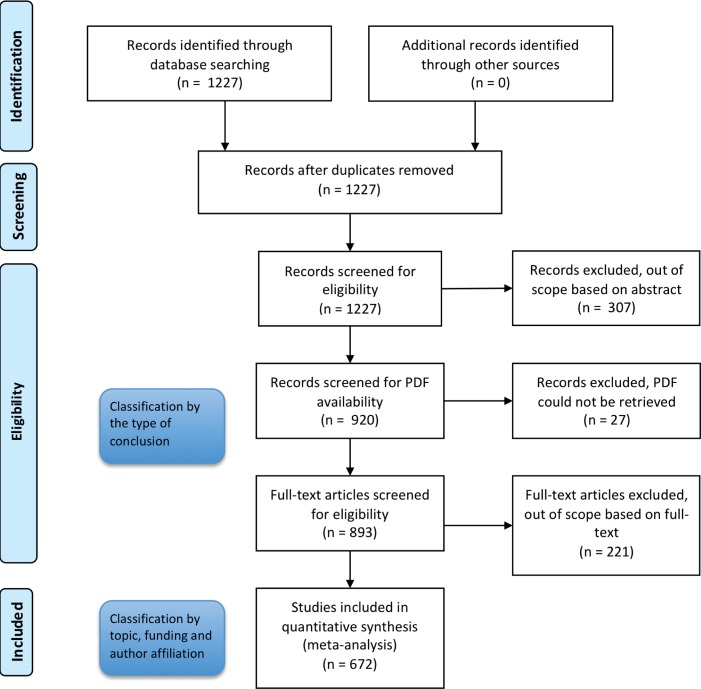
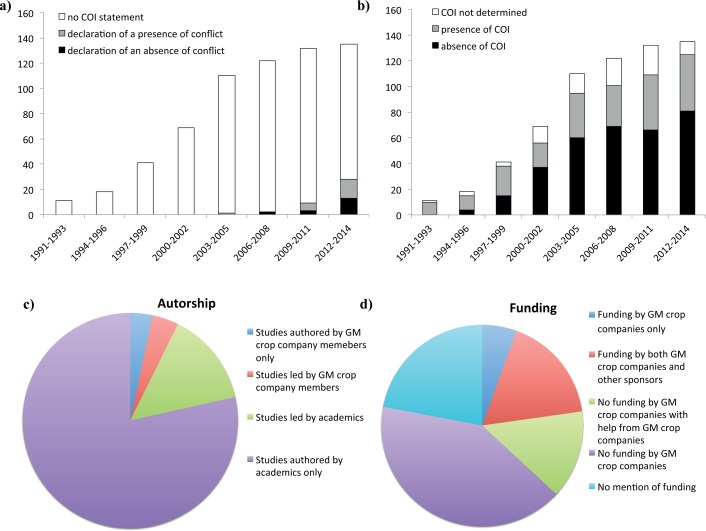
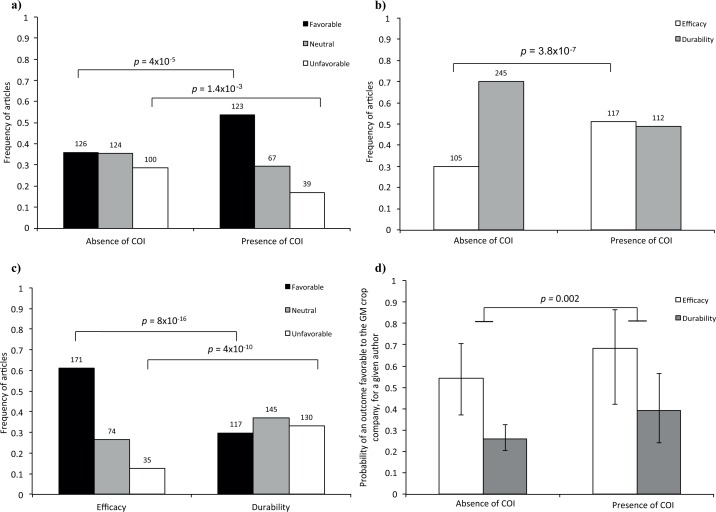
Public confidence in genetically modified (GM) crop studies is tenuous at best in many countries, including those of the European Union in particular. A lack of information about the effects of ties between academic research and industry might stretch this confidence to the breaking point. We therefore performed an analysis on a large set of research articles (n = 672) focusing on the efficacy or durability of GM Bt crops and ties between the researchers carrying out these studies and the GM crop industry. We found that ties between researchers and the GM crop industry were common, with 40% of the articles considered displaying conflicts of interest (COI). In particular, we found that, compared to the absence of COI, the presence of a COI was associated with a 50% higher frequency of outcomes favorable to the interests of the GM crop company. Using our large dataset, we were able to propose possible direct and indirect mechanisms behind this statistical association. They might notably include changes of authorship or funding statements after the results of a study have been obtained and a choice in the topics studied driven by industrial priorities.
在包括欧盟各国在内的许多国家,公众对转基因作物研究的信心充其量也很脆弱。缺乏关于学术研究与产业之间关系影响的信息可能会使这种信心达到崩溃的边缘。因此,我们对大量研究文章(n = 672)进行了分析,重点关注转基因Bt作物的功效或持久性以及开展这些研究的研究人员与转基因作物产业之间的关系。我们发现研究人员与转基因作物产业之间的关系很常见,40%的文章被认为存在利益冲突(COI)。特别是,我们发现,与不存在利益冲突相比,存在利益冲突与对转基因作物公司利益有利的结果出现频率高出50%有关。利用我们的大型数据集,我们能够提出这种统计关联背后可能的直接和间接机制。它们可能尤其包括在获得研究结果后作者身份或资金声明的变化,以及由产业优先事项驱动的研究主题选择。