Kawajiri Kaname, Fujii-Kuriyama Yoshiaki
Research Institute for Clinical Oncology, Saitama Cancer Center, 818 Komuro, Ina-machi, Saitama 362-0806, Japan.
Medical Research Institute, Tokyo Medical and Dental University, 1-5-45 Yushima, Bunkyo-ku, Tokyo 113-8510, Japan.
Exp Anim. 2017 May 3;66(2):75-89. doi: 10.1538/expanim.16-0092. Epub 2016 Dec 15.
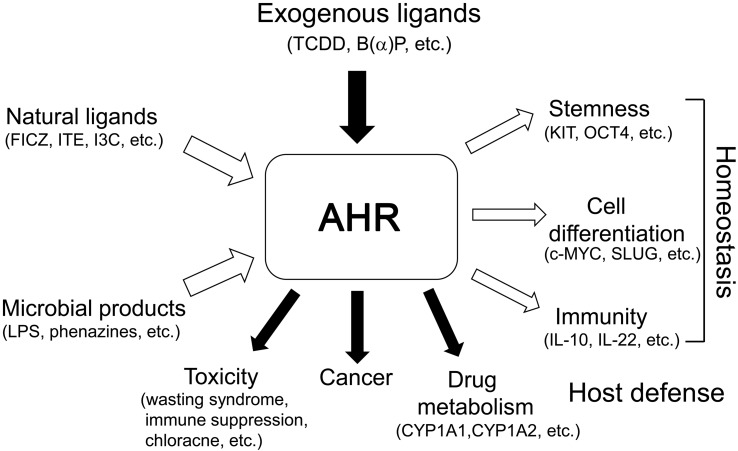
The aryl hydrocarbon receptor (AHR) is a pivotal chemical sensor that transduces extrinsic and intrinsic signals into cellular responses. AHR was originally thought to be involved in not only drug metabolism but also carcinogenic and toxicological responses against environmental contaminants, such as 2,3,7,8-tetrachlorodibenzo-p-dioxin (TCDD) and polycyclic aromatic hydrocarbons. However, recent studies demonstrate that the AHR plays multiple intrinsic roles in host defense and homeostasis as well, including immunity, stem cell maintenance, and cell differentiation, upon binding with an increasing number of newly defined dietary, cellular, and microbe-derived ligands. In addition, AHR is a convergence point for several signaling cascades, which may be involved in the diverse diseases caused by binding of the persistent ligand TCDD with extremely high affinity to AHR. A comprehensive understanding of physiological and pathological processes initiated by endogenous AHR agonists and antagonists may allow for the therapeutic regulation of AHR activity. Thus, the AHR can be a valuable diagnostic marker and therapeutic target for human diseases.
芳基烃受体(AHR)是一种关键的化学传感器,可将外在和内在信号转化为细胞反应。AHR最初被认为不仅参与药物代谢,还参与针对环境污染物(如2,3,7,8-四氯二苯并对二恶英(TCDD)和多环芳烃)的致癌和毒理学反应。然而,最近的研究表明,AHR在与越来越多新定义的饮食、细胞和微生物衍生配体结合后,在宿主防御和体内平衡中也发挥着多种内在作用,包括免疫、干细胞维持和细胞分化。此外,AHR是几个信号级联反应的汇聚点,这些信号级联反应可能与持久性配体TCDD以极高亲和力与AHR结合所导致的多种疾病有关。对内源性AHR激动剂和拮抗剂引发的生理和病理过程的全面理解可能有助于对AHR活性进行治疗性调节。因此,AHR可以成为人类疾病的有价值的诊断标志物和治疗靶点。