Silva Aldo Coelho, Dos Santos Ferreira Sandro, Alves Ragami Chaves, Follador Lucio, DA Silva Sergio Gregorio
Department of Physical Education from Federal University of Paraná, Curitiba, Paraná, Brazil.
Int J Exerc Sci. 2016 Oct 1;9(4):536-544. doi: 10.70252/JWPC6094. eCollection 2016.
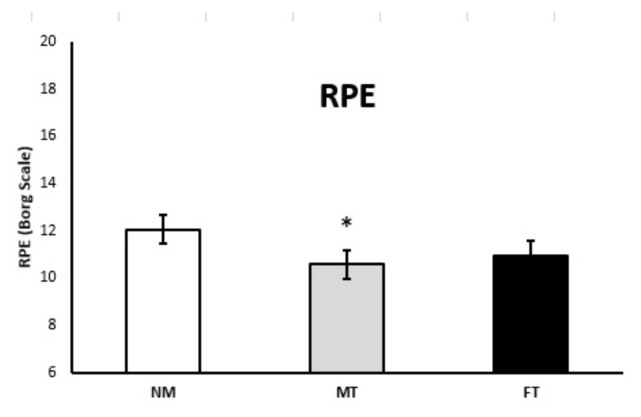
This study investigated the influence of music on the rating of perceived exertion (RPE) and attentional focus during walking at a self-selected pace. Fifteen overweight and obese women volunteered to participate in the study. They underwent four sessions: the first for incremental maximal test and anthropometric measurement followed by three experimental sessions. After the first session, they were exposed to three 30-minute walking sessions at a self-selected pace in a counterbalanced order: fast-tempo music (FT), medium-tempo music (MT) and no-music control (NM). Borg's RPE Scale and an Attentional Focus Questionnaire were used to measure the perceptual response and attentional focus, respectively. Results showed that the RPE was higher in the no-music control than in the medium-tempo music (12.05 ± 0.6 vs. 10.5 ± 0.5). Furthermore, dissociative attentional focus was greater for both conditions with music in comparison with the no-music control (NM= 39.0 ± 4.1; MT= 48.4 ± 4.1 and FT= 47.9 ± 4.5). The results indicated that the use of music during walking can modulate attentional focus, increasing dissociative thought, and medium-tempo music can reduce the RPE.
本研究调查了音乐对以自选步速行走时的主观用力感觉评分(RPE)和注意力焦点的影响。15名超重和肥胖女性自愿参与该研究。她们进行了四个阶段:第一个阶段是递增最大测试和人体测量,随后是三个实验阶段。在第一个阶段之后,她们以平衡的顺序进行了三个30分钟的自选步速行走阶段:快节奏音乐(FT)、中节奏音乐(MT)和无音乐对照(NM)。分别使用Borg的RPE量表和注意力焦点问卷来测量感知反应和注意力焦点。结果显示,无音乐对照组的RPE高于中节奏音乐组(12.05±0.6对10.5±0.5)。此外,与无音乐对照相比,两种有音乐的条件下的解离性注意力焦点都更大(无音乐对照=39.0±4.1;中节奏音乐=48.4±4.1,快节奏音乐=47.9±4.5)。结果表明,行走时使用音乐可以调节注意力焦点,增加解离性思维,并且中节奏音乐可以降低RPE。