Smith Sunny, Malinak David, Chang Jinnie, Perez Maria, Perez Sandra, Settlecowski Erica, Rodriggs Timothy, Hsu Ming, Abrew Alexandra, Aedo Sofia
Department of Family Medicine and Public Health, University of California San Diego (UCSD), 9500 Gilman Drive #0696, La Jolla, CA 92093-0696, USA; University of California San Diego (UCSD) School of Medicine, 9500 Gilman Drive #0696, La Jolla, CA 92093-0696, USA; University of California San Diego (UCSD) Student-Run Free Clinic Project, 9500 Gilman Drive #0696, La Jolla, CA 92093-0696, USA.
University of California San Diego (UCSD) School of Medicine, 9500 Gilman Drive #0696, La Jolla, CA 92093-0696, USA.
Prev Med Rep. 2016 Dec 8;5:134-139. doi: 10.1016/j.pmedr.2016.12.007. eCollection 2017 Mar.
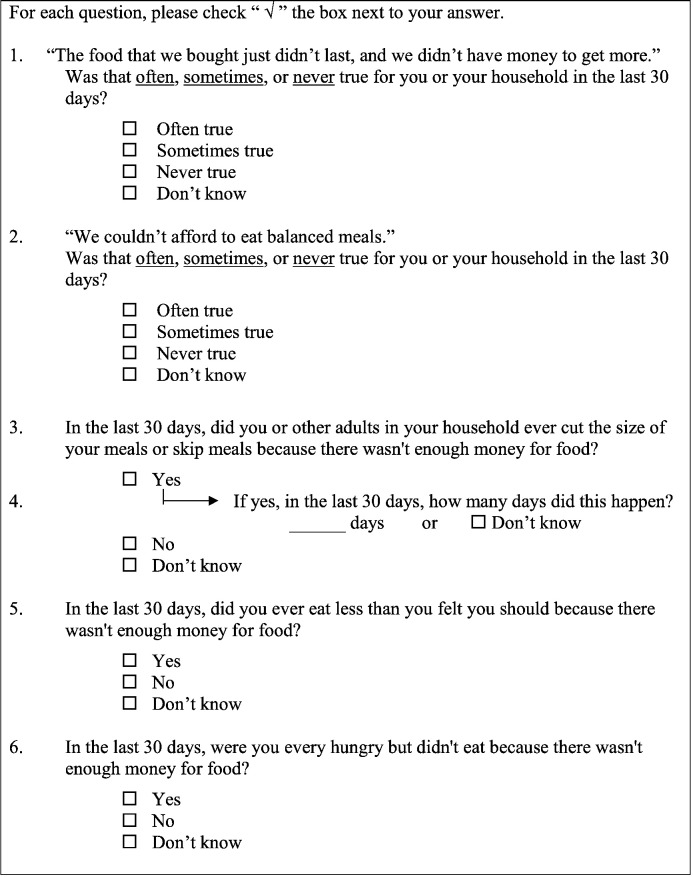
Food insecurity is associated with many poor health outcomes yet is not routinely addressed in clinical settings. The purpose of this study was to implement a food insecurity screening and referral program in Student-run Free Clinics (SRFC) and to document the prevalence of food insecurity screening in this low-income patient population. All patients seen in three SRFC sites affiliated with one institution in San Diego, California were screened for food insecurity using the 6-item United States Department of Agriculture (USDA) Food Security Survey between January and July 2015 and referred to appropriate resources. The percentage of patients who were food insecure was calculated. The screening rate was 92.5% (430/463 patients), 74.0% (318/430) were food insecure, including 30.7% (132/430) with very low food security. A food insecurity registry and referral tracking system revealed that by January 2016, 201 participants were receiving monthly boxes of food onsite, 66 used an off-site food pantry, and 64 were enrolled in the Supplemental Nutrition Assistance Program (SNAP). It is possible to implement a food insecurity screening and referral program into SRFCs. The prevalence of food insecurity in this population was remarkably high yet remained largely unknown until this program was implemented. Other health care settings, particularly those with underserved patient populations, should consider implementing food insecurity screening and referral programs.
粮食不安全与许多不良健康结果相关,但在临床环境中却未得到常规处理。本研究的目的是在学生运营的免费诊所(SRFC)中实施一项粮食不安全筛查和转诊计划,并记录该低收入患者群体中粮食不安全筛查的患病率。2015年1月至7月期间,对加利福尼亚州圣地亚哥一家机构附属的三个SRFC站点的所有就诊患者,使用美国农业部(USDA)的6项粮食安全调查问卷进行粮食不安全筛查,并转介至适当的资源处。计算粮食不安全患者的百分比。筛查率为92.5%(463名患者中的430名),74.0%(430名中的318名)粮食不安全,其中30.7%(430名中的132名)粮食安全程度极低。一个粮食不安全登记和转诊跟踪系统显示,到2016年1月,201名参与者在现场每月领取食品盒,66人使用场外食品储藏室,64人参加了补充营养援助计划(SNAP)。在SRFC中实施粮食不安全筛查和转诊计划是可行的。在实施该计划之前,该人群中粮食不安全的患病率极高,但在很大程度上仍不为人知。其他医疗保健机构,特别是那些服务不足患者群体的机构,应考虑实施粮食不安全筛查和转诊计划。