
运用三延迟模型审视印度尼西亚的民事登记障碍。
Using the Three Delays Model to Examine Civil Registration Barriers in Indonesia.
作者信息
Bennouna Cyril, Feldman Brooke, Usman Rahmadi, Adiputra Rama, Kusumaningrum Santi, Stark Lindsay
机构信息
Center on Child Protection and Wellbeing, Universitas Indonesia (PUSKAPA), School of Social and Political Sciences, Depok, Indonesia.
Program on Forced Migration and Health (PFMH), Mailman School of Public Health, Columbia University, New York, NY, United States of America.
出版信息
PLoS One. 2016 Dec 19;11(12):e0168405. doi: 10.1371/journal.pone.0168405. eCollection 2016.
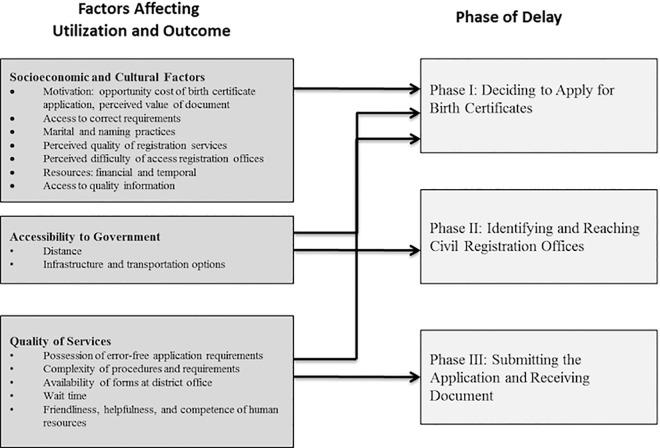
The Three Delays Model has proven a useful framework for examining barriers to seeking obstetric care and preventing maternal and child mortality. This article demonstrates the applicability of the Three Delays Model to the case of civil registration in rural Indonesia and examines ways that efforts to strengthen civil registration services can draw on lessons from maternal and child health programming. Twenty focus group discussions were conducted using a participatory ranking exercise in four Indonesian districts. Focus groups were stratified into four groups: (1) government officials involved in civil registration, (2) civil society organization members that assist communities in civil registration, and (3) female and (4) male community members. Transcripts were analyzed using constant comparative method and thematic analysis, revealing barriers that communities commonly faced in accessing civil registration services. In examining the categories and themes related to these barriers, the research team found a significant overlap with the factors and phases of the Three Delays Model. Participants were delayed from seeking registration services by a range of sociocultural factors and by the perceived inaccessibility and poor quality of services. Once they decided to seek care, long distances to services and poor transportation options delayed their access to registration offices. Finally, a series of bottlenecks in service provision created extended delays once applicants reached registration offices. Ownership of civil registration documents in Indonesia remains exceptionally low, with just over half of children and youth possessing a birth certificate. To strengthen civil registration and health systems more generally, it is important to understand the factors that enable and constrain civil registration, how these factors relate to one another, and how they change over a child's life.
“三个延误”模型已被证明是一个有用的框架,可用于研究寻求产科护理的障碍以及预防母婴死亡。本文展示了“三个延误”模型在印度尼西亚农村民事登记案例中的适用性,并探讨了加强民事登记服务的努力如何借鉴母婴健康项目的经验教训。在印度尼西亚的四个地区,通过参与式排序练习进行了20次焦点小组讨论。焦点小组分为四组:(1)参与民事登记的政府官员,(2)协助社区进行民事登记的民间社会组织成员,以及(3)女性和(4)男性社区成员。使用持续比较法和主题分析法对记录进行了分析,揭示了社区在获得民事登记服务时普遍面临的障碍。在研究与这些障碍相关的类别和主题时,研究团队发现与“三个延误”模型的因素和阶段有显著重叠。一系列社会文化因素以及服务难以获取和质量不佳的认知,使参与者延迟寻求登记服务。一旦他们决定寻求服务,前往服务地点的距离遥远以及交通选择不佳又延误了他们前往登记办公室的时间。最后,申请人到达登记办公室后,服务提供过程中的一系列瓶颈导致了更长时间的延误。印度尼西亚的民事登记文件持有率仍然极低,只有略超过一半的儿童和青年拥有出生证明。为了更全面地加强民事登记和卫生系统,了解促进和限制民事登记的因素、这些因素如何相互关联以及它们在儿童成长过程中如何变化非常重要。
 Zotero 插件