Cheong Amanda R, Baltazar Mary Anne K
Department of Sociology, The University of British Columbia, 6303 NW Marine Drive, Vancouver, BC V6T 1Z1 Canada.
Faculty of Humanities, Art, and Heritage, Universiti Malaysia Sabah, Kota Kinabalu, Malaysia.
Genus. 2021;77(1):18. doi: 10.1186/s41118-021-00129-3. Epub 2021 Sep 3.
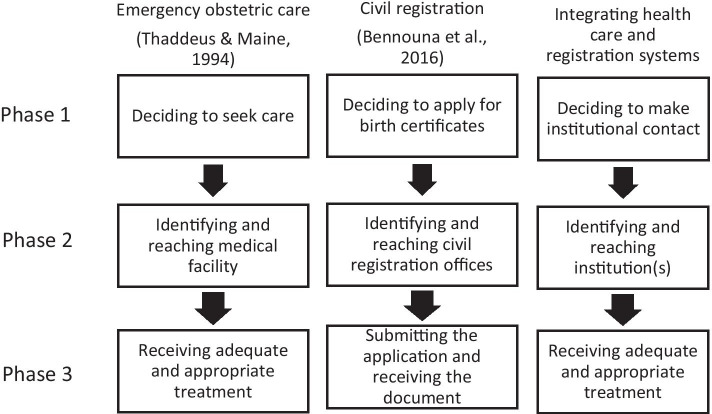
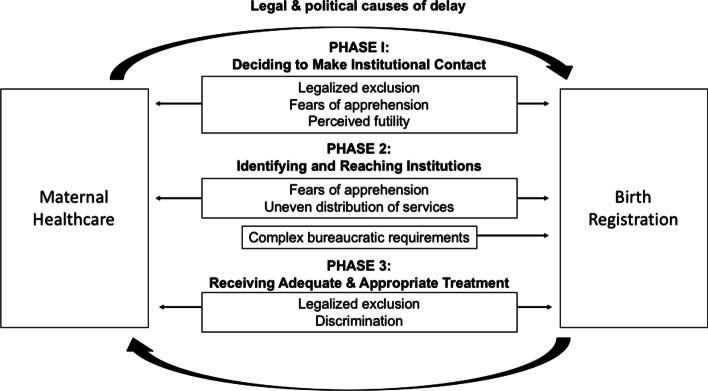
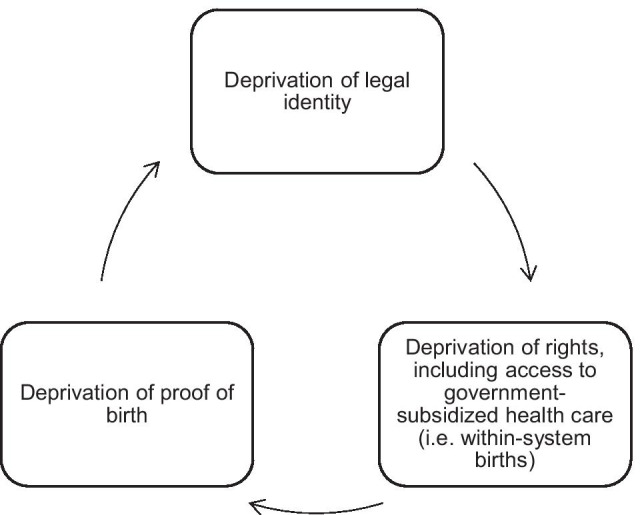
This study extends Thaddeus and Maine's (1994) "three delays" framework to model the interrelated barriers to maternal health care and birth registration. We focus on stateless persons and irregular migrants, populations that are especially at risk of being "left behind" in United Nations member states' efforts to "provide legal identity to all" as part of the 2030 Sustainable Development Agenda. Drawing on qualitative fieldwork conducted in Sabah, Malaysia, we model delays in accessing maternal health care and birth registration as an integrated, cyclical process. We identify the political and legal barriers that stateless or migrant families confront while deciding to make institutional contact (Phase I), identifying and reaching health or registering institutions (Phase II), and receiving adequate and appropriate treatment (Phase III). We find that exclusion from one system raises the risk of exclusion from the other, resulting in a range of negative consequences, including increased health risks, governments' impaired ability to monitor population health, and the perpetuation of intergenerational cycles of legal exclusion.
本研究扩展了萨德厄斯和缅因州(1994年)的“三个延误”框架,以模拟孕产妇保健和出生登记方面的相互关联障碍。我们关注无国籍人士和非正规移民,在联合国会员国为作为2030年可持续发展议程一部分的“为所有人提供合法身份”而做出的努力中,这些人群特别有可能被“落下”。借鉴在马来西亚沙巴进行的定性实地调查,我们将获得孕产妇保健和出生登记方面的延误模拟为一个综合的循环过程。我们确定了无国籍或移民家庭在决定与机构联系(第一阶段)、识别并前往卫生或登记机构(第二阶段)以及接受充分和适当治疗(第三阶段)时所面临的政治和法律障碍。我们发现,被一个系统排除会增加被另一个系统排除的风险,从而导致一系列负面后果,包括健康风险增加、政府监测人口健康的能力受损以及法律排斥的代际循环持续存在。