El-Kersh Talaat A, Ahmed Ashraf M, Al-Sheikh Yazeed A, Tripet Frédéric, Ibrahim Mohamed S, Metwalli Ali A M
Department of Clinical Laboratory Sciences, College of Applied Medical Sciences, King Saud University, Riyadh, Saudi Arabia.
Department of Zoology, College of Science, King Saud University, Riyadh, Saudi Arabia.
Parasit Vectors. 2016 Dec 19;9(1):647. doi: 10.1186/s13071-016-1922-6.
Worldwide, mosquito vectors are transmitting several etiological agents of important human diseases, including malaria, causing millions of deaths every year. In Saudi Arabia, as elsewhere, vector-control is based mostly on chemical insecticides which may be toxic and cause environmental deprivation. Here, to support the development of bio-pesticide alternatives, a study was conducted to identify native Bacillus thuringiensis (Bt) isolates with improved toxicity against the malaria vector, Anopheles gambiae (s.l.).
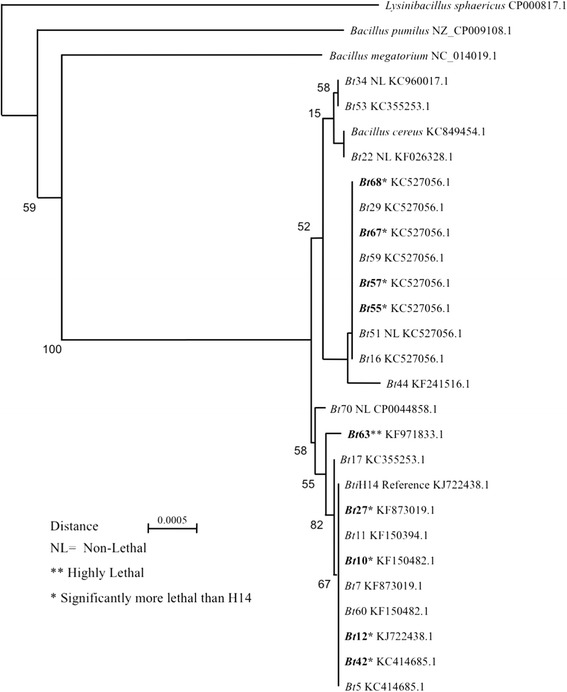
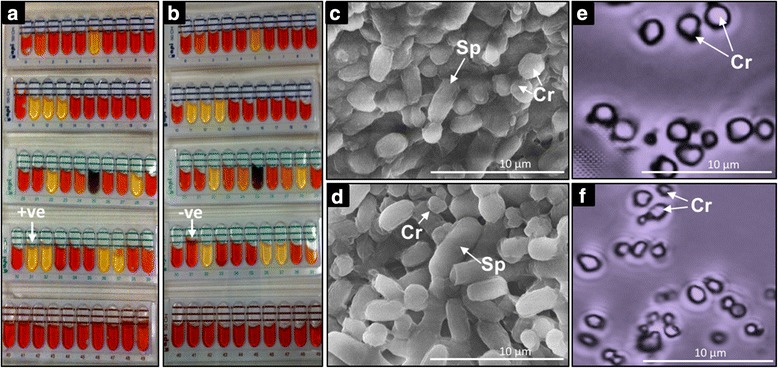
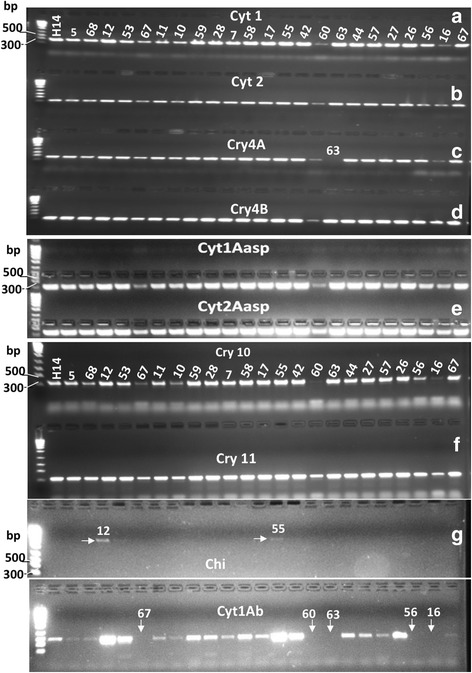
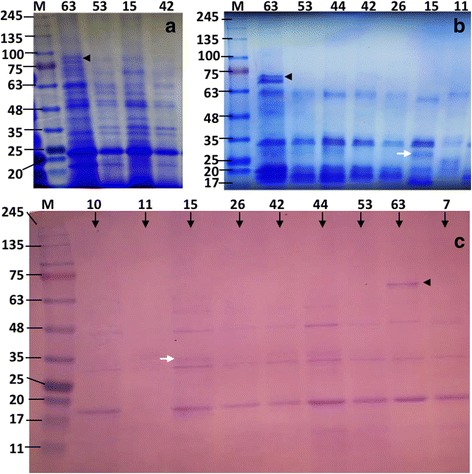
Sixty-eight Bt isolates were obtained from 300 soil and other samples collected from 16 sites across Saudi Arabia. Bt identification was based on morphological characteristics of colonies, shape of parasporal crystals and biochemical profiles. After characterization of their mosquitocidal activity, larvicidal strains were described through 16S ribosomal DNA gene sequencing, cry, cyt and chi genes PCR-amplification profiles, and SDS-PAGE protein analyses.
Spherical Bt crystals were predominant amongst the 68 isolates (34%), while irregular, bi-pyramidal and spore-attached crystals were found in 32, 13 and 21% of strains, respectively. LC and LC bioassays showed that 23/68 isolates were larvicidal, with distinct biochemical activity profiles compared to non-larvicidal Bt strains. Eight larvicidal strains showed larvicidal activity up to 3.4-fold higher (LC range: 3.90-7.40 μg/ml) than the reference Bti-H14 strain (LC = 13.33 μg/ml). Of these, 6 strains had cry and cyt gene profiles similar to Bti-H14 (cry4Aa, cry4Ba, cry10, cry11, cyt1Aa, cyt1Ab, cyt2Aa). The seventh strain (Bt63) displaying the highest larvicidal activity (LC = 3.90 μg/ml) missed the cry4Aa and cyt1Ab genes and had SDS-PAGE protein profiles and spore/crystal sizes distinct from Bti-H14. The eight strain (Bt55) with LC of 4.11μg/ml had cry and cyt gene profiles similar to Bti-H14 but gave a chi gene PCR product size of 2027bp. No strains harbouring cry2, cry17 + 27, cry24 + 40, cry25, cry29, cry30, or cyt2Ba were detected.
This study represents the first report of several Saudi indigenous Bt strains with significantly higher larvicidal efficacy against An. gambiae than the reference Bti-H14 strain. The very high toxicity of the Bt63 strain, combined with distinct cry and cyt genes and SDS-PAGE-protein profiles makes it a promising candidate for future applications in mosquito bio-control.
在全球范围内,蚊媒传播着几种重要人类疾病的病原体,包括疟疾,每年导致数百万人死亡。在沙特阿拉伯,与其他地方一样,病媒控制主要基于化学杀虫剂,这些杀虫剂可能有毒并导致环境恶化。在此,为支持生物农药替代品的开发,开展了一项研究,以鉴定对疟疾媒介冈比亚按蚊(复合组)具有更高毒性的本地苏云金芽孢杆菌(Bt)分离株。
从沙特阿拉伯16个地点采集的300份土壤和其他样本中获得了68株Bt分离株。Bt的鉴定基于菌落的形态特征、伴孢晶体的形状和生化特征。在对其杀蚊活性进行表征后,通过16S核糖体DNA基因测序、cry、cyt和chi基因PCR扩增图谱以及SDS-PAGE蛋白质分析对杀幼虫菌株进行了描述。
在68株分离株中,球形Bt晶体占主导(34%),而不规则、双锥形和附着孢子的晶体分别在32%、13%和21%的菌株中发现。LC和LC生物测定表明,68株分离株中有23株具有杀幼虫活性,与非杀幼虫Bt菌株相比,其生化活性图谱不同。8株杀幼虫菌株的杀幼虫活性比参考菌株Bti-H14(LC = 13.33 μg/ml)高3.4倍(LC范围:3.90 - 7.40 μg/ml)。其中,6株菌株的cry和cyt基因图谱与Bti-H14相似(cry4Aa、cry4Ba、cry10、cry11、cyt1Aa、cyt1Ab、cyt2Aa)。第七株菌株(Bt63)表现出最高的杀幼虫活性(LC = 3.90 μg/ml),缺少cry4Aa和cyt1Ab基因,并且SDS-PAGE蛋白质图谱以及孢子/晶体大小与Bti-H14不同。第八株菌株(Bt55)的LC为4.11μg/ml,其cry和cyt基因图谱与Bti-H14相似,但chi基因PCR产物大小为2027bp。未检测到携带cry2、cry17 + 27、cry24 + 40、cry25、cry29、cry30或cyt2Ba的菌株。
本研究首次报道了几种沙特本土Bt菌株对冈比亚按蚊的杀幼虫效力显著高于参考菌株Bti-H14。Bt63菌株的极高毒性,结合独特的cry和cyt基因以及SDS-PAGE蛋白质图谱,使其成为未来在蚊虫生物防治中应用的有前景的候选菌株。