De Gregori Manuela, Muscoli Carolina, Schatman Michael E, Stallone Tiziana, Intelligente Fabio, Rondanelli Mariangela, Franceschi Francesco, Arranz Laura Isabel, Lorente-Cebrián Silvia, Salamone Maurizio, Ilari Sara, Belfer Inna, Allegri Massimo
Pain Therapy Service, Fondazione IRCCS Policlinico San Matteo, Pavia, Italy; Study in Multidisciplinary Pain Research Group; Young Against Pain Group, Parma, Italy.
Study in Multidisciplinary Pain Research Group; Department of Health Sciences, Institute of Research for Food Safety and Health, University "Magna Graecia" of Catanzaro, Parma, Italy; IRCCS San Raffaele Pisana, Roccelletta di Borgia, Catanzaro, Italy.
J Pain Res. 2016 Dec 8;9:1179-1189. doi: 10.2147/JPR.S115068. eCollection 2016.
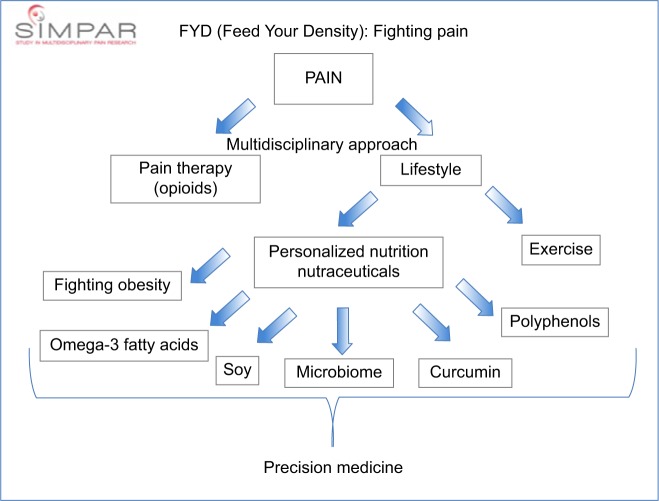
Recently, attention to the lifestyle of patients has been rapidly increasing in the field of pain therapy, particularly with regard to the role of nutrition in pain development and its management. In this review, we summarize the latest findings on the role of nutrition and nutraceuticals, microbiome, obesity, soy, omega-3 fatty acids, and curcumin supplementation as key elements in modulating the efficacy of analgesic treatments, including opioids. These main topics were addressed during the first edition of the Study In Multidisciplinary Pain Research workshop: "FYD (Feed Your Destiny): Fighting Pain", held on April 7, 2016, in Rome, Italy, which was sponsored by a grant from the Italian Ministry of Instruction on "Nutraceuticals and Innovative Pharmacology". The take-home message of this workshop was the recognition that patients with chronic pain should undergo nutritional assessment and counseling, which should be initiated at the onset of treatment. Some foods and supplements used in personalized treatment will likely improve clinical outcomes of analgesic therapy and result in considerable improvement of patient compliance and quality of life. From our current perspective, the potential benefit of including nutrition in personalizing pain medicine is formidable and highly promising.
最近,在疼痛治疗领域,对患者生活方式的关注迅速增加,尤其是在营养在疼痛发生及其管理中的作用方面。在本综述中,我们总结了关于营养与营养保健品、微生物群、肥胖、大豆、ω-3脂肪酸以及姜黄素补充剂作为调节包括阿片类药物在内的镇痛治疗效果的关键因素的最新研究结果。这些主要议题在2016年4月7日于意大利罗马举行的第一届多学科疼痛研究研讨会:“FYD(掌控你的命运):对抗疼痛”上进行了讨论,该研讨会由意大利教育部关于“营养保健品与创新药理学”的资助赞助。本次研讨会的关键信息是认识到慢性疼痛患者应接受营养评估和咨询,这应在治疗开始时就启动。个性化治疗中使用的一些食物和补充剂可能会改善镇痛治疗的临床结果,并显著提高患者的依从性和生活质量。从我们目前的角度来看,将营养纳入个性化疼痛医学的潜在益处是巨大且极具前景的。