Nees Michael A
Department of Psychology, Lafayette College, Easton PA, USA.
Front Psychol. 2016 Dec 2;7:1892. doi: 10.3389/fpsyg.2016.01892. eCollection 2016.
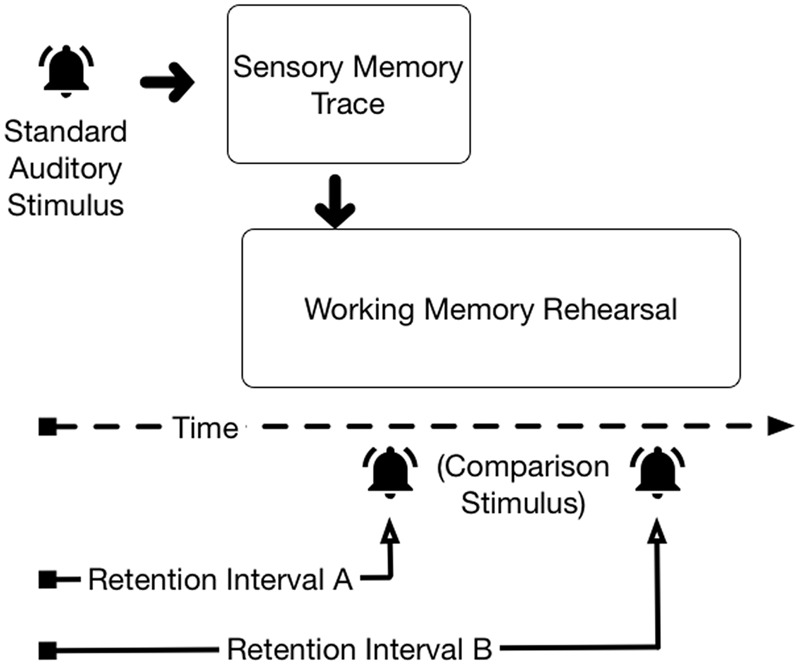
Researchers have shown increased interest in mechanisms of working memory for nonverbal sounds such as music and environmental sounds. These studies often have used two-stimulus comparison tasks: two sounds separated by a brief retention interval (often 3-5 s) are compared, and a "same" or "different" judgment is recorded. Researchers seem to have assumed that sensory memory has a negligible impact on performance in auditory two-stimulus comparison tasks. This assumption is examined in detail in this comment. According to seminal texts and recent research reports, sensory memory persists in parallel with working memory for a period of time following hearing a stimulus and can influence behavioral responses on memory tasks. Unlike verbal working memory studies that use serial recall tasks, research paradigms for exploring nonverbal working memory-especially two-stimulus comparison tasks-may not be differentiating working memory from sensory memory processes in analyses of behavioral responses, because retention interval durations have not excluded the possibility that the sensory memory trace drives task performance. This conflation of different constructs may be one contributor to discrepant research findings and the resulting proliferation of theoretical conjectures regarding mechanisms of working memory for nonverbal sounds.
研究人员对音乐和环境声音等非语言声音的工作记忆机制表现出了越来越浓厚的兴趣。这些研究通常使用双刺激比较任务:比较两个由短暂保持间隔(通常为3 - 5秒)隔开的声音,并记录“相同”或“不同”的判断。研究人员似乎假定感觉记忆对听觉双刺激比较任务的表现影响可忽略不计。本评论将详细探讨这一假设。根据经典文献和近期研究报告,感觉记忆在听到刺激后会与工作记忆并行持续一段时间,并可影响记忆任务中的行为反应。与使用系列回忆任务的言语工作记忆研究不同,探索非语言工作记忆的研究范式——尤其是双刺激比较任务——在分析行为反应时,可能没有在工作记忆和感觉记忆过程之间做出区分,因为保持间隔时长并未排除感觉记忆痕迹驱动任务表现的可能性。这种不同概念的混淆可能是导致研究结果不一致以及由此产生的关于非语言声音工作记忆机制的理论推测激增的一个原因。