Rukasha Ivy, Said Halima M, Omar Shaheed V, Koornhof Hendrik, Dreyer Andries W, Musekiwa Alfred, Moultrie Harry, Hoosen Anwar A, Kaplan Gilla, Fallows Dorothy, Ismail Nazir
Department of Medical Microbiology, Faculty of Health Sciences, University of the Free State Bloemfontein, South Africa.
Department of Medical Microbiology, Faculty of Health Sciences, University of the Free StateBloemfontein, South Africa; Centre for Tuberculosis, National Institute for Communicable DiseasesSandringham, South Africa.
Front Microbiol. 2016 Dec 5;7:1947. doi: 10.3389/fmicb.2016.01947. eCollection 2016.
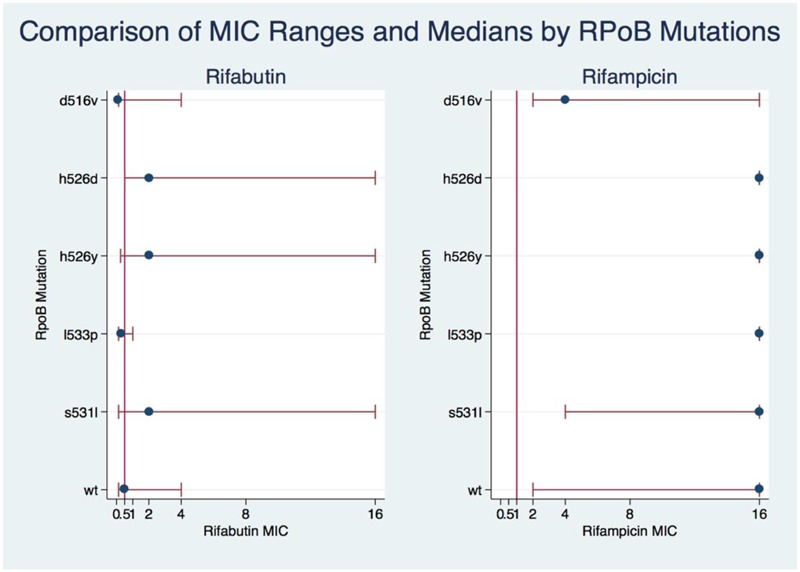
Treatment of tuberculosis (TB) and HIV co-infections is often complicated by drug-to-drug interactions between anti-mycobacterial and anti-retroviral agents. Rifabutin (RFB) is an alternative to rifampin (RIF) for TB regimens and is recommended for HIV patients concurrently receiving protease inhibitors because of reduced induction of CYP3A4. This study sought to determine the proportion of RFB susceptible isolates among RIF-resistant strains in a high HIV prevalence setting in South Africa. In addition, the study explored the association between mutations and minimum inhibitory concentrations (MIC) of RIF and RFB. A total of 189 multidrug resistant (MDR) isolates from the Centre for Tuberculosis repository were analyzed. The MICs were determined using a MYCOTB Sensititre plate method and the gene was sequenced. Of the 189 MDR isolates, 138 (73%) showed resistance to both RIF and RFB, while 51 (27%) isolates were resistant to RIF but retained susceptibility to RFB. The S531L was the most frequent point mutation in 105/189 (56%) isolates, followed by H526Y in 27/189 (14%) isolates. Resistance to both RIF and RFB was found predominantly in association with mutations S531L (91/105, 87%), H526Y (20/27, 74%), and H526D (15/19, 79%), while D516V (15/17, 88%), and L533P (3/4, 75%) were found in RIF-resistant, RFB-susceptible isolates. This study has shown that up to 27% of MDR-TB patients in South Africa may benefit from a treatment regimen that includes RFB.
结核病(TB)与艾滋病毒合并感染的治疗常常因抗分枝杆菌药物与抗逆转录病毒药物之间的药物相互作用而变得复杂。利福布汀(RFB)是结核病治疗方案中利福平(RIF)的替代药物,由于其对细胞色素P450 3A4(CYP3A4)的诱导作用降低,因此推荐给同时接受蛋白酶抑制剂治疗的艾滋病毒患者。本研究旨在确定在南非艾滋病毒高流行地区,耐利福平菌株中对利福布汀敏感的分离株比例。此外,该研究还探讨了基因突变与利福平和利福布汀最低抑菌浓度(MIC)之间的关联。对来自结核病资源中心的189株耐多药(MDR)分离株进行了分析。采用MYCOTB Sensititre平板法测定最低抑菌浓度,并对rpoB基因进行测序。在189株耐多药分离株中,138株(73%)对利福平和利福布汀均耐药,而51株(27%)分离株对利福平耐药,但对利福布汀仍敏感。S531L是105/189(56%)分离株中最常见的点突变,其次是H526Y,占27/189(14%)分离株。对利福平和利福布汀均耐药主要与S531L(91/105,87%)、H526Y(20/27,74%)和H526D(15/19,79%)突变相关,而D516V(15/17,88%)和L533P(3/4,75%)则出现在耐利福平、对利福布汀敏感的分离株中。本研究表明,南非高达27%的耐多药结核病患者可能从包含利福布汀的治疗方案中获益。