Naderi Mostafa, Jadidi Khosrow, Mosavi Seyed Aliasghar, Daneshi Seyed Aref
Department of Ophthalmology, Baqiyatallah University of Medical Sciences, Tehran, Iran; Bina Eye Hospital Research Center, Tehran, Iran.
Department of Ophthalmology, Baqiyatallah University of Medical Sciences, Tehran, Iran.
J Ophthalmic Vis Res. 2016 Oct-Dec;11(4):358-362. doi: 10.4103/2008-322X.194070.
To compare the effectiveness, safety and stability of the results of transepithelial photorefractive keratectomy (tPRK) with conventional photorefractive keratectomy (PRK) for low to moderate myopia.
In this prospective non-randomized case-control study, patients with low to moderate myopia were assigned to the tPRK group (cases) or the PRK group (controls). In the tPRK group, eyes were treated using the Amaris excimer laser (SCHWIND eye-tech-solutions GmbH and Co. KG, Germany). Outcome measures included postoperative pain using McGill Pain Questionnaire, epithelial healing time, uncorrected visual acuity (UCVA), best corrected visual acuity (BCVA), manifest refraction, and safety and efficacy indexes which were compared between the study groups.
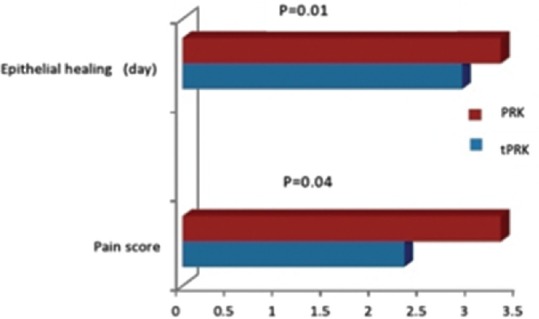
Three hundred forty eyes of 170 patients were enrolled in this study. Each study group comprised of 170 eyes of 85 patients. There was a significant difference between the two groups regarding the postoperative pain scores in favor of the tPRK group ( = 0.04). The tPRK group had a shorter epithelial healing time than the conventional PRK group postoperatively ( = 0.01). Mean UCVA was significantly better in the case group than in the control group at the postoperative month 2 ( = 0.01). Regarding the safety and efficacy indexes, the tPRK group had better results than the conventional PRK group ( < 0.01 for both comparisons).
Transepithelial PRK seems to be superior to conventional PRK for treatment of low to moderate myopia in terms of postoperative pain, epithelial healing time, visual recovery and safety and efficacy indexes.
比较经上皮准分子激光角膜切削术(tPRK)与传统准分子激光角膜切削术(PRK)治疗低度至中度近视的有效性、安全性及结果稳定性。
在这项前瞻性非随机病例对照研究中,低度至中度近视患者被分为tPRK组(病例组)或PRK组(对照组)。tPRK组使用阿玛仕准分子激光(德国SCHWIND眼科技解决方案有限公司)治疗眼睛。观察指标包括使用麦吉尔疼痛问卷评估的术后疼痛、上皮愈合时间、裸眼视力(UCVA)、最佳矫正视力(BCVA)、明显验光结果,以及研究组之间比较的安全性和有效性指标。
本研究纳入了170例患者的340只眼睛。每个研究组包括85例患者的170只眼睛。两组术后疼痛评分存在显著差异,tPRK组更具优势(P = 0.04)。tPRK组术后上皮愈合时间比传统PRK组短(P = 0.01)。术后第2个月,病例组的平均UCVA显著优于对照组(P = 0.01)。在安全性和有效性指标方面,tPRK组的结果优于传统PRK组(两项比较P均< 0.01)。
在术后疼痛、上皮愈合时间、视力恢复以及安全性和有效性指标方面,经上皮PRK治疗低度至中度近视似乎优于传统PRK。