Noor Ophthalmology Research Center, Noor Eye Hospital, 96, Esfandiar Blvd, Valiasr St, Tehran, Tehran, 1968653111, Iran.
Translational Ophthalmology Research Center, Tehran University of Medical Sciences, Tehran, Iran.
BMC Ophthalmol. 2022 Feb 11;22(1):68. doi: 10.1186/s12886-022-02293-2.
To assess transepithelial photorefractive keratectomy (tPRK) in terms of corneal epithelial healing rate, postoperative pain, postoperative discomfort, and visual and refraction outcomes compared to mechanical epithelial debridement PRK (mPRK) and alcohol-assisted PRK (aaPRK).
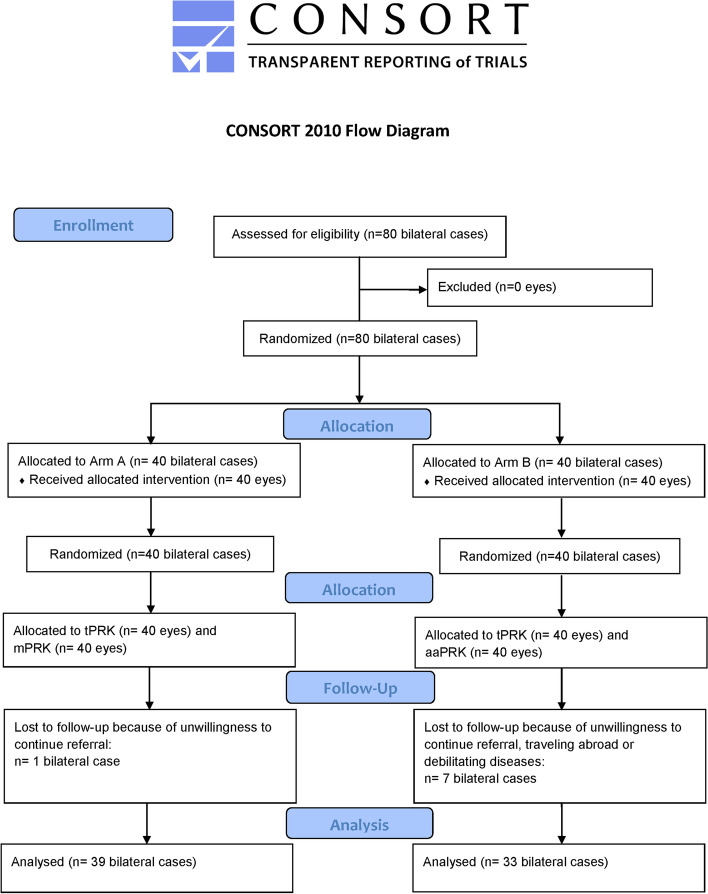
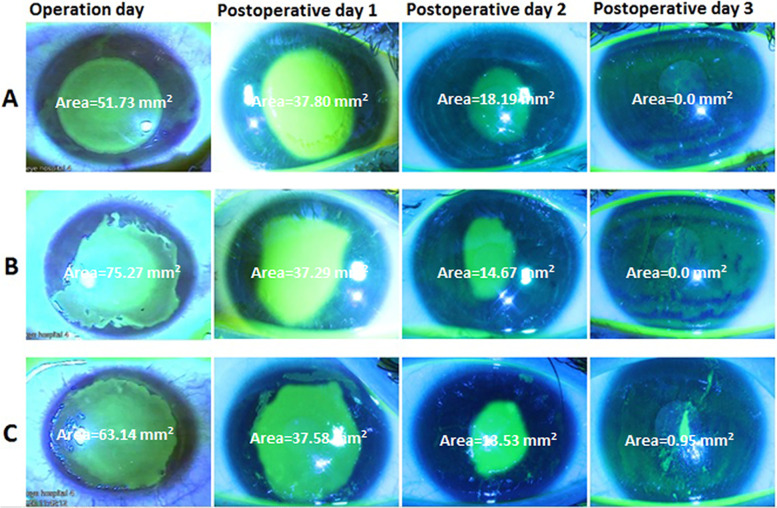
In this double-masked, randomized clinical trial, thirty-nine patients underwent tPRK in one eye and mPRK in the fellow eye (arm A), and 33 patients underwent tPRK in one eye and aaPRK in the contralateral eye (arm B). All surgical procedures were done using the Schwind Amaris excimer laser. The area of corneal epithelial defect in all eyes was captured and analyzed using ImageJ software.
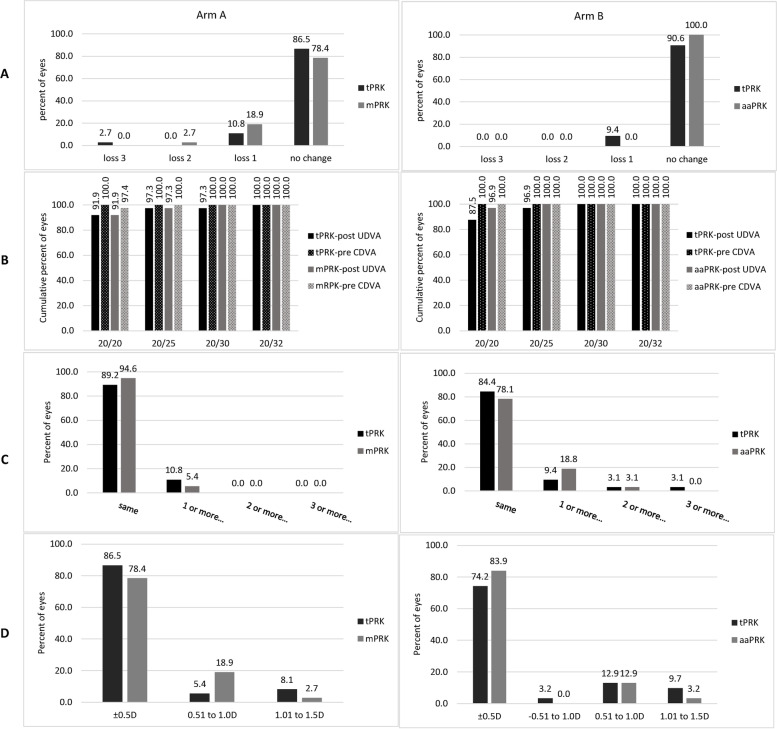
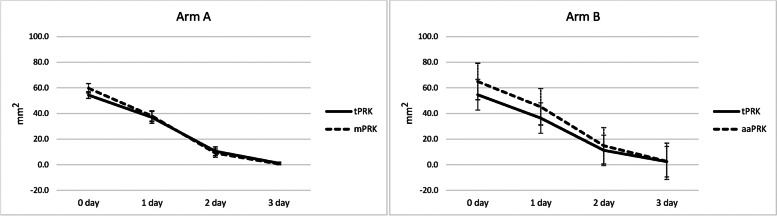
Mean epithelial healing time was respectively 3.74 ± 0.82 and 3.59 ± 0.79 days in tPRK versus mPRK (P = 0.21) in arm A, and 3.67 ± 0.92 and 3.67 ± 0.74 days in tPRK versus aaPRK (P = 1.00) in arm B. Accounting for the initial corneal epithelial defect area, the epithelial healing rate was faster in conventional PRK groups compared to tPRK (both P<0.001) in both arms. However, there was no significant difference in safety, efficacy, spherical equivalent refractive accuracy, or corneal haze development between tPRK and conventional PRK groups (all P > 0.05).
All three methods are effective in terms of visual and refractive outcomes. However, although time to complete re-epithelialization was similar with the three methods, the epithelial healing rate was faster in conventional PRK considering the initial corneal epithelial defect area, and the patients experienced less pain and discomfort in the first postoperative day.
IRCT, IRCT20200317046804N1 . Retrospectively registered 5 May 2020.
评估经上皮准分子激光角膜切削术(tPRK)在角膜上皮愈合率、术后疼痛、术后不适以及视力和屈光度方面的结果,与机械性上皮清创性准分子激光角膜切削术(mPRK)和酒精辅助性准分子激光角膜切削术(aaPRK)相比。
在这项双盲、随机临床试验中,39 名患者的一只眼接受 tPRK 治疗,另一只眼接受 mPRK 治疗(A 组),33 名患者的一只眼接受 tPRK 治疗,另一只眼接受 aaPRK 治疗(B 组)。所有手术均使用 Schwind Amaris 准分子激光仪完成。使用 ImageJ 软件捕获并分析所有眼睛的角膜上皮缺损面积。
在 A 组中,tPRK 组的平均上皮愈合时间分别为 3.74±0.82 天和 3.59±0.79 天(P=0.21),而在 B 组中,tPRK 组分别为 3.67±0.92 天和 3.67±0.74 天(P=1.00)。考虑到初始角膜上皮缺损面积,与 tPRK 相比,常规 PRK 组的上皮愈合速度更快(两组均 P<0.001)。然而,在安全性、疗效、等效球镜屈光准确性或角膜混浊发展方面,tPRK 与常规 PRK 组之间无显著差异(所有 P>0.05)。
三种方法在视力和屈光结果方面均有效。然而,尽管三种方法的完全上皮再形成时间相似,但考虑到初始角膜上皮缺损面积,常规 PRK 的上皮愈合速度更快,且患者在术后第一天疼痛和不适程度较轻。
IRCT,IRCT20200317046804N1。于 2020 年 5 月 5 日回顾性注册。