de Maar Josanne S, de Groot Marjolein A J, Luik Peter T, Mui Kwok Wai, Hagen E Christiaan
Department of Internal Medicine, Meander Medical Centre, Amersfoort, The Netherlands.
Gezonde Nieren B.V., Medworq, Doesburg, The Netherlands.
Clin Kidney J. 2016 Dec;9(6):826-832. doi: 10.1093/ckj/sfw037. Epub 2016 May 30.
Despite the many advantages it offers, the percentage of dialysis patients that receive home dialysis [peritoneal dialysis (PD) or home haemodialysis (HHD)] in the Netherlands has declined over the last decade. Pre-dialysis education could stimulate the use of home dialysis. This article presents the results of the pre-dialysis programme GUIDE, with regard to the following question: Does the implementation of a structured pre-dialysis programme with a home-focused approach increase the number of pre-dialysis patients that choose and receive home dialysis?
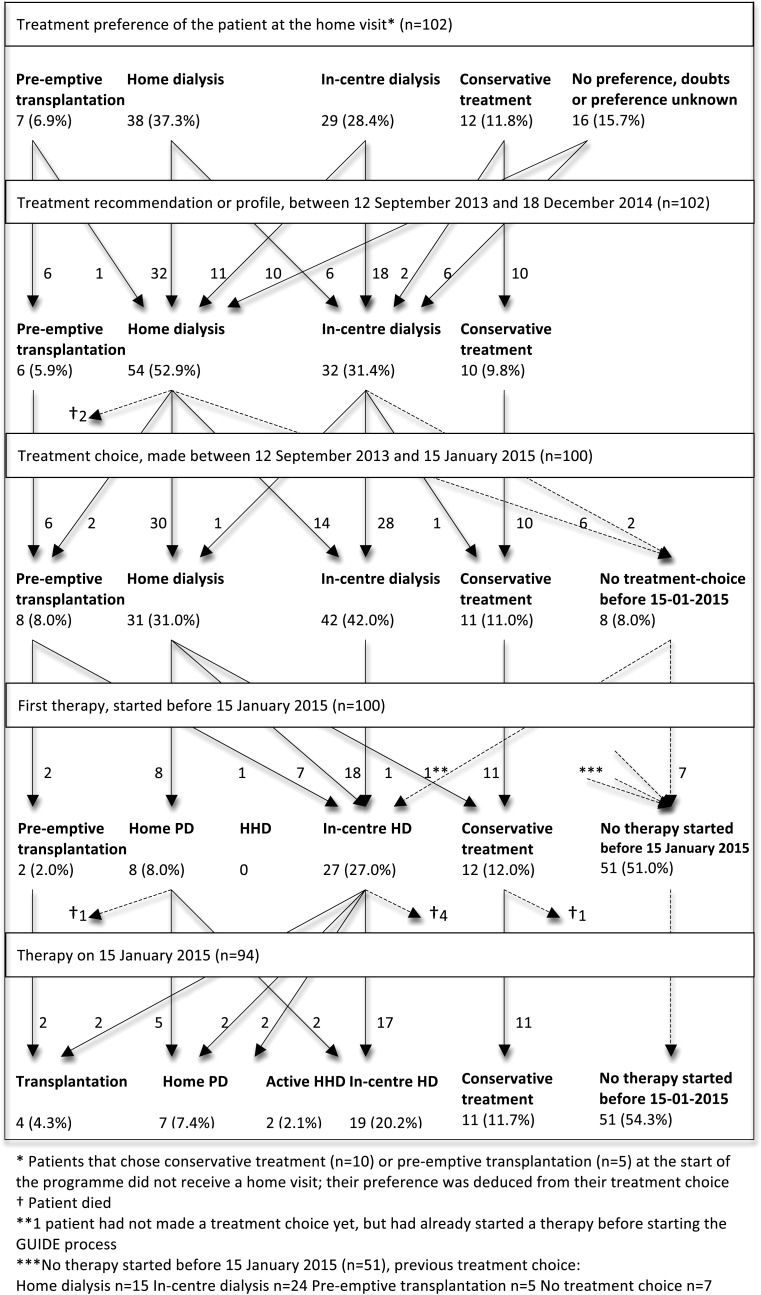
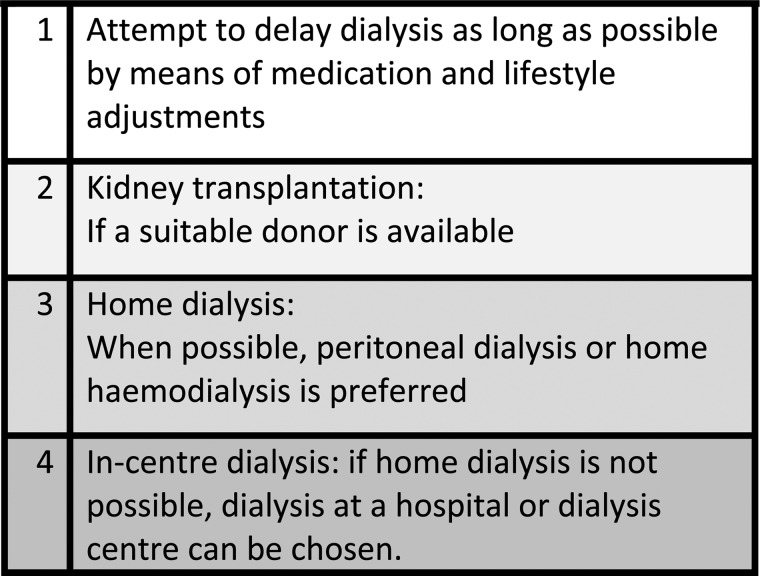
The GUIDE process starts when a patient has an eGFR of 15 mL/min/1.73 m. The process begins with a home visit from a case manager and the completion of questionnaires by the patient, the case manager and the nephrologist. A multidisciplinary meeting (MDM) is held to determine a specific patient profile (or treatment recommendation). This is followed by patient education, a second MDM and finally the selection of the treatment by the patient and the nephrologist. This retrospective observational study describes the selection process of all patients that received a treatment recommendation between 12 September 2013 and 18 December 2014 at Meander Medical Centre. Data were collected by file research and analysis of questionnaires.
One hundred and two patients were included. They started the process at a mean eGFR of 12.3 mL/min/1.73 m. Home dialysis was recommended for 62.8% of the patients who were advised to have dialysis treatment. Of the patients that opted for dialysis, 34.2% chose PD and 8.2% chose HHD; 22.9% started home dialysis as their first therapy, compared with 17.6% in the months before implementation of GUIDE. Finally, 32.1% of the patients that received dialysis therapy received home dialysis. In the months before GUIDE, an average of just 19.5% of the patients that received dialysis received home dialysis.
In comparison to historical data, the pre-dialysis programme GUIDE increases the number of patients that choose and receive home dialysis.
尽管家庭透析(腹膜透析或家庭血液透析)有诸多优势,但在过去十年中,荷兰接受家庭透析的透析患者比例有所下降。透析前教育可能会促进家庭透析的使用。本文介绍了透析前项目GUIDE的结果,涉及以下问题:实施以家庭为重点的结构化透析前项目是否会增加选择并接受家庭透析的透析前患者数量?
当患者的估算肾小球滤过率(eGFR)为15 mL/min/1.73 m²时,GUIDE流程开始。该流程始于个案管理员的家访以及患者、个案管理员和肾病专家完成问卷。随后召开多学科会议(MDM)以确定特定的患者概况(或治疗建议)。接着是患者教育、第二次MDM,最后由患者和肾病专家选择治疗方式。这项回顾性观察研究描述了2013年9月12日至2014年12月18日期间在梅安德医疗中心接受治疗建议的所有患者的选择过程。数据通过档案研究和问卷分析收集。
纳入了102名患者。他们开始该流程时的平均eGFR为12.3 mL/min/1.73 m²。在建议进行透析治疗的患者中,62.8%被推荐进行家庭透析。在选择透析的患者中,34.2%选择了腹膜透析,8.2%选择了家庭血液透析;22.9%开始将家庭透析作为其首次治疗方式,而在GUIDE实施前的几个月中这一比例为17.6%。最后,接受透析治疗的患者中有32.1%接受了家庭透析。在GUIDE实施前的几个月中,接受透析的患者平均只有19.5%接受家庭透析。
与历史数据相比,透析前项目GUIDE增加了选择并接受家庭透析的患者数量。