Mehrabi Maryam, Eskandarieh Sharareh, Khodadost Mahmoud, Sadeghi Maneli, Nikfarjam Ali, Hajebi Ahmad
Department of Mental, Social Health and Addiction, Ministry of Health, Tehran, Iran; Health and Medical Sociology Group of Iranian Sociology Association, Tehran, Iran.
Brain and Spinal Cord Injury Research Center, Neuroscience Institute, Tehran University of Medical Sciences, Tehran, Iran; MS Research Center, Neuroscience Institute, Tehran University of Medical Sciences, Tehran, Iran.
J Addict. 2016;2016:6891751. doi: 10.1155/2016/6891751. Epub 2016 Nov 29.
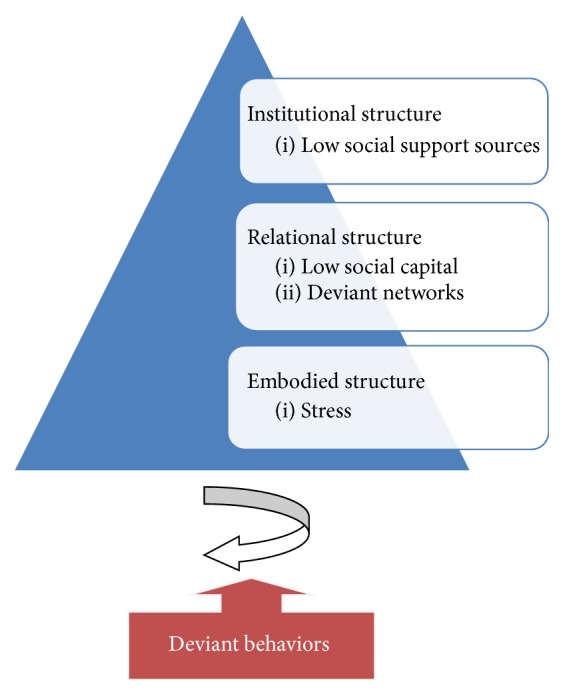
This study is a sociological analysis of the three dimensions of social structure including institutional, relational, and embodied structures that have an impact on the individuals' deviant behaviors in the society. The authors used a mix method to analyze the qualitative and quantitative data of 402 high risk abandoned substance users in 2008 in Tehran, capital city of Iran. The leading reasons of substance use were categorized into four fundamental themes as follows: stress, deviant social networks, and low social capital and weak social support sources. In addition, the epidemiology model of regression analysis provides a brief explanation to assess the association between the demographical and etiological variables, and the drug users' deviant behaviors. In sum, substance use is discussed as a deviant behavior pattern which stems from a comorbidity of weak social structures.
本研究是一项社会学分析,探讨社会结构的三个维度,包括制度结构、关系结构和体现性结构,这些结构对社会中个体的越轨行为产生影响。作者采用混合方法分析了2008年伊朗首都德黑兰402名高危遗弃药物使用者的定性和定量数据。药物使用的主要原因被归纳为四个基本主题:压力、越轨社会网络、低社会资本和薄弱的社会支持来源。此外,回归分析的流行病学模型简要解释了评估人口统计学和病因学变量与吸毒者越轨行为之间的关联。总之,药物使用被视为一种越轨行为模式,它源于薄弱社会结构的合并症。