Moreira Marta, Castro Olga, Palmieri Melissa, Efklidou Sofia, Castagna Stefano, Hoet Bernard
a GSK Vaccines , Global Medical affairs , Wavre , Belgium.
b GSK, Medical Affairs Vaccines , Algés , Portugal.
Hum Vaccin Immunother. 2017 Jun 3;13(6):1-12. doi: 10.1080/21645515.2016.1263409. Epub 2016 Dec 20.
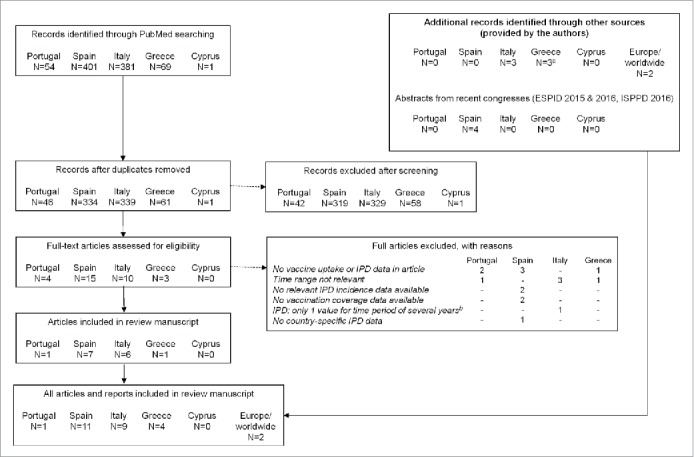
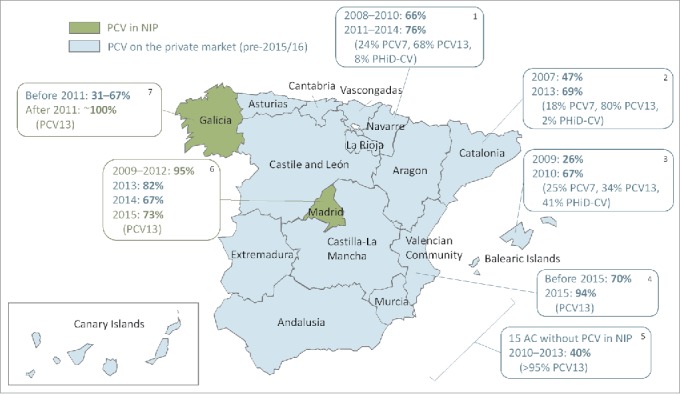
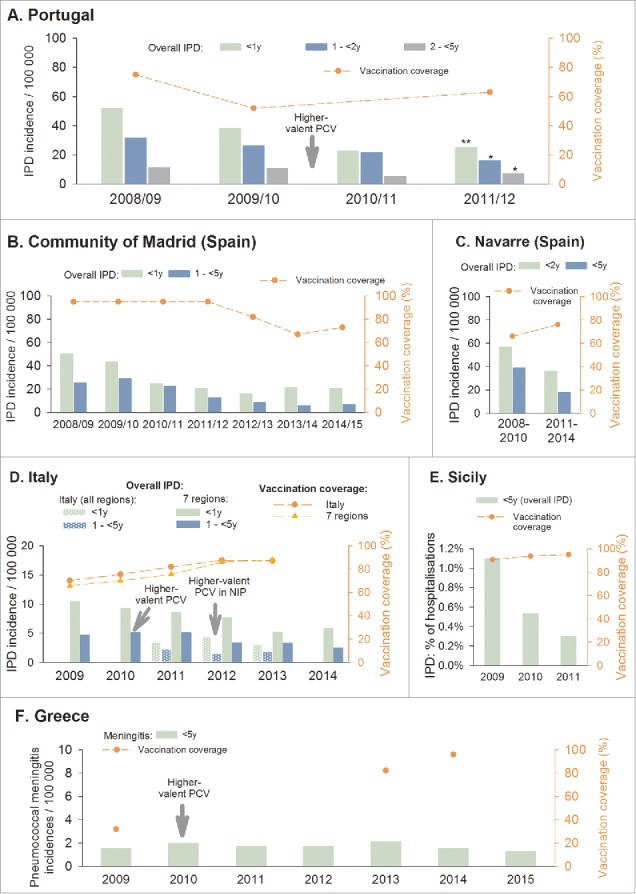
Higher-valent pneumococcal conjugate vaccines (PCVs) were licensed from 2009 in Europe; similar worldwide clinical effectiveness was observed for PCVs in routine use. Despite a proven medical need, PCV vaccination in Southern Europe remained suboptimal until 2015/16. We searched PubMed for manuscripts published between 2009 and mid-2016. Included manuscripts had to contain data about invasive pneumococcal disease (IPD) incidence, or vaccination coverage with higher-valent PCVs. This review represents the first analysis of vaccination coverage and impact of higher-valent PCVs on overall IPD in Southern European countries (Portugal, Spain, Italy, Greece, Cyprus). Vaccination coverage in the Portuguese private market peaked around 2008 at 75% (children ≤ 2 years) but declined to 63% in 2012. In Madrid, coverage was 95% (2007-2012) but dropped to 67% (2013/14; children ≤ 2 years) after funding termination in May 2012. PCVs were recently introduced in the national immunisation program (NIP) of Portugal (2015) and Spain (2015/16). In Italy, coverage for the complete PCV schedule (children ≤ 2 years) was 88% in 2013, although highly variable between regions (45-99%). In Greece, in 2013, 82.3% had received 3 PCV doses by 12 months, while 62.3% received the fourth dose by 24 months. Overall IPD (net benefit: effect on vaccine types, vaccine-related types, and non-vaccine types) has decreased; in Greece, pneumococcal meningitis incidence remained stable. Continued IPD surveillance or national registers using ICD-10 codes of clinically suspected IPD are necessary, with timely publicly available reports and adequate national vaccination registers to assess trends in vaccination coverage, allowing evaluation of PCVs in NIPs.
更高价的肺炎球菌结合疫苗(PCV)于2009年在欧洲获得许可;常规使用的PCV在全球范围内观察到了相似的临床效果。尽管有已证实的医疗需求,但直到2015/16年,南欧的PCV疫苗接种情况仍不理想。我们在PubMed上搜索了2009年至2016年年中发表的手稿。纳入的手稿必须包含侵袭性肺炎球菌疾病(IPD)发病率或更高价PCV疫苗接种覆盖率的数据。本综述是对南欧国家(葡萄牙、西班牙、意大利、希腊、塞浦路斯)疫苗接种覆盖率以及更高价PCV对总体IPD影响的首次分析。葡萄牙私人市场的疫苗接种覆盖率在2008年左右达到峰值,为75%(2岁及以下儿童),但在2012年降至63%。在马德里,覆盖率在2007 - 2012年为95%,但在2012年5月资金终止后,降至67%(2013/14年;2岁及以下儿童)。PCV最近被引入葡萄牙(2015年)和西班牙(2015/16年)的国家免疫规划(NIP)。在意大利,2013年完整PCV接种程序(2岁及以下儿童)的覆盖率为88%,尽管各地区差异很大(45% - 99%)。在希腊,2013年,82.3%的儿童在12个月时接种了3剂PCV,而62.3%的儿童在24个月时接种了第4剂。总体IPD(净效益:对疫苗型、疫苗相关型和非疫苗型的影响)有所下降;在希腊,肺炎球菌脑膜炎发病率保持稳定。有必要继续使用临床疑似IPD的ICD - 10编码进行IPD监测或建立国家登记册,并及时公开报告,同时要有完善的国家疫苗接种登记册来评估疫苗接种覆盖率的趋势,以便对国家免疫规划中的PCV进行评估。