Bertocci M A, Bebko G, Versace A, Iyengar S, Bonar L, Forbes E E, Almeida J R C, Perlman S B, Schirda C, Travis M J, Gill M K, Diwadkar V A, Sunshine J L, Holland S K, Kowatch R A, Birmaher B, Axelson D A, Frazier T W, Arnold L E, Fristad M A, Youngstrom E A, Horwitz S M, Findling R L, Phillips M L
Department of Psychiatry,Western Psychiatric Institute and Clinic, University of Pittsburgh Medical Center, University of Pittsburgh,Pittsburgh, PA,USA.
Department of Statistics,University of Pittsburgh,Pittsburgh, PA,USA.
Psychol Med. 2017 Jun;47(8):1357-1369. doi: 10.1017/S0033291716003147. Epub 2016 Dec 21.
Identifying youth who may engage in future substance use could facilitate early identification of substance use disorder vulnerability. We aimed to identify biomarkers that predicted future substance use in psychiatrically un-well youth.
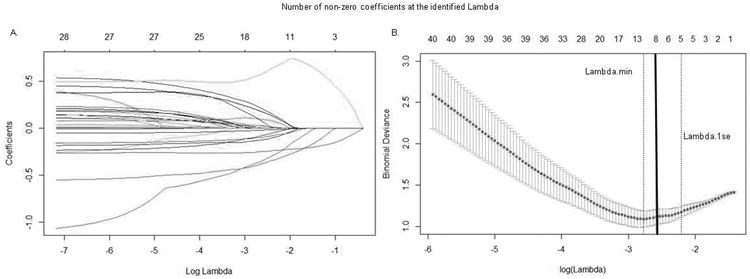
LASSO regression for variable selection was used to predict substance use 24.3 months after neuroimaging assessment in 73 behaviorally and emotionally dysregulated youth aged 13.9 (s.d. = 2.0) years, 30 female, from three clinical sites in the Longitudinal Assessment of Manic Symptoms (LAMS) study. Predictor variables included neural activity during a reward task, cortical thickness, and clinical and demographic variables.
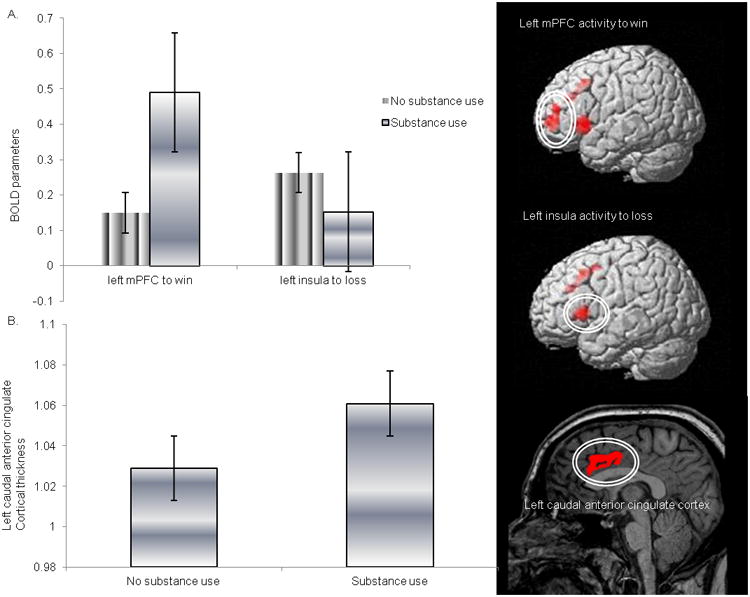
Future substance use was associated with higher left middle prefrontal cortex activity, lower left ventral anterior insula activity, thicker caudal anterior cingulate cortex, higher depression and lower mania scores, not using antipsychotic medication, more parental stress, older age. This combination of variables explained 60.4% of the variance in future substance use, and accurately classified 83.6%.
These variables explained a large proportion of the variance, were useful classifiers of future substance use, and showed the value of combining multiple domains to provide a comprehensive understanding of substance use development. This may be a step toward identifying neural measures that can identify future substance use disorder risk, and act as targets for therapeutic interventions.
识别可能在未来使用药物的青少年,有助于早期发现药物使用障碍的易感性。我们旨在识别能够预测精神状态不佳的青少年未来药物使用情况的生物标志物。
在纵向躁狂症状评估(LAMS)研究的三个临床地点,对73名年龄为13.9岁(标准差=2.0)、行为和情绪失调的青少年(30名女性)进行神经影像评估后24.3个月,使用套索回归进行变量选择,以预测药物使用情况。预测变量包括奖励任务期间的神经活动、皮质厚度以及临床和人口统计学变量。
未来药物使用与左中前额叶皮质活动增加、左腹侧前岛叶活动减少、尾侧前扣带回皮质增厚、抑郁评分较高和躁狂评分较低、未使用抗精神病药物、父母压力较大、年龄较大有关。这些变量的组合解释了未来药物使用差异的60.4%,并准确分类了83.6%。
这些变量解释了很大一部分差异,是未来药物使用的有效分类指标,并显示了结合多个领域以全面了解药物使用发展情况的价值。这可能是朝着识别能够识别未来药物使用障碍风险的神经测量方法迈出的一步,并可作为治疗干预的靶点。