Zhao Xue-Shan, Wu Qi, Peng Juan, Pan Li-Hong, Ren Zhong, Liu Hui-Ting, Jiang Zhi-Sheng, Wang Gui-Xue, Tang Zhi-Han, Liu Lu-Shan
Institute of Cardiovascular Disease, Key Laboratory for Arteriosclerology of Hunan University of South China, Hengyang, Hunan 421001, P.R. China.
College of Bioengineering, Chongqing University, Chongqing 400030, P.R. China.
Mol Med Rep. 2017 Feb;15(2):712-718. doi: 10.3892/mmr.2016.6055. Epub 2016 Dec 16.
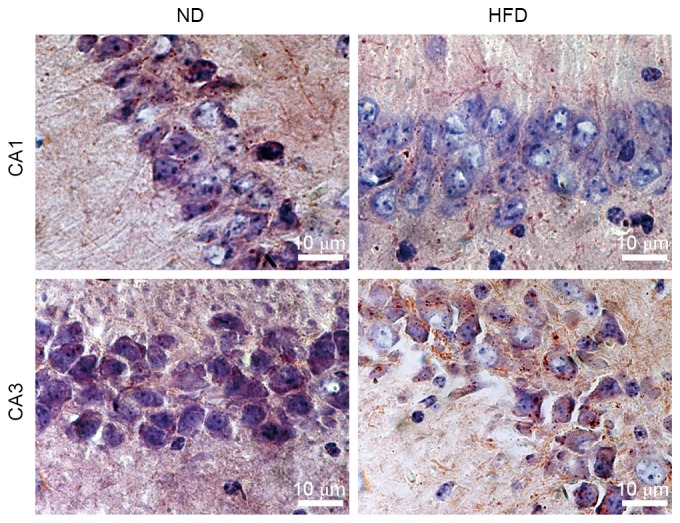
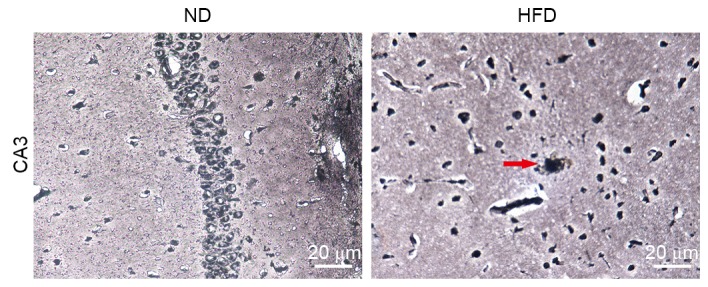
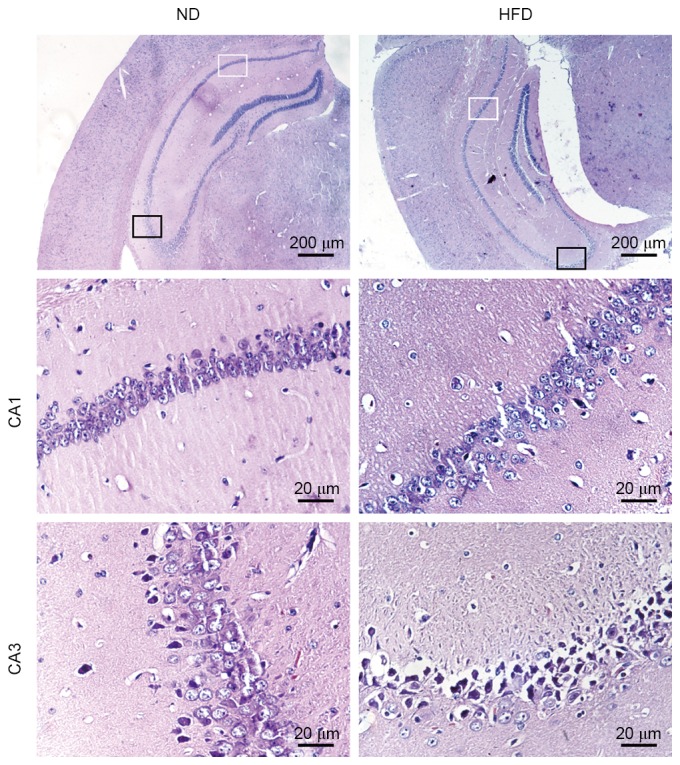
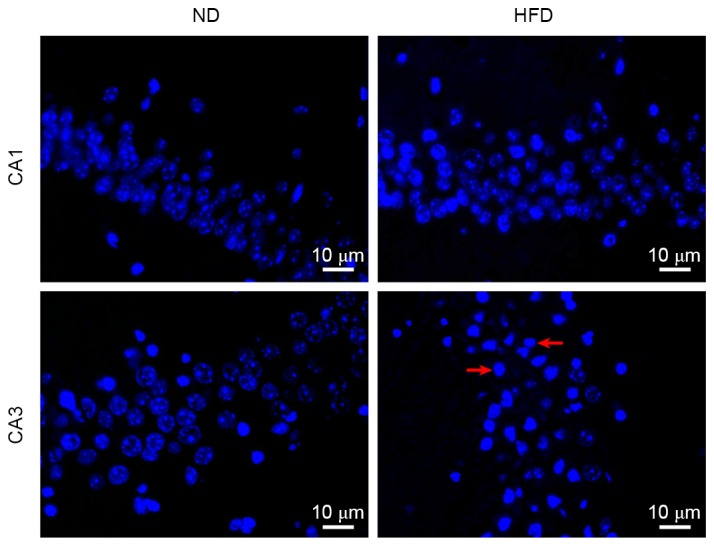
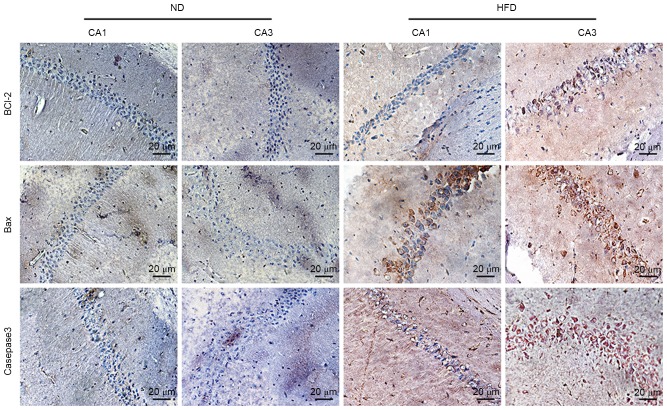
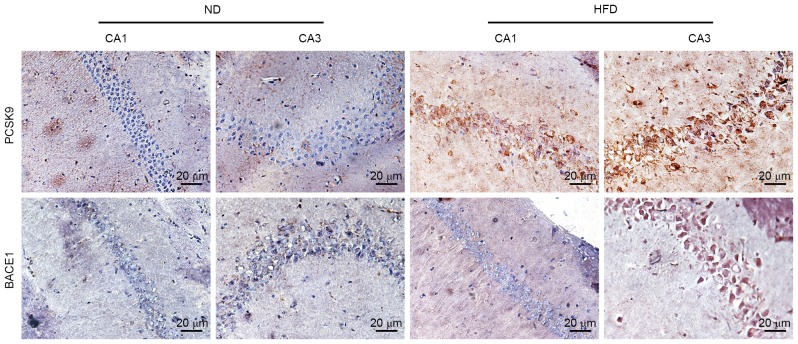
Hyperlipidemia is a risk factor for Alzheimer's disease (AD) and other neurodegenerative diseases. Proprotein convertase subtilisin/kexin type 9 (PCSK9) is a lipid regulatory gene involved in cell apoptosis. However, the function and mechanism of PCSK9 in neuronal apoptosis following hyperlipidemia remains to be elucidated. The present study established a hyperlipidemic mouse model by feeding a high‑fat diet (HFD) to 6‑week‑old apoE(‑/‑) mice. Plasma lipid levels, hippocampal lipid accumulation, hippocampal histology, and hippocampal neuronal apoptosis were all monitored for changes. The expression levels of PCSK9, β‑secretase 1 (BACE1), B‑cell lymphoma 2 (Bcl‑2), Bcl‑2‑associated X protein (Bax), and caspase‑3 in hippocampal CA3 and CA1 neurons were also measured. Results demonstrated that a HFD increased the lipid accumulation in the CA3 hippocampus and the levels of plasma lipids, including triglycerides, total cholesterol, low‑density lipoprotein, and high‑density lipoprotein. In addition, CA3 neurons in the HFD group indicated apparent injuries and increased neuronal apoptosis, which are associated with the expression of Bcl‑2, Bax, and caspase‑3. A HFD also increased the expression levels of PCSK9 and BACE1. BACE1 promotes cleavage of amyloid precursor proteins to generate β‑amyloid peptide (Aβ), which induces neuronal apoptosis. Protein levels of Aβ are associated with the observation of amyloid plaques in the hippocampus of the HFD group. The results suggest that hyperlipidemia regulates neuronal apoptosis by increasing PCSK9 and BACE1 expression. Overall, the current study may elucidate the role of lipid metabolism disorder in AD pathogenesis.
高脂血症是阿尔茨海默病(AD)和其他神经退行性疾病的一个危险因素。前蛋白转化酶枯草溶菌素/克新9型(PCSK9)是一种参与细胞凋亡的脂质调节基因。然而,PCSK9在高脂血症后神经元凋亡中的功能和机制仍有待阐明。本研究通过给6周龄的载脂蛋白E基因敲除(apoE(-/-))小鼠喂食高脂饮食(HFD)建立了高脂血症小鼠模型。监测血浆脂质水平、海马脂质蓄积、海马组织学以及海马神经元凋亡的变化。还测量了海马CA3和CA1神经元中PCSK9、β-分泌酶1(BACE1)、B细胞淋巴瘤2(Bcl-2)、Bcl-2相关X蛋白(Bax)和半胱天冬酶-3的表达水平。结果表明,高脂饮食增加了CA3海马区的脂质蓄积以及血浆脂质水平,包括甘油三酯、总胆固醇、低密度脂蛋白和高密度脂蛋白。此外,高脂饮食组的CA3神经元显示出明显损伤且神经元凋亡增加,这与Bcl-2、Bax和半胱天冬酶-3的表达有关。高脂饮食还增加了PCSK9和BACE1的表达水平。BACE1促进淀粉样前体蛋白的切割以生成β-淀粉样肽(Aβ),后者诱导神经元凋亡。Aβ的蛋白水平与高脂饮食组海马中淀粉样斑块的观察结果相关。结果表明,高脂血症通过增加PCSK9和BACE1的表达来调节神经元凋亡。总体而言,当前研究可能阐明脂质代谢紊乱在AD发病机制中的作用。