Gul Seema, Attaullah Sobia, Alsugoor Mahdi H, Bawazeer Sami, Shah Shahid Ali, Khan Sanaullah, Salahuddin Hafiza Sara, Ullah Mujeeb
Department of Zoology, Islamia College Peshawar, 25120, Khyber Pakhtunkhwa, Pakistan.
Umme Al-Qura University, Faculty of Pharmacy, Department of Pharmacognosy, Makkah, Saudi Arabia.
Heliyon. 2023 Jun 15;9(6):e16930. doi: 10.1016/j.heliyon.2023.e16930. eCollection 2023 Jun.
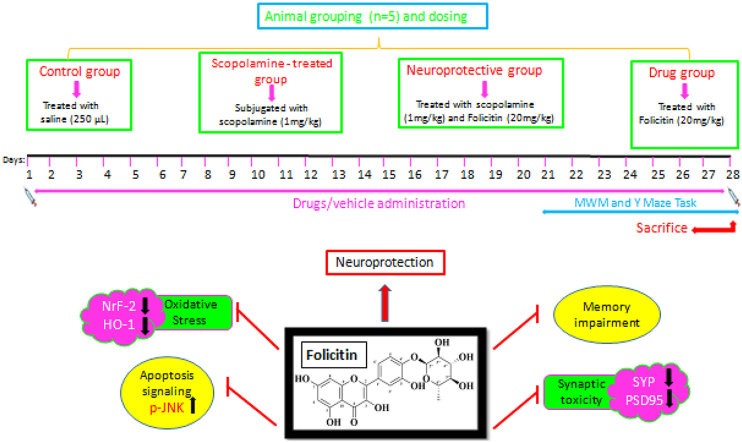
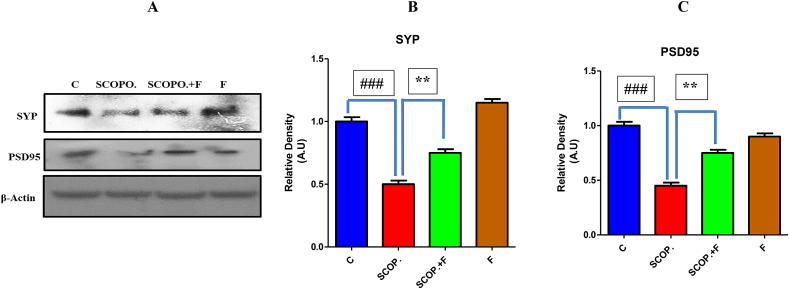
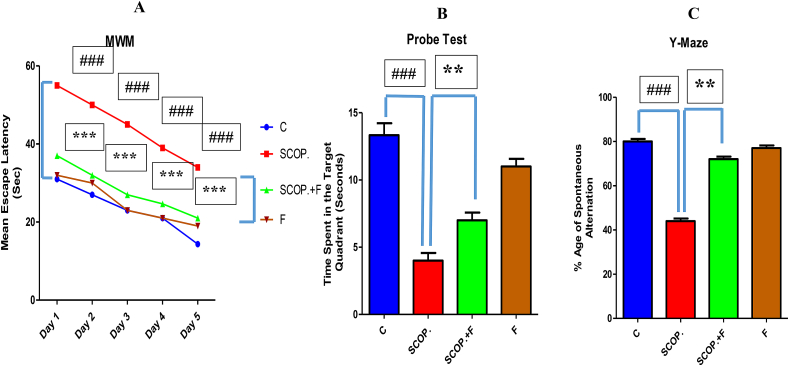
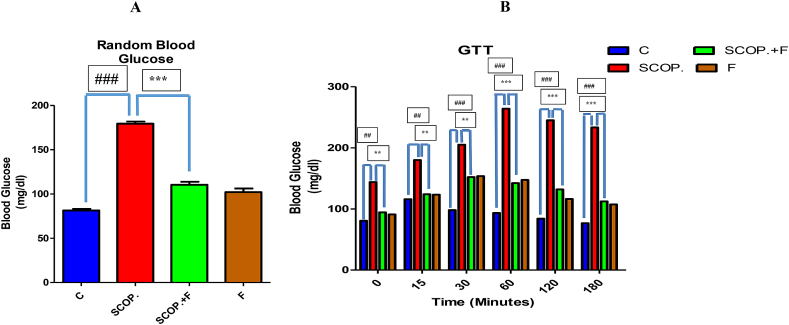
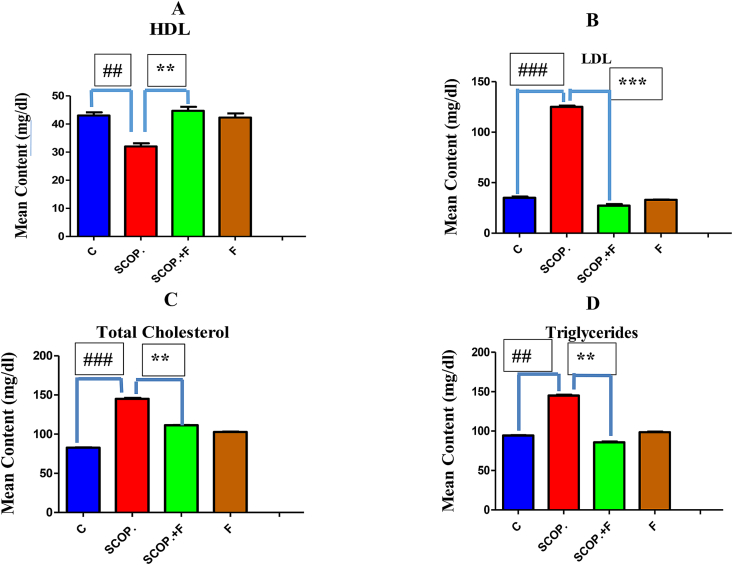
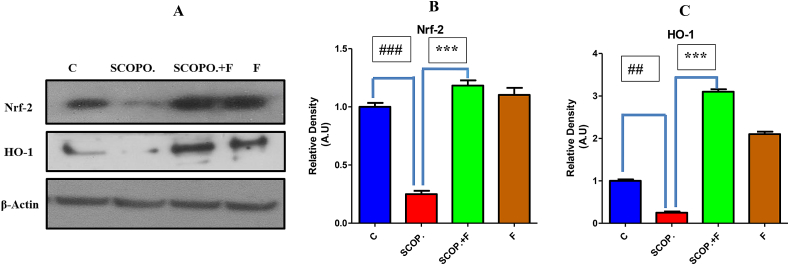
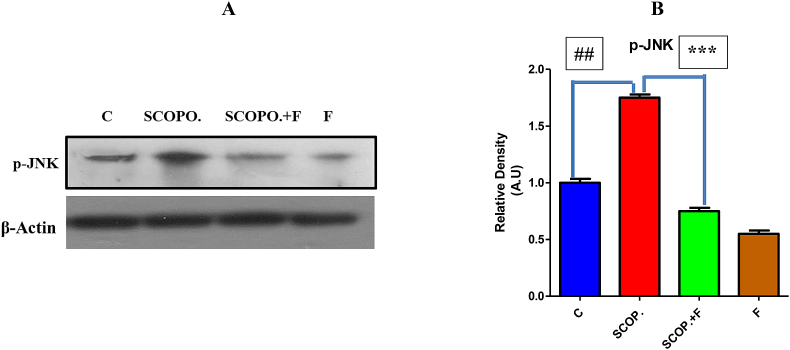
No effective drug treatment is available for Alzheimer disease, thus the need arise to develop efficient drugs for its treatment. Natural products have pronounced capability in treating Alzheimer disease therefore current study aimed to evaluate the neuro-protective capability of folicitin against scopolamine-induced Alzheimer disease neuropathology in mice. Experimental mice were divided into four groups i.e. control (single dose of 250 μL saline), scopolamine-administered group (1 mg/kg administered for three weeks), scopolamine plus folicitin-administered group (scopolamine 1 mg/kg administration for three weeks followed by folicitin administration for last two weeks) and folicitin-administered group (20 mg/kg administered for 5 alternate days). Results of behavioral tests and Western blot indicated that folicitin has the capability of recovering the memory against scopolamine-induced memory impairment by reducing the oxidative stress through up-regulating the endogenous antioxidant system like nuclear factor erythroid 2-related factor and Heme oxygenase-1 while prohibiting phosphorylated c-Jun N-terminal kinase. Similarly, folicitin also improved the synaptic dysfunction by up-regulating SYP and PSD95. Scopolamine-induced hyperglycemia and hyperlipidemia were abolished by folicitin as evidenced through random blood glucose test, glucose tolerance test and lipid profile test. All these results revealed that folicitin being a potent anti-oxidant is capable of improving synaptic dysfunction and reducing oxidative stress through Nrf-2/HO-1 pathway, thus plays a key role in treating Alzheimer disease as well as possess hyperglycemic and hyperlipidemic effect. Furthermore, a detailed study is suggested.
目前尚无针对阿尔茨海默病的有效药物治疗方法,因此需要开发有效的治疗药物。天然产物在治疗阿尔茨海默病方面具有显著能力,因此本研究旨在评估叶丝菌素对东莨菪碱诱导的小鼠阿尔茨海默病神经病理学的神经保护能力。将实验小鼠分为四组,即对照组(单剂量250μL生理盐水)、东莨菪碱给药组(1mg/kg给药三周)、东莨菪碱加叶丝菌素给药组(东莨菪碱1mg/kg给药三周,随后在最后两周给予叶丝菌素)和叶丝菌素给药组(20mg/kg每隔一天给药一次)。行为测试和蛋白质免疫印迹结果表明,叶丝菌素具有通过上调内源性抗氧化系统(如核因子红细胞2相关因子和血红素加氧酶-1)来降低氧化应激,同时抑制磷酸化c-Jun氨基末端激酶,从而恢复东莨菪碱诱导的记忆损伤的能力。同样,叶丝菌素还通过上调突触素(SYP)和突触后致密蛋白95(PSD95)改善了突触功能障碍。随机血糖测试、葡萄糖耐量测试和血脂谱测试证明,叶丝菌素消除了东莨菪碱诱导的高血糖和高血脂。所有这些结果表明,叶丝菌素作为一种有效的抗氧化剂,能够通过Nrf-2/HO-1途径改善突触功能障碍并降低氧化应激,因此在治疗阿尔茨海默病中起关键作用,同时具有降血糖和降血脂作用。此外,建议进行详细研究。