• 文献检索
  • 文档翻译
  • 深度研究
  • 学术资讯
  • Suppr Zotero 插件Zotero 插件
  • 邀请有礼
  • 套餐&价格
  • 历史记录
应用&插件
Suppr Zotero 插件Zotero 插件浏览器插件Mac 客户端Windows 客户端微信小程序
定价
高级版会员购买积分包购买API积分包
服务
文献检索文档翻译深度研究API 文档MCP 服务
关于我们
关于 Suppr公司介绍联系我们用户协议隐私条款
关注我们

Suppr 超能文献

核心技术专利:CN118964589B侵权必究
粤ICP备2023148730 号-1Suppr @ 2026

文献检索

告别复杂PubMed语法,用中文像聊天一样搜索,搜遍4000万医学文献。AI智能推荐,让科研检索更轻松。

立即免费搜索

文件翻译

保留排版,准确专业,支持PDF/Word/PPT等文件格式,支持 12+语言互译。

免费翻译文档

深度研究

AI帮你快速写综述,25分钟生成高质量综述,智能提取关键信息,辅助科研写作。

立即免费体验

使用转院患者和未转院患者评估急性心肌梗死时医院风险标准化死亡率的差异。

Differences in Hospital Risk-standardized Mortality Rates for Acute Myocardial Infarction When Assessed Using Transferred and Nontransferred Patients.

作者信息

Barbash Ian J, Zhang Hongwei, Angus Derek C, Reis Steven E, Chang Chung-Chou H, Pike Francis R, Kahn Jeremy M

机构信息

*Division of Pulmonary, Allergy, and Critical Care Medicine †Department of Critical Care Medicine, CRISMA Center, University of Pittsburgh School of Medicine ‡Department of Health Policy & Management, University of Pittsburgh Graduate School of Public Health §Clinical and Translational Science Institute, University of Pittsburgh ∥Division of Cardiology, University of Pittsburgh School of Medicine, Pittsburgh, PA.

出版信息

Med Care. 2017 May;55(5):476-482. doi: 10.1097/MLR.0000000000000691.

DOI:10.1097/MLR.0000000000000691
PMID:28002203
原文链接:https://pmc.ncbi.nlm.nih.gov/articles/PMC5391291/
Abstract

BACKGROUND

One in 5 patients with acute myocardial infarction (AMI) are transferred between hospitals. However, current hospital performance measures based on AMI mortality exclude these patients from the evaluation of referral hospitals.

OBJECTIVE

To determine the relationship between risk-standardized mortality for transferred and nontransferred patients at referral hospitals.

RESEARCH DESIGN

This is a retrospective cohort study.

SUBJECTS

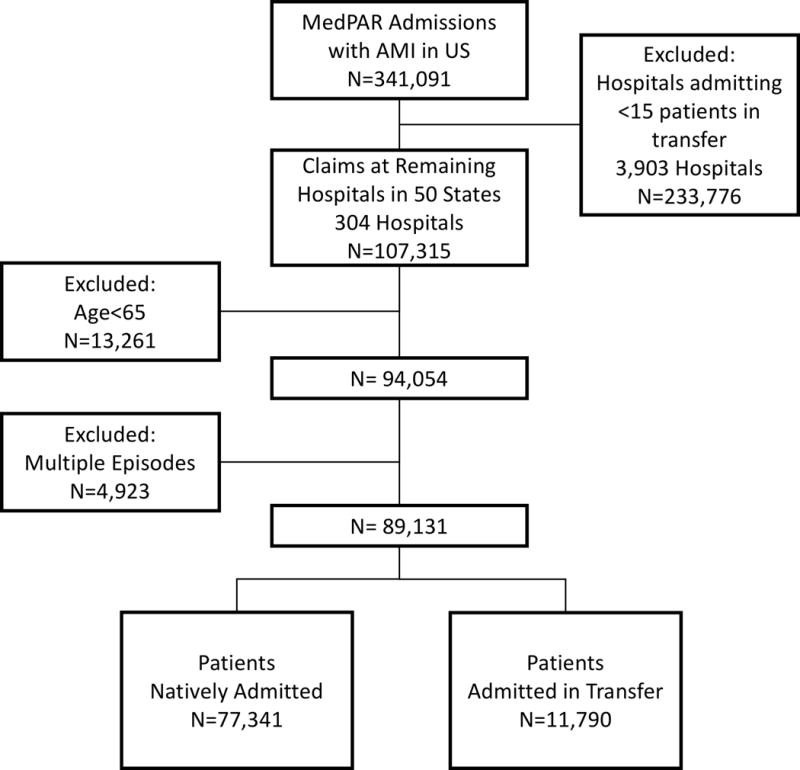
Fee-for-service Medicare claims from 2011 for patients hospitalized with a primary diagnosis of AMI, at hospitals admitting at least 15 patients in transfer.

MEASURES

Hospital-specific risk-standardized 30-day mortality rates (RSMRs) for 2 groups of patients: those admitted through transfer from another hospital, and those natively admitted without a preceding or subsequent interhospital transfer.

RESULTS

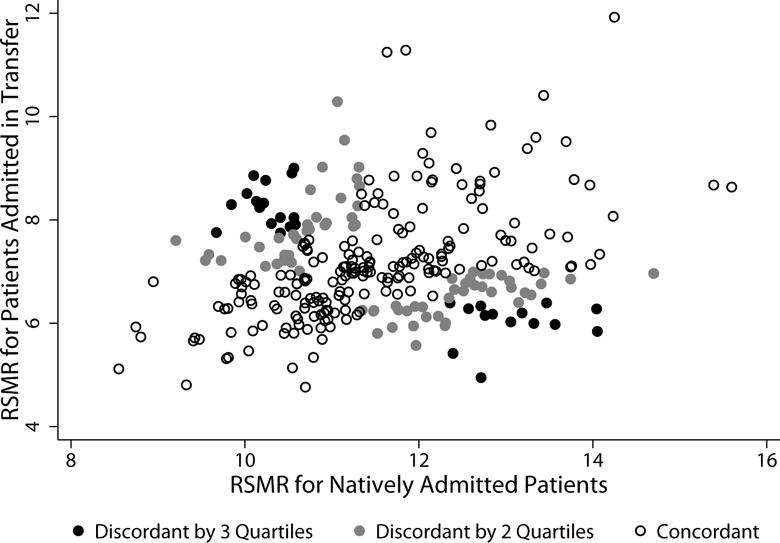
There were 304 hospitals admitting at least 15 patients in transfer. These hospitals cared for 77,711 natively admitted patients (median, 254; interquartile range, 162-321), and 11,829 patients admitted in transfer (median, 26; interquartile range, 19-46). Risk-standardized mortality rates were higher for natively admitted patients than for those admitted in transfer (mean, 11.5%±1.2% vs. 7.2%±1.1%). There was weak correlation between hospital performance as assessed by RSMR for patients natively admitted versus those admitted in transfer (Pearson r=0.24, P<0.001); when performance was arrayed by quartile, 102 hospitals (33.6%) differed at least 2 quartiles of performance across the 2 patient groups.

CONCLUSIONS

For Medicare patients with AMI, hospital-specific RSMRs for natively admitted patients are only weakly associated with RSMRs for patients transferred in from another hospital. Current AMI performance metrics may fail to provide guidance about hospital quality for transferred patients.

摘要

背景

五分之一的急性心肌梗死(AMI)患者会在不同医院之间转诊。然而,目前基于AMI死亡率的医院绩效评估指标将这些患者排除在转诊医院的评估之外。

目的

确定转诊医院中转诊患者和未转诊患者的风险标准化死亡率之间的关系。

研究设计

这是一项回顾性队列研究。

研究对象

2011年按服务收费的医疗保险索赔数据,涉及以AMI为主要诊断住院的患者,这些患者所在医院至少接收15例转诊患者。

测量指标

两组患者的医院特定风险标准化30天死亡率(RSMRs):一组是从另一家医院转诊入院的患者,另一组是未经过院际转诊直接入院的患者。

结果

有304家医院至少接收15例转诊患者。这些医院收治了77711例直接入院患者(中位数为254例;四分位间距为162 - 321例),以及11829例转诊入院患者(中位数为26例;四分位间距为19 - 46例)。直接入院患者的风险标准化死亡率高于转诊入院患者(平均分别为11.5%±1.2%和7.2%±1.1%)。对于直接入院患者和转诊入院患者,用RSMR评估的医院绩效之间存在弱相关性(Pearson相关系数r = 0.24,P < 0.001);当按四分位数排列绩效时,102家医院(33.6%)在两组患者中的绩效至少相差2个四分位数。

结论

对于患有AMI的医疗保险患者,医院特定的直接入院患者RSMRs与从另一家医院转诊入院患者的RSMRs仅存在弱关联。当前的AMI绩效指标可能无法为转诊患者的医院质量提供指导。
https://cdn.ncbi.nlm.nih.gov/pmc/blobs/b25a/5391291/708663db3b4a/nihms832374f2.jpg
https://cdn.ncbi.nlm.nih.gov/pmc/blobs/b25a/5391291/b00105492821/nihms832374f1.jpg
https://cdn.ncbi.nlm.nih.gov/pmc/blobs/b25a/5391291/708663db3b4a/nihms832374f2.jpg
https://cdn.ncbi.nlm.nih.gov/pmc/blobs/b25a/5391291/b00105492821/nihms832374f1.jpg
https://cdn.ncbi.nlm.nih.gov/pmc/blobs/b25a/5391291/708663db3b4a/nihms832374f2.jpg

相似文献

1
Differences in Hospital Risk-standardized Mortality Rates for Acute Myocardial Infarction When Assessed Using Transferred and Nontransferred Patients.使用转院患者和未转院患者评估急性心肌梗死时医院风险标准化死亡率的差异。
Med Care. 2017 May;55(5):476-482. doi: 10.1097/MLR.0000000000000691.
2
Relationship between hospital readmission and mortality rates for patients hospitalized with acute myocardial infarction, heart failure, or pneumonia.急性心肌梗死、心力衰竭或肺炎患者住院的再入院率与死亡率之间的关系。
JAMA. 2013 Feb 13;309(6):587-93. doi: 10.1001/jama.2013.333.
3
Comparison of hospital risk-standardized mortality rates calculated by using in-hospital and 30-day models: an observational study with implications for hospital profiling.应用院内模型和 30 天模型计算的医院风险标准化死亡率比较:一项对医院概况有影响的观察性研究。
Ann Intern Med. 2012 Jan 3;156(1 Pt 1):19-26. doi: 10.7326/0003-4819-156-1-201201030-00004.
4
Variation in and Hospital Characteristics Associated With the Value of Care for Medicare Beneficiaries With Acute Myocardial Infarction, Heart Failure, and Pneumonia.急性心肌梗死、心力衰竭和肺炎的 Medicare 受益人护理价值的变化及其与医院特征的关系。
JAMA Netw Open. 2018 Oct 5;1(6):e183519. doi: 10.1001/jamanetworkopen.2018.3519.
5
National patterns of risk-standardized mortality and readmission for acute myocardial infarction and heart failure. Update on publicly reported outcomes measures based on the 2010 release.急性心肌梗死和心力衰竭的全国风险标准化死亡率及再入院模式。基于2010年发布数据的公开报告结局指标更新。
Circ Cardiovasc Qual Outcomes. 2010 Sep;3(5):459-67. doi: 10.1161/CIRCOUTCOMES.110.957613. Epub 2010 Aug 24.
6
National patterns of risk-standardized mortality and readmission after hospitalization for acute myocardial infarction, heart failure, and pneumonia: update on publicly reported outcomes measures based on the 2013 release.急性心肌梗死、心力衰竭和肺炎住院后风险标准化死亡率及再入院率的全国模式:基于2013年发布数据的公开报告结局指标更新
J Gen Intern Med. 2014 Oct;29(10):1333-40. doi: 10.1007/s11606-014-2862-5. Epub 2014 May 14.
7
Evaluation of Risk-Adjusted Home Time After Acute Myocardial Infarction as a Novel Hospital-Level Performance Metric for Medicare Beneficiaries.评价急性心肌梗死后风险调整的家庭时间,作为医疗保险受益人的一种新的医院水平绩效指标。
Circulation. 2020 Jul 7;142(1):29-39. doi: 10.1161/CIRCULATIONAHA.119.044765. Epub 2020 May 15.
8
Transfer rates from nonprocedure hospitals after initial admission and outcomes among elderly patients with acute myocardial infarction.非手术医院老年急性心肌梗死患者初始住院后的转归及其预后
JAMA Intern Med. 2014 Feb 1;174(2):213-22. doi: 10.1001/jamainternmed.2013.11944.
9
Association of Frailty With 30-Day Outcomes for Acute Myocardial Infarction, Heart Failure, and Pneumonia Among Elderly Adults.老年人因急性心肌梗死、心力衰竭和肺炎导致的 30 天结局与衰弱的关系。
JAMA Cardiol. 2019 Nov 1;4(11):1084-1091. doi: 10.1001/jamacardio.2019.3511.
10
In-hospital mortality among rural Medicare patients with acute myocardial infarction: the influence of demographics, transfer, and health factors.农村 Medicare 急性心肌梗死患者住院死亡率:人口统计学、转院和健康因素的影响。
J Rural Health. 2011 Winter;27(4):394-400. doi: 10.1111/j.1748-0361.2010.00351.x. Epub 2011 Jan 4.

引用本文的文献

1
A proposed method for identifying Interfacility transfers in Medicare claims data.一种在医疗保险理赔数据中识别机构间转移的提议方法。
Health Serv Res. 2025 Feb;60(1):e14367. doi: 10.1111/1475-6773.14367. Epub 2024 Sep 10.
2
Comparison of Hospital Volume and Risk-Standardized Mortality Rate as a Proxy for Hospital Quality in Complex Oncologic Hepatopancreatobiliary Surgery.复杂肝胆胰肿瘤外科手术中以医院容量和风险标准化死亡率作为医院质量替代指标的比较。
Ann Surg Oncol. 2024 Aug;31(8):4922-4930. doi: 10.1245/s10434-024-15361-2. Epub 2024 May 3.
3
Did inter-hospital transfer reduce mortality in patients with acute myocardial infarction in the real world? A nationwide patient cohort study.

本文引用的文献

1
Hospital quality reporting by US News & World Report: why, how, and what's ahead.《美国新闻与世界报道》的医院质量报告:为何、如何以及未来走向
JAMA. 2015 May 19;313(19):1903-4. doi: 10.1001/jama.2015.4566.
2
Long-term mortality following interhospital transfer for acute myocardial infarction.急性心肌梗死院间转运后的长期死亡率。
Heart. 2015 Jul;101(13):1032-40. doi: 10.1136/heartjnl-2014-306966. Epub 2015 Mar 3.
3
Critical care bed growth in the United States. A comparison of regional and national trends.美国重症监护病床的增长。地区趋势与全国趋势的比较。
在真实世界中,医院间转运会降低急性心肌梗死患者的死亡率吗?一项全国性的患者队列研究。
PLoS One. 2021 Aug 5;16(8):e0255839. doi: 10.1371/journal.pone.0255839. eCollection 2021.
4
Association between Accreditation and In-Hospital Mortality in Patients with Major Cardiovascular Diseases in South Korean Hospitals: Pre-Post Accreditation Comparison.韩国医院主要心血管疾病患者的认证与住院死亡率的关系:认证前后比较。
Medicina (Kaunas). 2020 Aug 28;56(9):436. doi: 10.3390/medicina56090436.
5
Web-Based Dashboard for the Interactive Visualization and Analysis of National Risk-Standardized Mortality Rates of Sepsis in the US.基于网络的美国脓毒症国家风险标准化死亡率交互式可视化和分析仪表板。
J Med Syst. 2020 Jan 11;44(2):54. doi: 10.1007/s10916-019-1509-9.
6
The impact of interhospital transfer on mortality benchmarking at Level III and IV trauma centers: A step toward shared mortality attribution in a statewide system.探讨院间转运对三级和四级创伤中心死亡率基准的影响:在全州系统中实现共享死亡率归因的一步。
J Trauma Acute Care Surg. 2020 Jan;88(1):42-50. doi: 10.1097/TA.0000000000002491.
7
National Performance on the Medicare SEP-1 Sepsis Quality Measure.国家在 Medicare SEP-1 脓毒症质量测量上的表现。
Crit Care Med. 2019 Aug;47(8):1026-1032. doi: 10.1097/CCM.0000000000003613.
8
Calculating the 30-day Survival Rate in Acute Myocardial Infarction: Should we Use the Treatment Chain or the Hospital Catchment Model?计算急性心肌梗死的30天生存率:我们应该使用治疗链模型还是医院集水区模型?
Heart Int. 2017 Feb 12;12(1). doi: 10.5301/heartint.5000238. eCollection 2017 Jan-Dec.
9
Hospital Variation in Risk-Adjusted Pediatric Sepsis Mortality.医院间风险调整后儿科脓毒症死亡率的差异。
Pediatr Crit Care Med. 2018 May;19(5):390-396. doi: 10.1097/PCC.0000000000001502.
10
Treatment of acute myocardial infarction in the sub-arctic region of Norway. Do we offer an equal quality of care?挪威亚北极地区急性心肌梗死的治疗。我们提供的护理质量均等吗?
Int J Circumpolar Health. 2017;76(1):1391651. doi: 10.1080/22423982.2017.1391651.
Am J Respir Crit Care Med. 2015 Feb 15;191(4):410-6. doi: 10.1164/rccm.201409-1746OC.
4
Transfer rates from nonprocedure hospitals after initial admission and outcomes among elderly patients with acute myocardial infarction.非手术医院老年急性心肌梗死患者初始住院后的转归及其预后
JAMA Intern Med. 2014 Feb 1;174(2):213-22. doi: 10.1001/jamainternmed.2013.11944.
5
Composite quality measures for common inpatient medical conditions.常见住院医疗情况的综合质量指标。
Med Care. 2013 Sep;51(9):832-7. doi: 10.1097/MLR.0b013e31829fa92a.
6
Comparison of hospital performance in trauma vs emergency and elective general surgery: implications for acute care surgery quality improvement.创伤与急诊及择期普通外科的医院绩效比较:对急性护理手术质量改进的启示
Arch Surg. 2012 Jul;147(7):591-8. doi: 10.1001/archsurg.2012.71.
7
Medicare program; hospital inpatient value-based purchasing program. Final rule.医疗保险计划;医院住院患者基于价值的采购计划。最终规则。
Fed Regist. 2011 May 6;76(88):26490-547.
8
Who is missing from the measures? Trends in the proportion and treatment of patients potentially excluded from publicly reported quality measures.哪些人被遗漏了?潜在排除在公开报告质量指标之外的患者比例和治疗趋势。
Am Heart J. 2010 Nov;160(5):943-950.e1-5. doi: 10.1016/j.ahj.2010.06.046.
9
Ranking hospitals on surgical mortality: the importance of reliability adjustment.医院外科死亡率排名:可靠性调整的重要性。
Health Serv Res. 2010 Dec;45(6 Pt 1):1614-29. doi: 10.1111/j.1475-6773.2010.01158.x. Epub 2010 Aug 16.
10
System delay and mortality among patients with STEMI treated with primary percutaneous coronary intervention.直接经皮冠状动脉介入治疗治疗的 STEMI 患者的系统延迟与死亡率。
JAMA. 2010 Aug 18;304(7):763-71. doi: 10.1001/jama.2010.1139.