Ramirez Magaly, Wu Shinyi, Beale Elizabeth
Fielding School of Public Health, Department of Health Policy and Management, University of California, Los Angeles, 650 Charles Young Dr S, 31-269 CHS Box 951772, Los Angeles, CA 90095-1772. Email:
School of Social Work and Viterbi School of Engineering, University of Southern California, Los Angeles, California.
Prev Chronic Dis. 2016 Dec 22;13:E171. doi: 10.5888/pcd13.160035.
Automated text messaging can deliver self-management education to activate self-care behaviors among people with diabetes. We demonstrated how a discrete-choice experiment was used to determine the features of a text-messaging intervention that are important to urban, low-income Latino patients with diabetes and that could support improvement in their physical activity behavior.
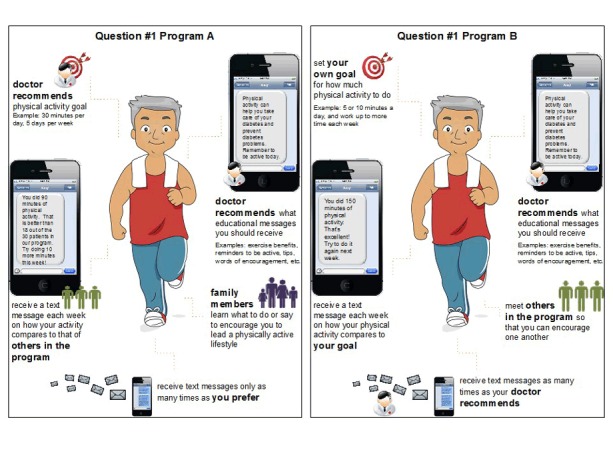
In a discrete-choice experiment from December 2014 through August 2015 we conducted a survey to elicit information on patient preferences for 5 features of a text-messaging intervention. We described 2 hypothetical interventions and in 7 pairwise comparisons asked respondents to indicate which they preferred. Respondents (n = 125) were recruited in person from a diabetes management program of a safety-net ambulatory care clinic in Los Angeles; clinicians referred patients to the research assistant after routine clinic visits. Data were analyzed by using conditional logistic regression.
We found 2 intervention features that were considered by the survey respondents to be important: 1) the frequency of text messaging and 2) physical activity behavior-change education (the former being more important than the latter). Physical activity goal setting, feedback on physical activity performance, and social support were not significantly important.
A discrete-choice experiment is a feasible way to elicit information on patient preferences for a text-messaging intervention designed to support behavior change. However, discrepancies may exist between patients' stated preferences and their actual behavior. Future research should validate and expand our findings.
自动短信可以提供自我管理教育,以激发糖尿病患者的自我护理行为。我们展示了如何使用离散选择实验来确定对城市低收入拉丁裔糖尿病患者重要的短信干预特征,这些特征可以支持改善他们的身体活动行为。
在2014年12月至2015年8月的离散选择实验中,我们进行了一项调查,以获取患者对短信干预的5个特征的偏好信息。我们描述了2种假设的干预措施,并在7次两两比较中要求受访者指出他们更喜欢哪一种。受访者(n = 125)是从洛杉矶一家安全网门诊护理诊所的糖尿病管理项目中亲自招募的;临床医生在常规门诊就诊后将患者转介给研究助理。使用条件逻辑回归分析数据。
我们发现调查受访者认为重要的2个干预特征:1)短信发送频率和2)身体活动行为改变教育(前者比后者更重要)。身体活动目标设定、身体活动表现反馈和社会支持并不显著重要。
离散选择实验是获取患者对旨在支持行为改变的短信干预偏好信息的可行方法。然而,患者陈述的偏好与其实际行为之间可能存在差异。未来的研究应该验证并扩展我们的发现。