Jud Aurelia, Kotur Monika, Berger Christoph, Gysin Claudine, Nadal David, Lünemann Anna
Children's Research Center, University Children's Hospital, Experimental Infectious Diseases and Cancer Research, Zurich, Switzerland.
Division of Infectious Diseases, and Children's Research Center, University Children's Hospital Zurich, Zurich, Switzerland.
Oncotarget. 2017 Jan 24;8(4):6130-6141. doi: 10.18632/oncotarget.14045.
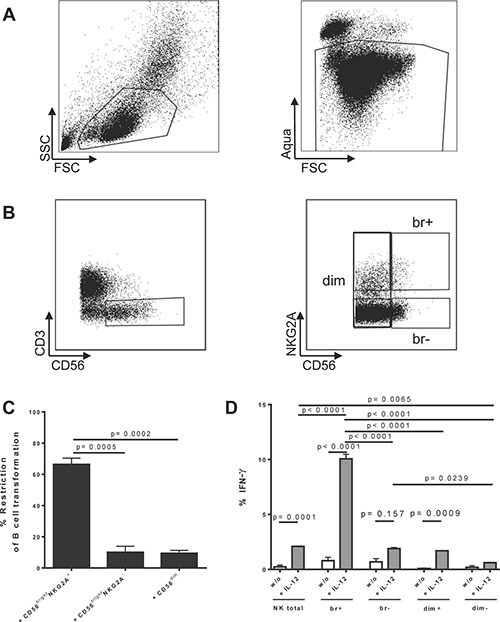
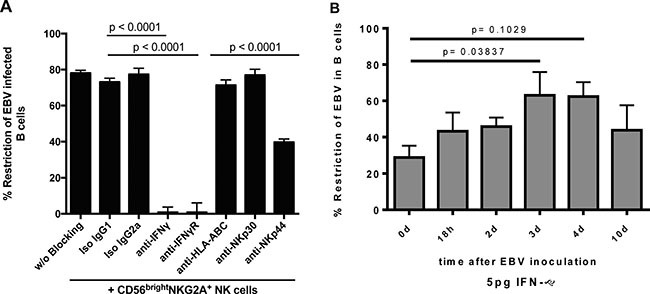
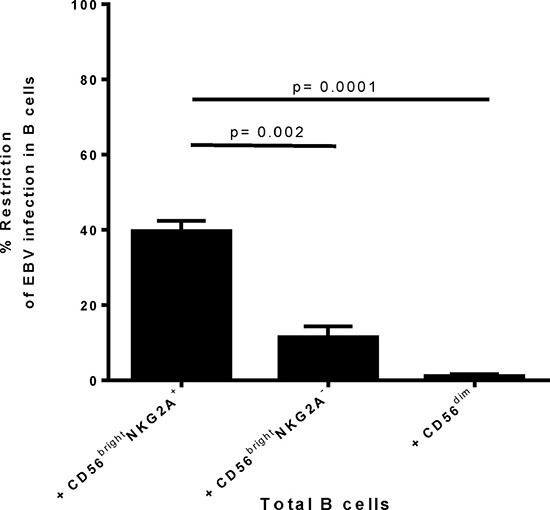
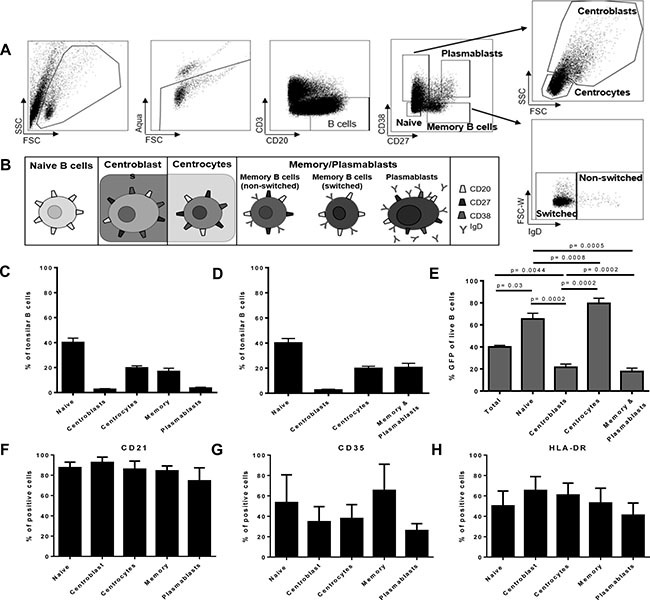
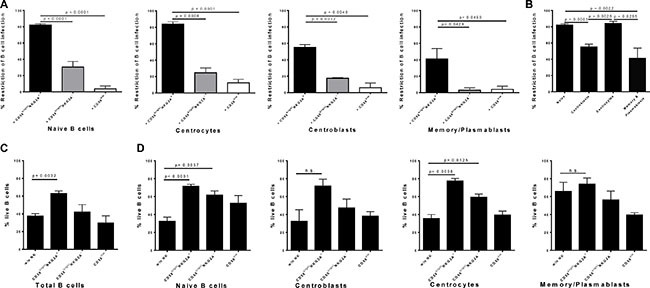
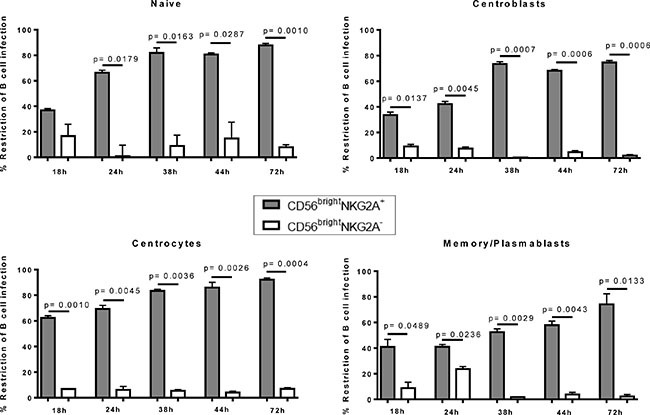
Natural killer (NK) cells constitute the first line of defense against viruses and cancers cells. Epstein-Barr virus (EBV) was the first human virus to be directly implicated in carcinogenesis, and EBV infection is associated with a broad spectrum of B cell lymphomas. How NK cells restrict EBV-associated oncogenesis is not understood. Here, we investigated the efficacies and mechanisms of distinct NK cell subsets from tonsils, the portal of entry of EBV, in limiting EBV infection in naïve, germinal center-associated and memory B cells. We found that CD56bright and NKG2A expression sufficiently characterizes the potent anti-EBV capacity of tonsillar NK cells. We observed restriction of EBV infection in B cells as early as 18 hours after infection. The restriction was most efficient in naïve B cells and germinal center-associated B cells, the B cell subsets that exhibited highest susceptibility to EBV infection in vitro. IFN-γ release by and partially NKp44 engagement of CD56bright and NKG2A positive NK cells mediated the restriction that eventually inhibited B-cell transformation. Thus, harnessing CD56brightNKG2A+ NK cell function might be promising to improve treatment strategies that target EBV-associated B cell lymphomas.
自然杀伤(NK)细胞构成了抵御病毒和癌细胞的第一道防线。爱泼斯坦-巴尔病毒(EBV)是第一种被直接认为与致癌作用有关的人类病毒,EBV感染与多种B细胞淋巴瘤相关。NK细胞如何限制EBV相关的肿瘤发生尚不清楚。在这里,我们研究了来自扁桃体(EBV的进入门户)的不同NK细胞亚群在限制EBV感染未成熟、生发中心相关和记忆B细胞方面的功效和机制。我们发现CD56bright和NKG2A表达足以表征扁桃体NK细胞强大的抗EBV能力。我们观察到感染后18小时,B细胞中的EBV感染就受到了限制。这种限制在未成熟B细胞和生发中心相关B细胞中最为有效,这两种B细胞亚群在体外对EBV感染表现出最高的易感性。CD56bright和NKG2A阳性NK细胞释放的IFN-γ以及部分NKp44的参与介导了这种限制,最终抑制了B细胞转化。因此,利用CD56brightNKG2A+NK细胞的功能可能有望改善针对EBV相关B细胞淋巴瘤的治疗策略。