Tian Guo, Zhao Qiyu, Chen Fen, Jiang Tian'an, Wang Weilin
State Key Laboratory for Diagnosis and Treatment of Infectious Diseases, The First Affiliated Hospital, Zhejiang University School of Medicine, Hangzhou 310003, China.
Collaborative Innovation Center for Diagnosis and Treatment of Infectious Diseases, The First Affiliated Hospital, Zhejiang University School of Medicine, Hangzhou 310003, China.
Oncotarget. 2017 Jan 24;8(4):5853-5860. doi: 10.18632/oncotarget.14030.
Irreversible electroporation (IRE) ablation is a new technique that is used to eliminate malignant tumors through nonthermal approaches.
The purpose of this review was to evaluate the efficiency of IRE for hepatic malignant tumors.
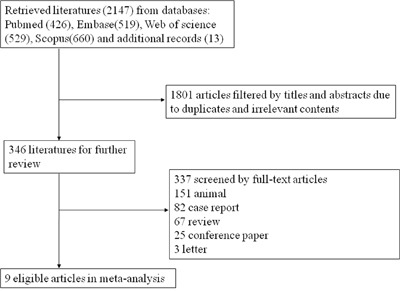
A systematic search was performed from PubMed, Embase, Web of science, Scopus and other potential literatures from references in relevant articles July 26th, 2016. Overall estimates of pooled standard mean difference (SMD) with 95% confidence interval (CI) were calculated for the changes of the pre- and post-IRE longest diameter, alkaline phosphatase (ALP), aspartate aminotransferase (AST) and serum total bilirubin levels. Sensitivity analysis and publication bias and were performed after the pooled analysis, and the quality of the included literatures was appraised using Newcastle-Ottawa Scale (NOS).
We finally included 300 patients (mean age: 51 to 66.6 years; male: 182; female: 118) from 9 studies of hepatic malignant tumors. The meta-analysis showed that comparing with the initial values, the longest diameter of the tumors was significantly decreased at the last follow-up months after IRE. Furthermore, the ALP, AST and total bilirubin levels were increased at 1 day after IRE while returned to baseline at the last follow-up month. No risk of publication bias was found, and all literatures were assessed good quality according to NOS.
The pooled data indicated that IRE could be a minimal invasive and effective approach for patients who had preoperative poor liver function or those whose masses were in refractory locations where surgical resection was unsuitable.
不可逆电穿孔(IRE)消融术是一种通过非热方法消除恶性肿瘤的新技术。
本综述旨在评估IRE治疗肝脏恶性肿瘤的疗效。
于2016年7月26日从PubMed、Embase、Web of science、Scopus以及相关文章参考文献中的其他潜在文献进行系统检索。计算IRE前后最长直径、碱性磷酸酶(ALP)、天冬氨酸氨基转移酶(AST)和血清总胆红素水平变化的合并标准均数差(SMD)及95%置信区间(CI)的总体估计值。合并分析后进行敏感性分析和发表偏倚分析,并采用纽卡斯尔-渥太华量表(NOS)评估纳入文献的质量。
我们最终纳入了9项肝脏恶性肿瘤研究中的300例患者(平均年龄:51至66.6岁;男性:182例;女性:118例)。荟萃分析显示,与初始值相比,IRE后最后随访月时肿瘤最长直径显著减小。此外,IRE后1天ALP、AST和总胆红素水平升高,而在最后随访月时恢复至基线水平。未发现发表偏倚风险,且根据NOS评估所有文献质量良好。
汇总数据表明,对于术前肝功能差或肿块位于手术切除不合适的难治部位的患者,IRE可能是一种微创且有效的方法。